tag

Thursday, May 14, 2026 | Daily Newspaper published by GPPC Doha, Qatar.

Tag Results for "hormuz" (65 articles)

Photos by Shaji Kayamkulam
Qatar

Qatar rejects Hormuz pressure tactics

Qatar has categorically rejected any attempt to weaponise the Strait of Hormuz as a tool of political pressure, warning that its closure has already triggered far-reaching repercussions for global energy, food security and international supply chains.Speaking at the Ministry of Foreign Affairs' weekly media briefing, Advisor to the Prime Minister and Official Spokesperson Dr Majed bin Mohamed al-Ansari said preventing the passage of ships and tankers through the strategic waterway was "unacceptable under any circumstances", and that keeping it open must remain a priority regardless of political or military considerations. He stressed that the current situation served no party's interests.Al-Ansari said Qatar places the safety of oil tanker crews at the forefront of its priorities and continues to closely monitor developments and negotiations aimed at reopening the waterway, while reiterating warnings against exploiting the strait amid mounting global economic and geopolitical tensions.Turning to the consultative Gulf summit held in Jeddah Tuesday, the spokesperson reaffirmed Qatar's commitment to the Gulf system, describing the leaders' meeting as a natural step given the continuous consultations, exchanges and visits among GCC leaders since the start of the crisis. The unified Gulf position, he said, is clear: "The resolution to the crisis must be diplomatic and achieved as swiftly as possible."He noted that Gulf states have in recent years demonstrated effective roles in mediation and conflict resolution, emerging as a global hub for dispute settlement and increasingly relied upon by the international community.On the broader conflict, al-Ansari said Qatar has consistently advocated negotiated solutions since the war began, and underlined the close coordination under way with Pakistan over its ongoing mediation efforts. Recent diplomatic engagements, including visits by the Pakistani prime minister to several Gulf states, fall within that sustained co-operation, he said."There is no need to expand the circle of negotiations at this stage," he added, noting that an active mediator was already engaged constructively, enjoyed full regional support, and should be given the opportunity to complete the task.The spokesperson confirmed that Qatar has taken all necessary defence measures to safeguard its sovereignty, stating that around 98% of incoming missiles targeting the country had been successfully intercepted. He described the ceasefire measures as a positive step that should be built upon, while reaffirming that Qatar is working towards a comprehensive and final settlement that ensures regional stability, alleviates economic and security fallout, and prevents any return to cycles of escalation.On Qatar's wider mediation portfolio, al-Ansari stressed that halting such initiatives would benefit no party. While acknowledging that mediators may face criticism, he said this did not diminish the importance of pressing ahead. Qatar, he noted, remains actively engaged across multiple regional and international files in close cooperation with partners including Egypt and Turkiye.He also expressed appreciation for European partners, citing their reliability and constructive role amid the current crisis.Regional security, he warned, remains the foremost concern, with threat perceptions evolving significantly among countries in the region. He stressed the importance of reaching comprehensive and sustainable solutions that serve the interests of all peoples, including the Iranian population.On Lebanon, al-Ansari reiterated Qatar's continued support across multiple fronts, including backing for the Lebanese Armed Forces and coordination with international partners within the framework of the Quintet Committee, alongside ongoing communication with all relevant parties. 

Gulf Times
Region

Hormuz closure leads to historic energy shock

Nearly two months after the Strait of Hormuz was effectively sealed by regional conflict, the world is confronting the largest single disruption to energy supplies in modern history.Nearly one-fifth of the planet’s seaborne oil and a fifth of its liquefied natural gas have been cut off from global markets, according to detailed assessments by the US Energy Information Administration (EIA) and the International Energy Agency (IEA). Before the closure in late February, roughly 20.9mn barrels per day of crude oil, condensate and petroleum products flowed through the narrow waterway — about 20% of all oil traded by sea and 25 percent of global petroleum liquids consumption — the EIA reported for the first half of 2025. An additional 20% of the world’s LNG trade, almost entirely from Qatar, passed through the same chokepoint.The result has been a net daily loss to world markets of between 16.7mn and 18.2mn barrels of oil equivalent, even after accounting for limited pipeline bypasses, the agencies’ data show. Only 3.5mn to 5.5mn barrels per day of oil can be rerouted via Saudi Arabia’s Petroline and the United Arab Emirates’ Abu Dhabi Crude Oil Pipeline. LNG, which has no meaningful alternative export route in the short term, remains almost entirely stranded.Converting the lost natural gas volumes to oil-equivalent terms adds another 1.7mn barrels of oil equivalent daily to the shortfall. Taken together, the gross daily disruption before any mitigation reached approximately 21.7mn barrels of oil equivalent. In energy terms, the net loss equates to 37–40 exajoules per year — roughly 5.5% to 6% of total global primary energy consumption.Minister of State for Energy Affairs, president and CEO of QatarEnergy HE Saad Sherida al-Kaabi delivered some of the starkest warnings in the early days of the crisis. In a Financial Times interview published in early March, he cautioned that the conflict could “bring down the economies of the world.”He predicted that if the situation persisted, “all exporters in the Gulf region will have to call force majeure,” warning that prolonged fighting would hit global GDP growth, drive energy prices sharply higher, and trigger shortages and factory shutdowns. On the ground, those warnings have materialised. Gulf oil production was shut in by 7.5mn to 9.1mn barrels per day in March and April, according to the IEA’s monthly Oil Market Report. Global oil supply fell by 10.1mon barrels per day in March alone, with cumulative losses now exceeding 360mn to 440mn barrels. Qatar declared force majeure on LNG cargoes after Iranian strikes damaged facilities responsible for about 17% of the country’s LNG export capacity — equivalent to roughly 12.8mn tonnes per year and potentially offline for three to five years.The disruption dwarfs every previous oil shock. Markets have responded with volatility. Strategic stockpiles in IEA member countries and coordinated releases have cushioned the immediate blow, but analysts warn that sustained losses of this magnitude will force deep demand destruction through higher prices.Independent economic modeling cited by the IEA projects global GDP losses ranging from $330bn in a short conflict to as much as $2.2tn if the strait remains closed for an extended period.For now, the world is adapting through higher fuel costs, conservation measures and frantic searches for alternative supplies. Yet with 80% of Hormuz-bound oil traditionally destined for Asia, the pain is being felt most acutely in import-dependent economies from Japan to India.Energy experts, including al-Kaabi, caution that the full economic and geopolitical fallout is still unfolding. The closure has exposed the fragility of global energy trade in ways few imagined possible in the 21st century.As one veteran oil-market analyst put it: “We have just witnessed the largest forced reordering of world energy flows since the Suez Canal crisis of 1956 — except this time the stakes are measured in millions of barrels every single day.”The coming weeks will determine whether the world can absorb the shock or whether the energy crisis of 2026 becomes the defining economic event of the decade. 

Britain's Defence Secretary John Healey is shown mine countermeasure equipment during a 'Strait of Hormuz Military Planning Conference' Thursday. (AFP)
International

French, UK defence chiefs eye 'real progress' in Hormuz plan

Britain and France Thursday voiced hope that military plans to secure the Strait of Hormuz were coming together and would succeed in restoring trade flows through the vital passage.At a two-day meeting in London, military planners discussed the practicalities of a multinational mission led by the UK and France to protect navigation in the key waterway following a sustainable ceasefire, top defence officials said.The aim is to form a "defensive, multinational mission that will strengthen the confidence of commercial shipping, and, if necessary, clear mines and protect vessels when the hostilities end", British defence minister John Healey said.The British ministry said the meeting involved more than 44 countries from every continent.Healey and French counterpart Catherine Vautrin said in a joint statement they were "confident that real progress can be made"."International trade, energy, and economic stability for all our nations depend on freedom of navigation" in the strait, Healey told those attending.He called for "practical military plans", saying "millions of people" were relying on a successful outcome from the meeting."We can't let them down," he said.British Prime Minister Keir Starmer has said more than a dozen countries have agreed to participate in the mission to free up navigation in Hormuz.Iran said on Wednesday it would not reopen the Strait of Hormuz as long as the United States continued to blockade Iranian ports.While strikes around the region have mostly stopped since the start of a ceasefire, the US and Iran have continued to exert pressure around the trade route.Before the war started on February 28, about a fifth of the world's oil was shipped through the Strait. 

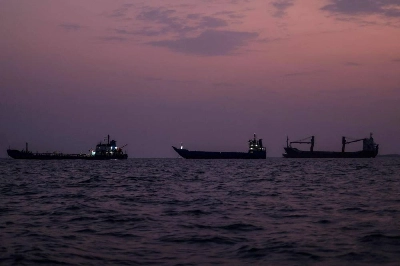
Cargo ships in the Gulf, near the Strait of Hormuz, as seen from northern Ras al-Khaimah, near the border with Oman’s Musandam governance, amid the US-Israeli conflict with Iran. The world’s top oil traders warned that the ongoing closure of the Strait of Hormuz is increasing the risk of a global recession as fuel-demand takes a hit.
Business

Oil traders warn of recession impact as Hormuz hits demand

The world’s top oil traders warned that the ongoing closure of the Strait of Hormuz is increasing the risk of a global recession as fuel-demand takes a hit.The vital energy channel has been largely closed to non-Iranian shipping since war began at the end of February, choking off hundreds of millions of barrels of supply. Consumer nations have been using up buffer inventories that they hold for emergencies to cope with the shortfall.While international forecasters already acknowledge that conflict is sapping economic growth and oil demand, merchants including Vitol Group, Gunvor Group and Trafigura Group warned on Tuesday that the situation will get even worse if Hormuz doesn’t open up soon.“We’ve borrowed supply,” Vitol Group Chief Executive Officer Russell Hardy said at the FT Commodities Global Summit in Lausanne, pointing to drawdowns of inventories from a variety of sources. “But you can’t do that forever. There are recessionary consequences from having to ration that demand.”Benchmark oil futures rallied about 30% since the war began. They spiked to almost $120 a barrel in early March but have since subsided, trading near $95 on Tuesday amid tentative hopes the US and Iran can reach some kind of peace deal.Hardy said the war so far eliminated about 4mn barrels a day of demand, a figure that will rise if Hormuz stays shut.Tracking the electronic signals of tankers suggest that only a few are passing through Hormuz, including some that are linked to Iran but aren’t leaving the region. Some carriers are sneaking through with their transponders off.Gunvor’s head of research, Frederic Lasserre, told the FT event that the amount of lost consumption may need to double next month to 5mn barrels a day — roughly 5% of global supply — in order to balance markets, and that a three-month closure of the waterway could trigger a worldwide recession.Crude oil and refined product supplies from the Arabian Gulf have been slashed by roughly 13mn barrels a day since the war started, according to the International Energy Agency. While the agency projects a sharp drop of 1.5mn barrels a day in demand this quarter, it anticipates a recovery in the second half of the year.The consumption hit is so far most concentrated in Asia, but will spread as global prices react, according to Trafigura Group.“Demand destruction is happening in places that are not visible pricing centers,” Chief Economist Saad Rahim said at the event. “People are underestimating that loss of supply that then has to be met with some loss of demand somewhere else.”Petrochemical producers in China, Japan and South Korea have scaled back operations, reining in output of plastics used in everything from bottles to electrical appliances. Airlines in nations from Vietnam to the Netherlands are canceling flights or drawing up contingency plans to do so. Across Southeast Asia, harvest-ready rice fields are lying idle as fuel and fertilizer costs bite.“That adjustment is already happening, but if this continues it has to get larger and larger,” Rahim said of the need for demand to recalibrate in response to lower supply. “We’re at a critical inflection point.”The US was still in the dark on whether Iran will take part in fresh talks to end the war before a ceasefire expires on Wednesday, with the sides deadlocked on issues including access to Hormuz.Should there be a diplomatic resolution, “I think you have just about dodged the bullet,” Rahim said. But if the crisis drags on, “you just don’t have those molecules, somebody has to go without. So that means a contraction of economic activity.”Gunvor’s Lasserre told the conference that the trader is focused on three scenarios, ranging from the continued closure of Hormuz to a partial or full reopening.“If you don’t get any reopening in three months’ time, then the case becomes a macro issue where the world is about to fall into recession,” he said. “And then you have massive demand adjustment.” 

Oil prices settled down by around 9% on Friday after Iran said passage for all commercial vessels through the Strait of Hormuz was open for the remaining ceasefire period and US President Donald Trump said Iran has agreed to never close the strait again. 

Picture credit:  Abdullah bin Hamad Al-Attiyah International Foundation for Energy and Sustainable Development.
Business

Oil settles down 9% after Iran declares Strait of Hormuz open

OilOil prices settled down by around 9% on Friday after Iran said passage for all commercial vessels through the Strait of Hormuz was open for the remaining ceasefire period and US President Donald Trump said Iran has agreed to never close the strait again.**media[436871]**Brent crude futures settled at $90.38, while US West Texas Intermediate (WTI) crude finished at $83.85. For the week, Brent fell 5.1%, while WTI rose by 13.2%. The US and Iran have made progress in negotiations over a three-page memorandum of understanding to end the war, according to an Axios report. Around 20 ships were seen moving from the Gulf towards the Strait of Hormuz exit, according to ship-tracking data. Traffic could be halted again in the strait if an agreement on Iran’s nuclear ambitions and the lifting of US sanctions remains elusive, analysts said. GasAsia spot liquefied natural gas fell for a fourth straight week, weighed by softer demand and contained geopolitical risk as the US-Iran ceasefire held, despite some spot purchases by South Asian buyers.**media[436872]**The average LNG price for June delivery into northeast Asia was $16.05 per million British thermal units, down from $17.00 per mmBtu the week before. US President Donald Trump expressed confidence that an agreement to end the Iran war could be reached soon, adding that the next meeting between the two countries could take place over the weekend. In Europe, the Dutch TTF gas price settled at $13.55 per mmBtu, posting a weekly loss of 10.2%. European buyers are increasingly leaning on pipeline gas to balance short positions, while optimising regas capacity and slot usage rather than competing aggressively for prompt LNG cargoes.  

Gulf Times
Business

The world economy enters a slow crisis

There is a well-used metaphor of a frog in boiling water: If a frog touches boiling water, it will jump out immediately – but if it is in cool water that is heated with a steady flame, it may not notice the danger until it is too late.This comes to mind as describing the likely medium- and long-term effects of the war in the Gulf and the near-closure of the Strait of Hormuz, a strategically important trading route.While the ceasefire in the Gulf conflict appears to be holding, just seven weeks of war have had a major impact on the global economy. Oil has risen from around $70 per barrel before the conflict started on February 28 to over $100 before fluctuating around this figure.A reopening of the Strait of Hormuz will not result in a swift return to trading and economic normality. Some LNG and oil production facilities been damaged, and production has been curbed at unaffected oil wells given lower trading volumes, and it takes time and skilled expertise to repressurise and return to full production. It will take between three and five months for oil facilities to be repaired, on average; more for some sites. In the case of Qatar’s Ras Laffan LNG production site, which lost 17% of capacity in the March 10 strike by Iran, repairing the damage will take years.All maritime schedules have been upended by the conflict. Insurance costs will rise given heightened risk to shipping in the region. After several days of the ceasefire, only a trickle of sea freight was allowed passage. Iran and the US have both imposed naval blockades.There are other causes of the lagging impact of the war. At the outset of hostilities, nations had stocks of commodities, plus strategic reserves, while ships that had been loaded before the conflict began were already en route. In March there was a release from strategic reserves of oil of 400mn barrels, but by definition this source is finite.The economic impact ripples throughout the entire global economy: From AI data centres to crop producers. There have been blackouts and energy rationing in some countries. ACI Europe, which represents airports in the European Union, has warned that the European aviation industry is running low on jet fuel. Diversion of supply for military use is compounding the issue.The IMF’s latest report on the global growth outlook sets out three scenarios:Reference projection, with a limited conflict and swift reopening of the Strait – Global growth slows from 3.3% to 3.1%, inflation reaches 4.4%.Adverse scenario, larger, persistent increases in energy prices – Growth falls to 2.5% and inflation is 5.4%.Severe scenario, prolonged conflict with further damage to oil and gas installations in the Gulf – Growth is just 2% and inflation is over 6%.The latter two indicate global stagflation. The impact will be highly variable, with nations directly affected by the conflict, such as Iran, Kuwait, Lebanon and Qatar, experiencing the biggest shocks, along with vulnerable emerging markets that are reliant on importing key commodities.Elevated inflation risk means there will likely be no cut in interest rates, and possibly some increases.The impact on some farmers is likely to be devastating, given that the Strait of Hormuz is the trade route for around one third of maritime fertiliser traffic in normal conditions. The conflict erupted during the planting season in the northern hemisphere. Fertiliser is perishable and normally cheap, so stocks are typically low. Farmers face higher prices for both fuel and fertiliser. The United Nations World Food Programme has warned that 45mn people face acute food insecurity if the conflict lasts until the middle of the year and oil prices are above $100 per barrel.As regards oil, there are other sources around the world, but Gulf oil is cheap and easy to extract. Also, it is light oil, which is cheaper to refine than heavy oil from Venezuela. Refined oil products are exported via the Gulf, so some countries without refining capacity may be badly affected.Many governments are in a weak fiscal position, following the cost of the Covid pandemic, although the private sector, both corporate and households, were entering the crisis in better state, according to the IMF.Gulf economies have built up a vast treasure chest, worth an estimated $6tn. But the direct costs of repairing oil and gas infrastructure amount to around $25bn, economic will be affected.Humans are inventive, and have a need to trade. Usually, we will find a way, but this transition will be long and economically painful. In the context of the global economy, the metaphor of the frog in hot water is inexact: There is nowhere for us to jump to.The author is a Qatari banker, with many years of experience in the banking sector in senior positions. 

Ships and tankers in the Strait of Hormuz off the coast of Musandam, Oman, Saturday. (Reuters)
Region

Iran shuts Hormuz again after US stays blockade

Iran's military declared the Strait of Hormuz closed again Saturday, prompting ships to abandon attempts to transit the waterway and President Donald Trump to warn Tehran against trying to "blackmail" the United States.On Friday, Tehran had declared the strait, which usually carries a fifth of the world's oil and liquefied natural gas, open after a ceasefire was agreed in Israel's war with Iran's ally Hezbollah in Lebanon.This prompted elation in global markets and sent oil prices plunging but, with Trump insisting that a US naval blockade of Iranian ports would continue until a deal to end the wider Middle East war was concluded, Tehran threatened to shutter the strait once more.Late last morning, Iran's central military command said that, in response to the US blockade, "control of the Strait of Hormuz has returned to its previous status" and "is under strict management and control of the armed forces".Trump had previously said the two sides were "very close" to striking a deal, but following Iran's announcement Saturday, he insisted Tehran "can't blackmail us", even as he maintained communications were ongoing."We'll be talking about Iran later. We have very good conversations going on," he added, accusing Tehran of getting "a little cute" with its recent moves.Iran's top national security body, meanwhile, said that during a visit by the military chief of mediator Pakistan that concluded Saturday, "new proposals have been put forward by the Americans, which Iran is currently reviewing and has not yet responded to".It went on to say, however, that Iran's negotiating delegation would not offer "even the slightest compromise, retreat or leniency" in talks with Washington.A handful of oil and gas tankers crossed the Strait of Hormuz early Saturday during the brief reopening, tracking data showed, but others retreated and tracking platforms showed hardly any vessels crossing the waterway by the late afternoon.A UK maritime security agency said Iran's Revolutionary Guards (IRGC) fired at one tanker, while security intelligence firm Vanguard Tech reported the force had threatened to "destroy" an empty cruise ship that was fleeing the Gulf.In a third incident, the UKMTO said that it received a report of a vessel in the same area "being hit by an unknown projectile which caused damage" to shipping containers but no fire.Speaking at a diplomatic forum in Turkiye, Iranian deputy foreign minister Saeed Khatibzadeh said the "Americans cannot impose their will over Iran" with a siege, and suggested the blockade was a violation of the ceasefire that merited "repercussions".Meanwhile, in a written message, Iran's supreme leader Mojtaba Khamenei, who has yet to be seen since taking power, said Iran's navy "stands ready" to defeat the United States.There are just four days remaining before the end of the two-week ceasefire in the US and Israel's war on Iran, launched by Washington and its ally on February 28.Nevertheless, Trump has appeared convinced that a deal could be finished shortly, and has made a series of social media posts praising talks mediator Pakistan.Egypt, which has also been involved in diplomatic efforts, appeared similarly upbeat Saturday, with Foreign Minister Badr Abdelatty saying Cairo and Islamabad hoped to secure a final agreement "in the coming days".He was speaking at the same event in Antalya as Khatibzadeh, who insisted no date had been set for the next round of talks, though Tehran was "very much committed to diplomacy".Islamabad has emerged as the lead mediator during the conflict, hosting a marathon first round of talks last weekend, with a second expected in the Pakistani capital this coming week. 

A satellite image shows the ship movement at the Strait of Hormuz. REUTERS/File Picture
Qatar

5 vessels carrying Qatari LNG approach Hormuz

Five vessels loaded with liquefied natural gas (LNG) from Ras Laffan, Qatar, are approaching the Strait of Hormuz, ‌ship-tracking data showed Saturday.If the ​vessels successfully crossed ‌the strait, it would be the first ‌transit of ⁠LNG ‌cargoes through the waterway ‌since the US-Israel war with Iran began on ⁠February 28.On Friday, Iran reopened the strait, which before the war carried a fifth of the world's LNG trade, following a separate US-brokered ceasefire agreement on Thursday by Israel and Lebanon. A convoy of oil tankers was ​crossing the Strait of Hormuz Saturday.Data from analytics firm Kpler showed the vessels, Al Ghashamiya, Lebrethah, Fuwairit, ‌Rasheeda and Disha, have ⁠moved eastward towards ​the Strait of Hormuz. The first ​four tankers are controlled by QatarEnergy, while Disha is chartered by India's Petronet."Currently, we see five laden vessels approaching the Strait of Hormuz. All five vessels loaded from Qatar's Ras Laffan plant. Of the five, two are destined for Pakistan, ‌two likely destined for India ‌and one with ⁠no clear destination," said Laura Page, manager of ⁠LNG Insight ⁠at Kpler."In addition, two ballast Adnoc vessels enter the Gulf of Oman and moor outside Fujairah. The vessel movements align with flaring data which suggests multiple trains at Ras Laffan’s north site have ​restarted as well as UAE’s Das Island plant," she added.Qatar is the world's second-largest exporter of LNG, with shipments mostly going to buyers in Asia. Iranian attacks, however, knocked out 17% of Qatar's LNG export capacity, with repairs expected to sideline 12.8 million metric tons per year of ‌the fuel ​for three to five years. 

Gulf Times
Qatar

EU stands firmly with GCC

European Council President Antonio Costa has declared the European Union's full solidarity with the Gulf Cooperation Council states in the wake of what he described as Iran's unjustified attacks on the region, calling for a durable ceasefire, the restoration of freedom of navigation through the Strait of Hormuz, and a comprehensive diplomatic settlement addressing Iran's destabilising behaviour.Speaking at a press conference in Doha — his third stop on a Gulf tour that has also taken him to Saudi Arabia and the United Arab Emirates — Costa said his visit came at a critical moment, with a fragile ceasefire in place and the region still reeling from Iranian strikes that he said constituted a clear violation of the sovereignty and territorial integrity of the Gulf states. "This is unacceptable," he stated.The EU president said the primary purpose of his tour was to listen to Gulf leaders, understand their reading of the situation, and deliver an unambiguous message: that Europe is a reliable partner the region can count on both now and in the future. He reaffirmed the bloc's commitment to the region's security and stability, and said several EU member states had already deployed military assets to support Gulf defences, alongside firm diplomatic and political backing.Antonio Costa identified two overriding priorities for the EU in the current crisis. The first is achieving a stable and lasting ceasefire that creates conditions for sustainable peace. The second is reopening the Strait of Hormuz to international shipping. He described the strait — along with the Red Sea — as a vital artery for global supply chains and trade, warning that the conflict had already inflicted severe damage on the world economy and would worsen considerably if no resolution was found.He said the EU had consistently called for de-escalation and respect for international law since the outset of the conflict, and expressed support for the US-Iran talks mediated by Pakistan as a foundation on which to build a lasting agreement. That agreement, he said, must address not only the nuclear question, but also Iran's ballistic missile programme, its support for regional proxies, and its closure of international shipping lanes. France and the United Kingdom, he noted, are working with global partners to establish a broad coalition to guarantee safe passage through the strait, and the EU intends to contribute actively to that effort.Responding to a question from the Qatar News Agency, Antonio Costa described Qatar as an "honest mediator" for peace and regional stability — a role it had demonstrated during the Gaza conflict — and said Doha was continuing its efforts to consolidate the ceasefire and lay the groundwork for negotiations on the broader range of outstanding issues. He added that Qatar was actively supporting freedom-of-navigation discussions, and praised the country's constructive engagement throughout the crisis.On Lebanon, Antonio Costa said Hezbollah posed an existential threat to the country and was a serious source of regional instability. He welcomed Lebanese President Joseph Aoun's move to restrict Hezbollah's military activities, and said empowering Beirut to disarm the group was the only sustainable path to stability. He also welcomed talks held in Washington between Lebanon and Israel as an important step that needed to yield concrete results.On EU-GCC relations more broadly, Antonio Costa said the current moment had only reinforced the importance of deeper cooperation, with free trade negotiations under way with some member states and strategic partnerships being developed with others. He expressed hope for a second EU-GCC summit before the year's end, to be held in the Gulf region.He closed with a sobering note, warning that the world was at a juncture where adherence to the rules-based international order was not optional — and that the alternative was chaos. 

A pedestrian walks past the Tokyo Stock Exchange building. The Nikkei 225 closed up 0.4% to 58,134.24 points Wednesday.
Business

Asian markets rally as Trump fans fresh peace hopes

Asian markets rose and crude dropped again Wednesday after Donald Trump said a second round of US-Iran talks could take place "over the next two days", fuelling hopes for a deal that would reopen the Strait of Hormuz and allow crude to flow again.In Tokyo, the Nikkei 225 closed up 0.4% to 58,134.24 points; Hong Kong - Hang Seng Index ended up 0.3% to 25,947.32 points; and Shanghai - Composite ended flat at 4,027.21 points Wednesday.Traders were also cheered by news that Israel and Lebanon had agreed to launch direct negotiations, fuelling optimism for an end to a conflict that has been a key sticking point in the fragile ceasefire between Washington and Tehran.While the United States continued a blockade of Iranian ports imposed following failed negotiations in Islamabad at the weekend, the US president told the New York Post that a new round of talks could take place."You should stay there, really, because something could be happening over the next two days, and we're more inclined to go there," Trump was quoted as saying in a phone interview with a Post reporter in the Pakistani capital.He later told FOX Business's "Mornings with Maria" -- in an interview to air Wednesday -- that the war was "very close to being over".Senior Pakistani sources earlier told AFP the country was working to bring the two sides back together, with one saying negotiators were working to extend the current two-week ceasefire.The comments from Trump provided a fresh boost to equities, which were already rising this week on optimism the six-week conflict, which has sent chills through the world economy, could be close to an end.After all three main indexes on Wall Street rallied -- with the Nasdaq and S&P 500 back well above pre-war levels -- Asia followed suit.Gains were led by Seoul, which was the standout performer before hostilities broke out on February 28 and then became one of the worst.The Kospi jumped more than two percent and was just a few hundred points short of its all-time peak, while Tokyo, Hong Kong, Sydney, Mumbai, Bangkok, Wellington, Taipei, Singapore and Manila were also well up. Shanghai was flat.London and Frankfurt were flat while Paris fell.Oil prices extended losses after a hefty plunge Tuesday that saw West Texas Intermediate dive around eight percent and Brent more than four percent.Investors were also cheering the decision of Israel and Lebanon to open direct talks after meeting in Washington, marking a rare diplomatic breakthrough between two countries formally at war for decades.Lebanon was drawn into the broader war when Hezbollah attacked Israel in support of Iran, its key ally, triggering an Israeli ground invasion.Washington fears the Israel-Hezbollah conflict could unravel the US-Iran ceasefire."Continued pressure alongside hopes of diplomatic engagement... has helped push oil prices below $100 and Treasury yields down, supporting equities and highlighting how sensitive markets remain to developments in the region," wrote Fiona Cincotta at City Index."A credible diplomatic off-ramp could further boost risk appetite."Some observers warn that while the end of the war would be widely welcomed, there were big question marks over what a peace would look like, while crude production would take some time to get back up to capacity.And on Tuesday the International Monetary Fund said it had cut its 2026 global growth projection, warning that the world economy could be "thrown off course" by war.On announcing a new forecast of 3.1% expansion -- down from its previous 3.3% estimate -- Fund chief economist Pierre-Olivier Gourinchas told AFP it was "planning to upgrade growth for 2026 to 3.4%" if not for the war. 

South Korean President Lee Jae Myung (Reuters/File photo)
International

South Korea's Lee warns Iran war to keep oil price high, orders quick aid rollout

South Korean President Lee Jae ​Myung said rising tensions around ‌the Strait of Hormuz made it hard to be optimistic about the ‌fallout from the ⁠Iran war, warning that ‌high oil prices and supply-chain strains were likely ‌to persist for some time.Lee told a cabinet meeting on Tuesday the government should treat ⁠prolonged disruption in global energy and raw materials markets as a given and reinforce its emergency response system."For the time being, difficulties in global energy and raw materials supply chains and high oil prices will continue," Lee said."I ask that we pursue the development of alternative supply chains, medium- to long-term industrial restructuring, and the transition to a post-plastic economy as top-priority national strategic projects." Lee also urged ministries to move quickly to ​deploy a supplementary budget passed in response to the war.At the meeting, ministers outlined steps to contain the economic shock from the conflict, including support for crude imports, controls against hoarding of petrochemical ‌feedstocks and medical supplies, and expanded financial ⁠assistance for affected companies.Industry Minister Kim Jung-kwan said disruptions to shipping through the ​Strait of Hormuz were still affecting supplies and that even if the passage normalises, it could take around 20 days for Middle Eastern cargoes to reach South Korea.The government is prioritising support for the passage of seven South Korea-bound oil tankers stuck in the Gulf area, a document shown during the cabinet meeting said. Foreign Minister Cho Hyun told the meeting that the ministry had sent officials to the Congo, Algeria and Libya in a bid to secure energy supplies, in addition to presidential Chief of Staff Kang Hoon-sik travelling to countries such as Kazakhstan since last week."I also urge ‌the parties to this war to ‌take courageous steps toward the peace ⁠the world so desperately wants, based on the principles of protecting universal human rights and ⁠the lessons of history," Lee said. South Korea's ⁠energy ministry said on Tuesday it would begin rolling out a revised seasonal and time-of-use electricity pricing system to shift power demand away from evening peak hours toward midday, when solar generation is higher. The new rates take effect for large industrial users from April 16 while weekend discounts for electric-vehicle charging will begin on April 18. Meanwhile, Middle Eastern oil producers are in ​contact with South Korea about using the country's petroleum storage facilities as disruptions at the Strait of Hormuz continue, a South Korean industry ministry official said on Tuesday, signalling growing interest in offshore crude storage hubs.Yang Ki-wook, a senior official at the industry ministry, told a briefing that Middle Eastern countries were showing increased interest in storing oil outside the strait because a prolonged disruption in logistics would hit their economies and pre-positioning crude could reduce export risks.Yang said that in addition to Abu Dhabi National Oil Company (Adnoc), which already has a ‌joint stockpiling agreement with South ​Korea, other Middle Eastern producers were also in contact, though he did not identify them. 

Gulf Times
International

Singapore refuses to negotiate with Iran on Hormuz tolls

Singapore has flatly rejected any suggestion it would pay transit fees to Iran for passage through the Strait of Hormuz, with Foreign Minister Vivian Balakrishnan telling parliament the right of free navigation is enshrined in international law — not a toll concession for Tehran to extract. Responding to a parliamentary question, Balakrishnan said Singapore would continue engaging Iran diplomatically but ruled out any negotiation over safe passage fees. "It is not a privilege to be granted by the bordering state, it's not a licence to be supplicated for, it is not a toll to be paid," he said. The remarks come as Iran has imposed what shipping sources describe as a de facto toll system — administered by the Iranian Revolutionary Guard Corps — in the wake of US and Israeli strikes on Iranian infrastructure. Reports suggest demands of up to $2mn per vessel, payable in cryptocurrency or yuan, ostensibly to fund reconstruction. Traffic through the strait plummeted by an estimated 90% during peak hostilities, with only partial recovery following a tentative ceasefire. Tehran, which signed but never ratified the UN Convention on the Law of the Sea (UNCLOS), maintains it is not bound by its transit passage provisions and retains the right to regulate movement through its territorial waters on security grounds. Balakrishnan dismissed that argument, saying non-ratification was not a "get-out-of-jail-free card" and that the principle of free transit applied universally as customary international law. Singapore's hard line is rooted as much in strategic interest as legal principle. Balakrishnan drew an explicit parallel with the Strait of Malacca and the Strait of Singapore — chokepoints that carry roughly a quarter to two-fifths of global seaborne trade, including nearly half of China's oil imports. Were Hormuz tolls to go unchallenged, he warned, similar demands could follow on the very waterways Singapore depends on for its economic existence. The shipping industry has broadly backed Singapore's stance, with insurers and major operators advised against payment to avoid legitimising the practice. A clip of Balakrishnan's remarks, posted to social media on April 11, drew more than 3mn views and sharp debate over the tension between legal norms and geopolitical realities.