

Qatar Museums (QM) Chairperson Her Excellency Sheikha Al Mayassa bint Hamad bin Khalifa al-Thani has announced the establishment of the Qatar Fashion and Crafts Council as Qatar steps up efforts to strengthen its creative industries and attract investment in culture, fashion and design.
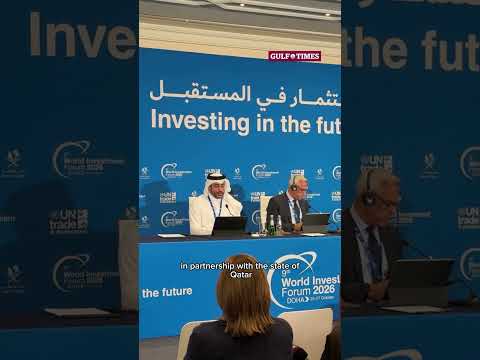
Delivering a keynote address at the ongoing World Investment Forum 2026 (WIF 2026), HE Sheikha Al Mayassa said that the new initiative aims to connect local talent with global markets, spearheaded by Creative Hubs and supported by joint efforts from the public and private sectors.
“It is a joint effort between the public and private sectors,” she said. “This will be an advisory council contributing to the strategic orientation of both sectors, enhancing investment partnerships, and opening new horizons for talents in Qatar and the region to reach global markets.”
HE the QM Chairperson said that Qatar had spent more than two decades developing a comprehensive cultural ecosystem spanning cinema, theatre, fashion, design, digital production and live arts.
She pointed to the country's fashion and design sectors as examples of how traditional heritage can be combined with contemporary creativity to produce distinctive work capable of competing in international markets.
“Initiatives and institutions such as Fire Station, Fashion Trust Arabia and M7 have played a role in supporting emerging talent by providing platforms for guidance, professional development and creative collaboration,” HE Sheikha Al Mayassa noted.
These programmes, she said, support nearly 200 designers and artists annually, helping Qatari and regional creators showcase their work internationally and expand their presence in global markets.
She noted that museums worldwide now exhibit works by homegrown artists from Qatar and the region, while designs by Qatari and Arab creatives have reached international markets.
HE Sheikha Al Mayassa also highlighted the cultural sector's economic contribution, saying that the QM supports nearly 7,000 full-time jobs.
She added that data from Qatar University indicates 40% of students are interested in pursuing careers in creative businesses.
"These figures demonstrate the potential of creative industries to generate employment, encourage entrepreneurship and attract investment,” she highlighted.
“In the age of AI, creative skills and the capacity for innovation are increasingly important for future jobs,” HE Sheikha Al Mayassa said. “However, talent alone cannot build a sustainable economy; creators need support, guidance, production, and distribution, which requires the integration of cultural institutions with the private sector.”
Speaking at a panel discussion at the WIF 2026 on "Investing in Art and Civilisation", she noted that Qatar possesses the necessary assets to lead the creative industries, including high-end infrastructure and museums that inspire generations, foster creativity, and open up opportunities for learning and engagement with the world, alongside the nation's wealth of creative professionals and promising talent.
"It has been five decades since Qatar opened its first national museum, but really in the last 25 years perhaps, there has been a big shift from culture becoming an investment to culture becoming a necessity in human development,” HE Sheikha Al Mayassa stated. “And, the results speak for themselves."
She underscored that there has been significant investment in cultural infrastructure, collections, and architecture over the years.
“I would say, the next 10 years, I will be focusing on creative house and the talent incubation in order to really build the creative economy and create resilience to AI and the technology that goes with that,” HE Sheikha Al Mayassa said.
“We contribute about QR3.6bn a year to the local economy,” she continued. “We also create lots of jobs. So we look at cultural infrastructure as the hardware and the software are the people that we are very much invested in.”
Sheikha Al Mayassa added that, in the age of artificial intelligence (AI), creative skills and the ability to innovate are becoming increasingly significant for the jobs of the future.