
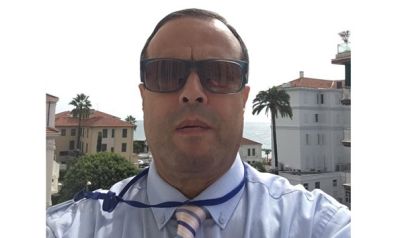




For Qatari engineer and artist Abdullah al-Fakhro, Arabic calligraphy is not confined to ink and paper. Through sculpture, public art and handcrafted jewellery, he has spent more than a decade transforming the Arabic letter into a contemporary artistic language that celebrates identity, heritage and innovation.
Al-Fakhro's journey began during his university years under the mentorship of renowned the late calligrapher Saeed al-Ansari (Arabic calligraphy teacher at the Ministry of Education, and founder in 2011 of the Arabic calligraphy department at the Museum of Islamic Art). While studying traditional calligraphic techniques, he became fascinated by the artistic possibilities embedded within the Arabic script itself.
Around 2013, he began experimenting with geometric Kufic forms, treating letters not merely as written symbols but as architectural structures capable of taking three-dimensional form. The exploration gradually evolved into a distinctive visual practice that bridges classical calligraphy and contemporary art.
“I work with freehand calligraphy, using my sense of letterform beauty to create art without being limited by strict classical rules,” al-Fakhro says. “This direction was influenced by the artist eL Seed, whose work does not follow traditional calligraphy styles. In these paintings, I focus on the idea and its impact, creating work that fits more naturally within contemporary art.”
Among the scripts that continue to inspire him is the early classical Kufic style associated with Kairouan, in Tunisia.
“It is characterised by balance, dignity and strong horizontal flow,” he says. “My interest in this script lies in its historical depth and its ability to connect heritage with modern artistic expression.”
By 2016, his artistic experiments had found one of their most compelling expressions in jewellery. Drawing on Arabic script and Islamic aesthetics, al-Fakhro began creating handcrafted pieces that transformed letters and words into wearable works of art.
“Jewellery is more than decoration,” he explains. “It can express identity, values and a connection to culture. Arabic calligraphy allows people to wear a piece of art that carries meaning.”
Crafted primarily from 18-karat gold and produced in collaboration with skilled artisans in Qatar and abroad, the pieces quickly gained recognition for combining cultural symbolism with contemporary design.
In 2020, he launched Midad, a brand inspired by the traditional ink associated with Quranic calligraphy. Through the venture, he produces limited-edition jewellery and artistic objects rooted in Arabic script and Islamic visual heritage.
His artistic practice extends well beyond jewellery. Al Fakhro has created sculptures, furniture pieces and public installations inspired by Arabic letters, participating in numerous cultural initiatives across Qatar. In 2016, he contributed to the “Katara Murals by Artists’ Brushes” project alongside calligrapher Issa al-Fakhroo, helping create large-scale public artworks that enriched Qatar’s visual landscape.
He later participated in the “Qatar’s Iconic Limousine” competition with a work inspired by the beloved national song “Allah Ya Omri Qatar” by Mohammed Al Saei. In 2022, he collaborated with the Museum of Islamic Art shop on a collection inspired by the celebrated Blue Qur’an, featuring the saying attributed to Ali ibn Abi Talib: “You think you are a small entity, yet within you the greater world unfolds,” rendered in Qur’anic Kufic script through a contemporary visual interpretation.
Most recently, al-Fakhro participated in the Msheireb Design District competition with three sculptural works inspired by Arabic calligraphy and centred on universal human values.
“I chose values that resonate with the atmosphere of Msheireb, a district that blends Arab and Islamic identity with a global outlook,” he says. “I selected ‘mercy’, ‘blessing’ and ‘kindness’ because we all need mercy and blessings, and kindness can create a positive impact on visitors.”
Drawing inspiration from Qatari and Gulf heritage, his works frequently incorporate Mashrabiya (Arabesque sculture) motifs alongside colours and materials associated with Islamic art, including turquoise and lazord stone.
Yet for al-Fakhro, the true value of art lies not in precious metals or materials, but in the idea behind them.
“The artist is the creator of the concept and the design,” he says. “That creative vision is what gives a work its greatest value.”
Through gold, sculpture and the enduring beauty of Arabic script, Abdullah al-Fakhro continues to redefine the possibilities of calligraphy, transforming letters into objects of beauty, cultural memory and artistic expression.

