


As part of the events accompanying the awards ceremony of the third edition of the Arab Book Award, the organisers hosted a symposium titled “The Arab Book and Cultural Identity.”
The symposium brought together a distinguished group of academics and researchers from Qatar and across the Arab world and was attended by a large number of intellectuals and interested participants.
Dr Naji al-Sharif, executive director of the Arab Book Award, welcomed the guests and attendees to Doha, underscoring the symposium's importance. He noted that it reflects the award’s vision of becoming a global platform for recognising scientific and intellectual excellence and highlighting original scholarly contributions. This, he said, contributes to raising the quality of the Arab book in both form and content, while strengthening its regional and international presence. He also announced that this year’s symposium coincides with the opening of nominations for the fourth edition of the award.
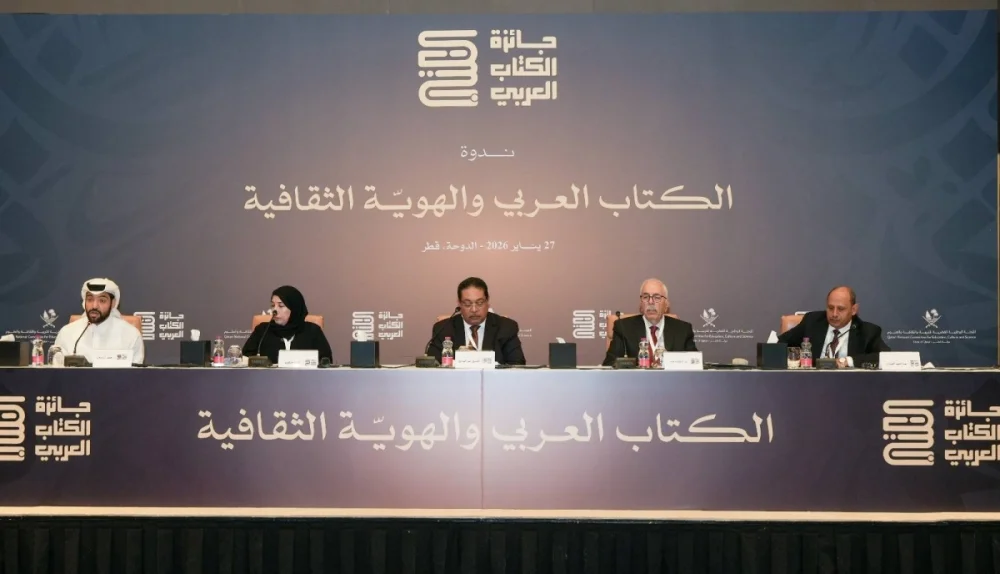
The first session opened with a presentation by Dr Abdul Hamid al-Hussami, Professor of Modern Literature and Criticism at King Khalid University, who examined representations of identity in interpretive discourse.
Professor Abdel Latif Abid, Professor of Contemporary Tunisian Thought and Literature, followed with an analysis of identity in selected modern Tunisian works, highlighting the plurality of identity frameworks, including Arabism, Islam, and national particularity. He stressed that Tunisian identity is shaped as both a historical continuum and a cultural and political project oriented toward the future.
In a paper presented by Dr Imtenan Smadi, Iraqi critic Dr Nadia Hanawi, Professor of Modern Literary Criticism and Narrative Theory, explored the centrality of identity in Arabic travel literature. She argued that this genre has preserved its cultural identity through adaptation rather than rupture, by reworking earlier models while acknowledging their origins and emphasising the author’s role in safeguarding authenticity and narrative identity. The session concluded with a presentation by Dr Hassan al-Rumaihi, a thinker and researcher in contemporary Arab thought, titled “Gaza the Successor,” offering an ethical and identity-based reading of the Palestinian cause. He described Gaza as a model of succession and historical responsibility, affirming that the Palestinian people are historical agents rather than merely victims of suffering.
The second session began with Professor Dr Nelly Hanna, Professor of Social and Cultural History and a specialist in Ottoman Egyptian history, who examined the relationship between language and identity in Egypt during the 17th and 18th centuries. Dr Fatima Al-Suwaidi, a researcher in Arabic literature and travel writing and a professor at Qatar University, presented a reading of identity in Ibn Battuta’s travels, exploring the tension between the self and the dialectic of decline. Dr Tayeb Bouaza, a researcher in contemporary philosophy and issues of identity and globalisation, then addressed the meaning of identity in an age of globalised communication, arguing that identity is not a fixed essence but a dynamic historical construct. He warned that the real danger lies not in globalisation itself, but in identity-based isolation and the refusal to engage with others.
The symposium concluded with a presentation by Professor Dr Abdelhakim Ajhar, a researcher in philosophy and contemporary cultural thought, titled “Identity and the Arabic Book.”
In their closing remarks, participants emphasised that identity in the Arabic book is neither static nor closed, but a dynamic historical and cultural process. They affirmed that rereading heritage through the lens of contemporary writing remains essential to understanding the Arab self and its place in a rapidly changing world.

