
tag

Tuesday, July 21, 2026 | Daily Newspaper published by GPPC Doha, Qatar.

Tag Results for "Qatar 2022" (9 articles)


Ghanim al-Muftah hoisted on the shoulders of his supporters.
Qatar

Ghanim al-Muftah: Qatar’s inspiring voice of resilience, learning, humanity

In a moment that remains etched in global memory, Qatari youth Ghanim al-Muftah emerged as one of the most inspiring figures to represent Qatar during the opening ceremony of the FIFA World Cup Qatar 2022. His appearance was far more than a symbolic role in a sporting spectacle; it was a powerful statement of humanity, celebrating coexistence, mutual understanding and respect for diversity while demonstrating how determination can transform adversity into a source of inspiration. Watched by millions around the world, al-Muftah shared the stage with acclaimed actor Morgan Freeman in one of the ceremony’s defining moments. By reciting a verse from Surah Al-Hujurat, he delivered a timeless message that humanity’s diversity is not a cause for division but an invitation to know one another and build bridges of respect across cultures. The segment stood out as one of the most memorable highlights of the opening ceremony, seamlessly blending the universal appeal of football with values that transcend sport. His message of perseverance continues to resonate. In a post shared on his X account Monday, al-Muftah urged young people to remain steadfast in pursuing their dreams, emphasising that true success is measured not by the absence of challenges but by the determination to overcome them. He reaffirmed that faith, education and resilience remain the foundations of meaningful achievement, encouraging his followers to transform every obstacle into an opportunity for growth. Yet, al-Muftah’s story extends well beyond the World Cup stage. His journey is equally defined by academic ambition, discipline and an unwavering belief in the transformative power of education. Pursuing higher studies at Loughborough University in the United Kingdom, he has demonstrated that academic excellence is achieved not through favourable circumstances but through perseverance and hard work. His commitment to education has also inspired the creation of the Ghanim al-Muftah Excellence Scholarship, offering talented Qatari students new opportunities to pursue their aspirations. Al-Muftah has become a role model for young people because his message is rooted in lived experience rather than rhetoric. Through his achievements, he shows that ambition can overcome even the greatest obstacles when paired with knowledge, discipline and self-belief. His public appearances and continued accomplishments have inspired a generation searching for authentic examples of resilience, reminding them that success is built through patience, determination and sustained effort, not ideal conditions. His appointment as a Goodwill Ambassador and active participation in humanitarian initiatives further underscore a mission that reaches beyond personal achievement. Al-Muftah embodies a vision of social responsibility, encouraging young people to embrace education, perseverance and service to others. His journey is more than an individual success story; it is compelling proof that resilience can challenge stereotypes, inspire hope and help build a more inclusive future, one in which obstacles are not the end of the road, but the beginning of extraordinary possibilities. 

Spain's midfielder Rodri lifts the trophy with his teammates after winning the 2026 World Cup final against Argentina at the New York/New Jersey Stadium in East Rutherford on July 19, 2026. (AFP)
Sport

FACTBOX: List of World Cup winners

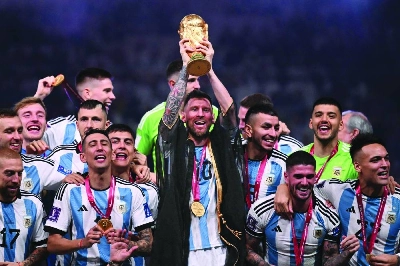
List of World Cup champions since the tournament began in 1930 (hosts, winners):URUGUAY 1930 - URUGUAY* Uruguay won the inaugural World Cup by beating Argentina 4-2 in the final in Montevideo.* The first tournament included 13 teams, with only four from Europe. The trip to South America was challenging for many European players because they feared losing their jobs after being absent for a long time. ITALY 1934 - ITALY* Hosts Italy defeated Czechoslovakia 2-1 in Rome in a tournament consisting of a Round of 16.* Holders Uruguay declined to participate in protest at the refusal of several European countries to travel to South America for the previous World Cup. At the same time, Egypt became the first African country to participate.FRANCE 1938 - ITALY* Italy claimed their second World Cup trophy, beating Hungary 4-2 in the final.* Dutch East Indies, present-day Indonesia, became the first Asian team to participate in the World Cup.BRAZIL 1950 - URUGUAY* The first World Cup after World War Two, where England made their debut. Uruguay lifted their second World Cup after a 2-1 win against hosts Brazil in a game that later became known as "Maracanaco".* With 173,850 spectators, the game is still the highest-ever attended World Cup match.SWITZERLAND 1954 - GERMANY* West Germany claimed their first title with a 3-2 win in the final against Hungary.SWEDEN 1958 - BRAZIL* The only World Cup staged in a Nordic country saw the debut of 17-year-old Brazilian Pele, who scored six goals and helped his team beat hosts Sweden 5-2 in the final.* France's Just Fontaine scored 13 goals in the tournament, still a record.CHILE 1962 - BRAZIL* Brazil retained their title in a 3-1 victory over Czechoslovakia in the final in Santiago.ENGLAND 1966 - ENGLAND* The only World Cup triumph for England, as they secured a 4-2 extra-time win over West Germany in the final.* North Korea and Portugal debuted in this World Cup, with the Portugal striker Eusebio the tournament's top scorer.MEXICO 1970 - BRAZIL* Brazil won their third title in Pele's last World Cup by winning 4-1 against Italy at the Azteca Stadium in Mexico City.* The tournament passed without a player being sent off. It was the first time substitutes were allowed, and yellow and red cards were introduced. It was also the first World Cup broadcast in colour and the first with an officially sponsored match ball.WEST GERMANY 1974 - WEST GERMANY* The host nation lifted their second World Cup after beating the Netherlands 2-1 in the final.* A new trophy was introduced for the tournament as Brazil had kept the Jules Rimet Trophy permanently due to three wins.ARGENTINA 1978 - ARGENTINA* The host nation again lifted the trophy as Argentina won 3-1 against the Netherlands in the final at Estadio Monumental.* Tunisia's 3-1 win over Mexico was the first time an African team had won a match in the tournament's history.SPAIN 1982 - ITALY* Italy became world champions for the third time with a 3-1 victory over West Germany in Spain.* The tournament marked the first time a penalty shootout was used.MEXICO 1986 - ARGENTINA* Mexico hosted the World Cup for the second time, with Argentina's Diego Maradona dominating the tournament and helping secure his nation's second World Cup by beating West Germany 3-2 in the final.* Argentina's quarter-final against England is probably best remembered, however, as it included Maradona's infamous "Hand of God" goal and his brilliant mazy dribble and strike that was later dubbed the "Goal of the Century".ITALY 1990 - WEST GERMANY* West Germany won the tournament for the third time as they beat Argentina 1-0 in Rome.* Cameroon beat Argentina in the group stage at San Siro before becoming the first African team to reach the World Cup quarter-finals.UNITED STATES 1994 - BRAZIL* The first tournament held in the United States was marked by several high-profile teams and players.* Romario and Bebeto guided Brazil to the final, where Italy and Roberto Baggio waited. After a lacklustre game, it saw the World Cup final's first penalty shootout, with Brazil claiming their fourth trophy after Baggio missed.FRANCE 1998 - FRANCE* The first World Cup with 32 teams competing. The hosts, led by Didier Deschamps, beat Brazil 3-0 in the final.SOUTH KOREA/JAPAN 2002 - BRAZIL* The first World Cup co-hosted by two nations and the first held in Asia. Ronaldo crowned his career by helping Brazil claim their fifth world title by beating Germany 2-0 in Yokohama.GERMANY 2006 - ITALY* Italy beat France 5-3 on penalties in Berlin after the game finished 1-1 after extra time in a clash in which Zinedine Zidane's got a red card for head-butting Marco Materazzi.* Another infamous game was the last-16 match between Portugal and Netherlands. Nicknmed the "Battle of Nuremberg", the game had four red cards and 16 yellows - a record for cards shown at a FIFA international tournament. Portugal won 1-0.SOUTH AFRICA 2010 - SPAIN* The tournament was held in Africa for the first time, with Spain claiming their first World Cup by defeating Netherlands 1-0 in the final after extra time.BRAZIL 2014 - GERMANY* Germany won their fourth title by beating Argentina 1-0 in the final.RUSSIA 2018 - FRANCE* France won their second title, beating Croatia 4-2 in the final, making coach Didier Deschamps the second man to win the World Cup as both a captain and a manager (following Germany's Franz Beckenbauer), after he led the team to victory in 1998.* The tournament marked the first use of Video Assistant Referees (VAR).QATAR 2022 - ARGENTINA* Argentina won their third title, beating France on penalties after the game ended 3-3 following extra time. Lionel Messi scored twice for Argentina, while Kylian Mbappe netted a hat-trick as Les Bleus recovered from 2-0 down.UNITED STATES, MEXICO AND CANADA 2026 - SPAIN* Spain won their second World Cup with a 1-0 win over defending champions Argentina after extra time thanks to a goal from Ferran Torres. Argentina's 39-year-old captain Lionel Messi became the second player to feature in three World Cup finals. 

Gulf Times
Sport

QFA supports the delivery of FIFA World Cup 2026

The Qatar Football Association (QFA) is taking part in delivering the FIFA World Cup 2026, with several of its staff managing match operations as part of a knowledge and expertise transfer programme between the Supreme Committee for Delivery & Legacy (SC) and FIFA. The programme draws on the organisational experience Qatar gained from hosting the FIFA World Cup Qatar 2022 and other major international tournaments. QFA staff are taking on key roles at several stadiums, including overseeing operations and coordinating with participating teams, helping to deliver a seamless match experience in line with FIFA standards.  Abdulla Mohammed Jassim Al IshaqDeputy Match DirectorNew York New Jersey Stadium Abdulla Mohammed Jassim Al Ishaq is taking part as Deputy Match Director at New York New Jersey Stadium, leading operational activities and overseeing the stadium's readiness to host fixtures in line with FIFA requirements. His role includes managing team arrival and match coordination meetings, collaborations with participating teams and various operational bodies, as well as following up on pre-match ceremonies, pitch management, dressing rooms and match official facility readiness.  Ali Hamoud Al NuaimiMatch CommissionerHouston Stadium Ali Hamoud Al Nuaimi is serving as Match Commissioner at Houston Stadium, overseeing all organisational aspects of the match and monitoring proceedings and ensuring all parties comply with tournament regulations and FIFA requirements. He is also responsible for documenting events related to the match and preparing official match reports.  Abdulla Al AnsariMatch CoordinatorHouston Stadium Abdulla Al Ansari is working as Match Coordinator at Houston Stadium, liaising between teams and tournament management, running coordination meetings, ensuring the readiness of dressing rooms and other facilities, and managing team schedules from arrival at the stadium through to departure.  Ahmed Al SayedMatch CoordinatorMiami Stadium Ahmed Al Sayed is serving as Match Coordinator at Miami Stadium, handling team logistics and ensuring compliance with tournament regulations. His responsibilities also include reviewing and approving player and technical staff lists, overseeing team schedules, and coordinating with match officials, the match commissioner, media, security and the anti-doping team. This participation reflects the growing trust placed in Qatari professionals on the international stage, and the talent Qatar continues to build through its experience organising major global events.

Gulf Times
Qatar

Qatar World Cup Photography Exhibition opens in Mexico City

A selection of photographs from the "After the Game" exhibition, first shown at the Tasweer Photo Festival Qatar, has been included in a new exhibition in Mexico City exploring the legacy of the FIFA World Cup Qatar 2022.The works form part of "Journeys to Greatness: Qatar 2022 Legacy", presented by the 3-2-1 Qatar Olympic and Sports Museum in partnership with Mexico's Ministry of Culture through the Centro de Cultura Digital (CCD).The exhibition links the legacy of Qatar 2022 with the next World Cup in Canada and Mexico in 2026 and is part of the Qatar Canada and Mexico 2026 Year of Culture programme.It uses photography, objects and multimedia storytelling to present football as a shared cultural experience, bringing together players, fans and communities from around the world.The selected images, originally shown in the third edition of the Tasweer Photo Festival Qatar, are integrated across sections of the exhibition including “Look of the Game”, “Matches and Players”, and “Unity in Diversity”, highlighting human stories behind the tournament.3-2-1 Qatar Olympic and Sports Museum director Abdulla al-Mulla said the legacy of Qatar 2022 extended beyond players and matches to include fans whose experiences helped define the tournament.He said the exhibition demonstrated how those memories continued to connect people across borders, adding that visitors had engaged with Qatari and Gulf customs and traditions.Tasweer Photo Festival Qatar director Khalifa al-Obaidli said photography has a unique ability to preserve emotion, noting that the works captured shared human experiences that made Qatar 2022 a transformative milestone.The original "After the Game" exhibition was created for the 2025 edition of Tasweer Photo Festival Qatar and explored the tournament's legacy through photographers documenting moments of celebration, reflection and connection.The "Journeys to Greatness" exhibition is an interactive multimedia presentation of the World Cup as a defining moment for Qatar and the wider region.It runs at the Centro de Cultura Digital in Mexico City until August 9 as part of a wider cultural programme symbolically linking Qatar 2022 with Mexico 2026. 

Gulf Times
Qatar

Qatar takes 2022 legacy to UN stage

The whistle in Doha may have blown long ago, but the echo carries still. At the United Nations Headquarters in New York, the Supreme Committee for Delivery & Legacy (SC) — represented by Managing Director His Excellency Hassan al-Thawadi — joined a high-level reception to mark World Football Day, a celebration of the imprint left by the FIFA World Cup Qatar 2022 even as the world looks ahead to the next chapter.Hosted by the Permanent Mission of Qatar to the UN under the theme "From FIFA World Cup 2022 to FIFA World Cup 2026: A Legacy in Motion," the gathering traced a thread that runs from the floodlights of Lusail to the stadiums of North America, where the United States, Canada and Mexico will share hosting duties this summer.It was a moment, al-Thawadi suggested, that always belonged to more than one nation. "For the Arab world and the Middle East, Qatar 2022 was a moment of pride that belonged to far more than one country," he told the reception. "It proved that a region too often defined by others could host the world on its own terms with warmth, excellence and a story worth telling."That story, he made clear, was never meant to end with the final whistle. "We never intended the tournament to be a moment in isolation," he said. "From the day we won the bid, our ambition was to build something that would outlast the final whistle — in infrastructure, in expertise, and in the connections forged between people. Today, we see that ambition come to fruition as the lessons learned in Doha continue to shape how the world delivers its greatest sporting experiences."Those lessons are now being packed and posted abroad. The SC and FIFA recently signed a knowledge and expertise transfer Memorandum of Understanding to support the delivery of the 2026 finals. Under it, a dedicated team of SC experts from Qatar has fanned out across Host Cities in the United States and Canada, sharing what they know across a wide span of operations, while a second contingent observes the choreography of a tournament stretched across three nations and two borders.The pedigree is hard to argue with. As the first World Cup staged in the Middle East and the Arab world, Qatar 2022 rewrote the benchmarks for innovation, operational efficiency and fan experience, offering a compact, sustainability-minded blueprint that has since informed how major events are delivered the world over.Doha has scarcely paused for breath since. The country went on to host the AFC Asian Cup in 2023, and in 2025 wrote a fresh entry in the record books by staging the finals of three FIFA competitions in the space of three weeks — the inaugural 48-team FIFA U-17 World Cup, the FIFA Intercontinental Cup and the FIFA Arab Cup.And the welcome mat stays out. Later this year Qatar opens its doors again for the second of five consecutive editions of the FIFA U-17 World Cup, running from 19 November to 13 December — proof, if any were needed, that the legacy is still very much in motion. 

Jassim al-Jassim at Mutual Dialogue Summit session Tuesday.
Qatar

Hosting major sports events in Qatar has enable young Qataris to realise their full potentials

Qatar plans to host more high-profile sports and football tournaments over the next five years, building on the success of the FIFA World Cup Qatar 2022, the FIFA Arab Cup, the AGCFF U-23 Gulf Cup, and other major events, according to Jassim al-Jassim, CEO of the Local Organising Committee for Football Events.Al-Jassim was speaking at the third edition of the Mutual Dialogue Summit during a session titled “From Hosting to Legacy: How Gulf Sports Shape a Youth-Led Future,” moderated by Asrar al-Ansari, director of the Youth Department at the Co-operation Council for the Arab States of the Gulf (Kuwait).He said the experience gained from hosting global tournaments, coupled with Qatar’s advanced infrastructure, has positioned the country to stage major international sporting events. He noted that many young Qataris discovered and developed their capabilities through hands-on involvement in these tournaments, enabling them to assume senior organisational and management roles without external supervision.Al-Jassim stressed that Qatari professionals have earned FIFA's full confidence to organise events independently, without direct intervention. He added that Hamad International Airport, security agencies, administrative bodies, and other state institutions are now fully equipped to manage large-scale international events, supported by effective contingency plans to address unforeseen challenges.He also highlighted Qatar’s growing reputation as a family-friendly, safe, and welcoming destination for women, noting that the country's sporting events consistently record high ticket sales.While embracing modern technologies and global best practices, al-Jassim said Qatar has remained committed to showcasing its heritage and traditions. He cited Al Bayt Stadium’s architecture and the Gulf bisht presented to Lionel Messi at the 2022 World Cup final as examples of this cultural emphasis.He further noted that Souq Waqif has emerged as one of the most popular destinations for visitors during international tournaments. This outcome was not deliberately planned, but one that reflects the enduring appeal of authentic Gulf heritage. Respect for national traditions, customs, and laws, he said, has remained central to all event-planning efforts.Among the most significant outcomes of the FIFA World Cup Qatar 2022, al-Jassim added, was the importance of investing in local youth by training and engaging them in planning and organisational processes. This approach has paid off, with many trainees now holding senior management and supervisory positions and performing their roles with high efficiency.The third edition of the Mutual Dialogue Summit concluded on Monday. Organised by the QatarDebate Centre, the two-day event was held at Msheireb Museums in Doha and brought together more than 100 young men and women from GCC countries. It was held in strategic partnership with the Ministry of Sports and Youth, in co-operation with Msheireb Museums as the cultural partner. 

Exhibition poster
Qatar

Katara to open 2022 World Cup Legacy exhibition tomorrow

Katara Cultural Village, in collaboration with the Supreme Committee for Delivery and Legacy, will host the “FIFA World Cup Qatar 2022 Legacy” exhibition at 5.30pm Monday (December 29), at Building 45.The exhibition will highlight the cultural, humanitarian, and sporting legacy of the first World Cup to be held in the Arab region and the Middle East.It will offer an interactive experience showcasing the milestones of Qatar's hosting of the 2022 FIFA World Cup and its exceptional organisational successes.The values it embodied include bringing people together, sustainability, innovation, and Qatari cultural identity.The exhibition will also highlight the lasting impact of the tournament on various levels, including infrastructure development, the promotion of cultural and artistic activities, and the support of community initiatives.Furthermore, it will document unforgettable moments that will remain engraved in the memories of fans worldwide.This exhibition reflects Katara and the Supreme Committee for Delivery & Legacy's commitment to preserving and enhancing the tournament's legacy for future generations, consolidating Qatar's position as a global cultural and sporting destination. 

Gulf Times
Sport

FIFA set to kick off 2026 World Cup ticket sales

FIFA will kick off a multi-phase ticket sale process for the 2026 World Cup this month with initial single seat prices as low as $60 for group-stage matches and as high as $6,710 for the final.Those prices will fluctuate based on demand, and fans will be able to buy single-game tickets, venue-specific tickets and team-specific packages, world football's governing body said Wednesday as it announced a schedule for the first phase of sales.Forty-eight teams, the biggest field in World Cup history, will play in the United States, Canada and Mexico from June 11-July 19 next year.Fans who have a Visa card can register for a FIFA ID on the body's website to enter a presale draw to be held September 10-19.Those selected through the randomized presale draw can then apply to purchase tickets starting October 1.Sales will be capped at four tickets per person per match, and no person can purchase more than 40 for the entire tournament.Further ticket sales will be launched in the coming months, with registration for phase two expected to take place October 27-31 for sales from mid-November to early December.Phase three will begin shortly after the tournament draw is held in Washington on December 5 and fans can submit applications for specific matches.Closer to the tournament, fans will be able to buy remaining inventory on a first-come, first-served basis.FIFA said in a statement it planned to offer additional products such as supporter tickets for fans who want to sit with others backing the same team, and conditional supporter tickets for fans who want to reserve a place in potential knockout rounds.FIFA will also launch an official resale platform.

Ahmed Habib in an interview at the Gulf Times stand at the event. PICTURES: Thajudheen
Qatar

FIFA World Cup 2022’s accessibility legacy highlighted at QES 2025

The FIFA World Cup Qatar 2022’s success as the most accessible tournament ever, a notable feat given the country’s developing infrastructure, was a key insight shared at the Qatar Events Show 2025, highlighting a commitment to lasting accessibility. Speaking at the Qatar Events Show’s second day at a talk titled ‘Accessibility in Events Design’, Ahmed Habib, a senior media content specialist at the Supreme Committee for Delivery and Legacy, noted that true accessibility extends far beyond physical infrastructure, demanding a holistic approach rooted in inclusivity and a deep understanding of diverse needs. “Qatar has done a very good job of building world-class events facilities that are accessible,” Habib said, citing the country’s fortunate starting point with accessible hotels, public spaces, and cultural sites. He pointed out that the foundation of the FIFA World Cup Qatar 2022’s unparalleled accessibility was the establishment of an Accessibility Forum. Operating under the theme, ‘Nothing about us without us,’ this initiative brought together disabled individuals from the community six years prior to the tournament. Habib said their direct involvement was instrumental in shaping a tournament that was not only accessible in its execution but also actively contributed to making Qatar more accessible for people with disabilities in the long term. “We brought disabled people from the community and we said, ‘Listen, we're going to organise a massive tournament in Qatar, and how do you want the tournament to be accessible? But more importantly, is how can this tournament make Qatar more accessible for you after the tournament is over?’” he said. This collaborative approach, he added, ensured the tournament was “delivered to the highest standards,” driven by innovation and a belief that “football is for all”. Habib underlined key innovations such as the introduction of Audio Descriptive Commentary in the Arabic language, offering blind fans an immersive experience through dedicated commentary accessible via their own devices. He noted that this groundbreaking facility, previously unavailable to Arabic speakers, has now paved the way for similar accessibility features in cultural spaces, events, and theaters. “What’s the point if I come to an event that’s physically accessible, but the staff meet me at the door and say, ‘I don’t know if you can come in because you're in a wheelchair’? Then the event is not accessible because staff and volunteers have not been trained,” he added. Habib stressed the critical need for comprehensive staff and volunteer training, equipping them with the knowledge and cultural understanding to welcome and support individuals with disabilities, whether they are attendees, speakers, or colleagues. “What are you going to do if someone who is deaf shows up at your event? Someone who is blind? At least have some sort of minimum training, recognition, understanding, and build that culture amongst your staff and team,” he urged event planners. Habib emphasised the importance of universal design principles in graphic design, citing high colour contrast, appropriate font choices, and clear hierarchy in signage as beneficial for everyone, not just those with specific visual needs. He illustrated this with an example of signage at Toronto Pearson International Airport, where icons and shapes communicate effectively, allowing non-English or French speakers to navigate with ease. Habib also discussed the distinction between the medical model and the social model of disability, where the former often views disability as an illness requiring supervision and dependence. In contrast, he said the social model suggests that disability is a societal construct, and it is the responsibility of society to create inclusive environments where everyone is equal and can participate fully. “Event planners play an important role,” Habib said, reiterating that they have the power to determine whether guests feel ‘disabled or enabled’”. He added that event planners should never view individuals with disabilities as a “loss or abnormality”, nor should they see them as having “restrictions or lack of ability”. Instead, he said the focus must be on fostering an environment where every individual, regardless of ability, can fulfill their potential and participate without limitation.