tag

Friday, February 27, 2026 | Daily Newspaper published by GPPC Doha, Qatar.

Tag Results for "EU sanctions" (25 articles)

Tributes lie partially covered in snow Monday at a makeshift memorial to fallen Ukrainian and foreign soldiers in Independence Square in Kyiv, as the conflict with Russia reaches its four-year mark. AFP
International

Hungary blocks Russia sanctions, EU cash for Kyiv

Hungary maintained its veto Monday on new EU sanctions on Russia and a huge loan for Ukraine, while a Ukrainian strike on a Russian pumping station serving the Druzhba oil pipeline threatened to further harm Kyiv's fraught ties with Budapest.On the ground in Ukraine, which marks today the fourth anniversary of Russia's full-scale invasion, Kyiv claimed a rare frontline advance, though Moscow continued its campaign of targeting Ukrainian cities, killing two people in drone strikes in the south.The diplomatic spotlight was on Brussels, where European foreign ministers tried to persuade Hungary and Slovakia to back off threats to punish Ukraine for delays restarting the flow of Russian oil via a Soviet-era pipeline.However, an overnight drone strike claimed by Kyiv which caused a fire at the pumping station more than 1,200km (750 miles) from the Russia-Ukraine border threatened to inflame tensions further.Ukraine gave no details about the strike's broader impact on the pipeline.Kyiv says that the Druzhba pipeline, which still carries Russian oil via Ukrainian territory to Europe, was damaged a month ago by a Russian drone strike, and it is fixing it as fast as it can.Slovakia and Hungary, which have the EU's only two refineries that still rely on oil via Druzhba, blame Ukraine for the delay."It is up to Ukraine, whether it restarts shipments on the pipeline or not, it is increasingly clear that we are facing open political blackmail here," Hungary's Prime Minister Viktor Orban told parliament in Budapest. "The Hungarian government does not give in to any blackmail."Ukrainian Foreign Minister Andrii Sybiha said in a post on X that Hungary and Slovakia should not be allowed to "hold the entire EU hostage" and called on them to "engage in constructive co-operation and responsible behaviour".Hungary and Slovakia both have leaders who have bucked the European consensus by maintaining close relations with Moscow, but have previously stopped short of blocking EU sanctions on Russia or loans to Ukraine.In a letter seen by Reuters, Orban told European Council chief Antonio Costa that the pipeline outage was an "unprovoked act of hostility that undermines the energy security of Hungary" and vowed to block a €90bn ($106bn) loan until it was solved.Hungary has also blocked the latest sanctions package on Russia.Hungary and Slovakia also threatened to stop emergency electricity exports to Ukraine unless oil shipments resume.Slovakia had set a deadline Monday, though exports were continuing, according to data from transmission system operator SEPS.Russian President Vladimir Putin's decision to send his forces into Ukraine on February 24, 2022, triggered Europe's deadliest conflict since World War II.Russian forces have killed tens of thousands of Ukrainian civilians and destroyed Ukrainian cities.Hundreds of thousands of soldiers on both sides have died or been wounded.In the war's first year, Ukraine forced back the Russian offensive at the gates of Kyiv and reclaimed swathes of occupied land.However, a Ukrainian counteroffensive failed the following year, and since then Moscow has made slow but relentless gains in costly battles along a 1,200km (750-mile) front.In a rare announcement of a Ukrainian advance, the commander-in-chief of Ukraine's armed forces, Oleksandr Syrskyi, said Monday that his forces had "restored control" over 400sq km of territory along a stretch of the southern frontline.Reuters was not immediately able to confirm the claim, and there was no immediate response from Moscow.If true, it would be the first big Ukrainian gain since December and one of the biggest in many months.The US has been trying to broker a peace deal between Russia and Ukraine, but progress has proved elusive.Their most recent talks, in Geneva on February 17-18, did not produce a breakthrough.Another round of talks aimed at ending the war in Ukraine could be held at the end of this week, President Volodymyr Zelensky's chief of staff told Ukrainian media Monday. 

Pump jacks operate in front of a drilling rig in an oil field in Midland, Texas.  A deep freeze in the US contributed to two of the four largest declines in American oil inventories this century.
Business

Oil traders rush to hedge Iran risk after wild start to year

The oil market is in the middle of its strongest start to a year since 2022 as supply shocks and sanctions confound expectations of a glut. Now traders are racing to cover themselves against the prospect of the US attacking Iran again. A surge in activity across futures and options markets is already pulling up crude prices — Brent futures touched a seven-month high of more than $72 a barrel on Friday, and some analysts see a risk premium of as much as $10. The rally — Brent is up about 18% since the end of last year — represents a marked shift from just weeks ago, when traders were focused on forecasts for a record surplus, especially around now.**media[419803]**Instead, there’s been unexpected strength thanks to supply disruptions in the US and Kazakhstan — as well as a shunning of sanctioned crude. That’s been amplified by geopolitical risk — starting in Venezuela and extending to Iran — where President Donald Trump could order fresh strikes in a region home to about a quarter of the world’s seaborne oil trade. “You have a potential war, and that’s the overriding factor, but it’s in addition to a much tighter market than people anticipated,” said Gary Ross, a veteran oil consultant turned hedge fund manager at Black Gold Investors LLC. “I would fasten my seatbelt and wouldn’t want to be short in this market.” Trump said in response to reporters’ questions on Friday that he’s considering a limited strike on Iran after amassing the biggest US force since 2003. The number of Brent oil futures held surged to an all-time high this year, while last month saw record trading in options to protect against a further rally. Volatility has surged to the highest since the US last bombed Iran in June, and traders have — for the longest period in years — been charging premiums to protect against a surge. “It does feel that the probability of limited strikes and limited retaliatory strikes from Iran seems less likely this time around,” said Jorge Leon, head of geopolitical analysis at consultant Rystad Energy AS. “It worked last year, but right now I have the feeling it’s a nuclear deal, or a wider escalation, not something in the middle.” That prices haven’t pushed higher is a sign of how much global output has expanded. US Energy Secretary Chris Wright even said this week that American energy dominance has made the country’s foreign policy less beholden to supply shocks. The Organization of the Petroleum Exporting Countries and its allies steadily lifted output last year. Likewise, volumes from outside the group also hit a record, leaving global production at 108mn barrels a day at the end of 2025, according to IEA estimates. That’s almost 3mn barrels a day higher than consumption over the same period, its figures show.**media[419804]**Still, the first few weeks of January offered an example of how unexpected output curbs can quickly narrow that gap. Planned exports of Kazakhstan’s CPC Blend crude fell to the lowest level in about a decade due to a combination of drone attacks, maintenance, damage to a production facility and bad weather. At the same time, a deep freeze in the US contributed to two of the four largest declines in American oil inventories this century. Crude stockpiles alone fell by 9mn barrels last week. While output in both countries has since picked up again, the disruption helped to erode western stockpiles at a time when they’d been expected to grow quickly. Physical oil traders are watching the situation in Iran closely, too. Some refiners in Asia, the top consuming region, have begun asking about the availability of cargoes from regions outside of the Gulf in order to cover themselves against the risk of disruption. Earnings for oil supertankers, whose supply was already constrained, have also soared partly in anticipation of a US move. The market’s biggest ships are earning more than $150,000 a day, the most since the pandemic when many of them were deployed to store unwanted barrels. Rates for the ships have been bolstered by tensions in recent days, after Iran claimed earlier this week it briefly closed part of the narrow Strait of Hormuz chokepoint, through which a fifth of the world’s barrels flow. “Right now, the focus is overwhelmingly on Iran and what happens with the Strait of Hormuz,” said Rob Thummel, a portfolio manager at Tortoise Capital Advisors. “That is the billion dollar question.” 

A man cycles past a mural and a giant billboard in Palestine Square, in Tehran, Monday.
Region

Iran says it could dilute enriched uranium if all sanctions are lifted

Iran could agree to dilute its most highly enriched uranium in exchange for all financial sanctions being lifted, its atomic chief said Monday, one of the most ‌direct indications so far of its position at talks with Washington.US and ‌Iranian diplomats held talks through ‍Omani mediators in Oman last week in an effort to revive diplomacy, after US President Donald Trump positioned ⁠a naval flotilla in the region raising ⁠fears of new military action.The talks follow a crackdown on anti-government demonstrations in Iran ‍last month when thousands of people were killed, the biggest domestic unrest since the 1979 Revolution.Trump joined an Israeli bombing campaign last year and hit Iranian nuclear sites. He also threatened last month to intervene militarily during the protests but ultimately held off.Washington has demanded Iran relinquish its stockpile — estimated last year by the UN nuclear agency at more than 440kg — of uranium enriched to up ‌to 60% fissile purity, a small step away from the 90% that is considered weapons grade.The head of Iran's Atomic Energy Organisation, Mohammad Eslami, said Monday: "The possibility of diluting 60% enriched ‍uranium... depends on whether, in ⁠return, all sanctions are ‌lifted or not".Eslami, whose remarks were reported by Iran's ISNA news agency, said however that another proposal, sending Iran's highly enriched uranium abroad to another country, had not been discussed at the talks with US officials.Ali Larijani, a close adviser to Iran's Supreme Leader Ayatollah Ali Khamenei and secretary of its national security council, will visit Oman Tuesday following the US-Iranian talks there, the semi-official Tasnim news agency reported."During this trip, (Larijani) will meet with high-ranking officials of the Sultanate of Oman and discuss the latest regional and international developments and bilateral cooperation at various levels," Tasnim said.The date and ​venue of the next round of ‌talks have yet to be announced. Iran’s President Masoud Pezeshkian said Monday that a new round of talks would ⁠be "an appropriate opportunity for a fair ‍and balanced resolution of this case," and that a desired outcome could be reached if the US avoids maximalist positions and respects its commitments.Iran would continue to demand the lifting of sanctions and insist on its nuclear rights including enrichment, he said.Iran and the US held five rounds of talks last year on curbing Tehran's nuclear programme, with ​the process breaking down mainly due to disputes over uranium enrichment inside Iran.Since Trump struck Iran's facilities, Tehran has said it has halted enrichment activity. It has always said its nuclear programme is solely for peaceful purposes.The US wants to include Iran's ballistic missile arsenal in negotiations, but Tehran has ruled this out.In a televised statement aired Monday, Khamenei called on Iranians to participate in the coming anniversary of the Revolution."The presence of the people in the march and their expression of ⁠loyalty to the Islamic Republic will cause the enemy to stop coveting Iran," Khamenei said. 

People wait for transportation in Havana as Cubans brace for fuel scarcity measures after the US tightened the oil supply blockade. Reuters
International

Cuba adopts urgent measures to address energy crisis

The Cuban government has announced emergency measures to address a crippling energy crisis worsened by US sanctions, including the adoption of a four-day work week for state-owned companies and fuel sale restrictions.Deputy Prime Minister Oscar Perez-Oliva Fraga blamed Washington for the crisis, telling Cuban television that the government would "implement a series of decisions, first and foremost to guarantee the vitality of our country and essential services, without giving up on development”."Fuel will be used to protect essential services for the population and indispensable economic activities," he said."This is an opportunity and a challenge that we have no doubt we will overcome," Perez-Oliva said. "We are not going to collapse."Among the new measures are the reduction of the working week in state-owned companies to four days, from Monday to Thursday; restrictions on fuel sales; a reduction in bus and train services between provinces; and the closure of certain tourist establishments.School days will also be made shorter and universities will reduce the requirement of in-person attendance.These measures are intended to save fuel in order to promote "food and electricity production" and enable "the preservation of fundamental activities that generate foreign currency", said Perez-Oliva Fraga.The government will supply fuel to the tourism and export sectors, including for the production of Cuba's world-famous cigars, to ensure the foreign exchange necessary to fund other basic programmes, he said, adding: "If we don't have income, then we will not overcome this situation."Domestic and international air travel will not be immediately affected by the fuel rationing, although drivers will see cutbacks at the pump until supply normalises, he said.Perez-Oliva also announced an ambitious plan to plant 200,000 hectares (500,000 acres) of rice to guarantee "an important part of our demand", but acknowledged fuel shortfalls would push the country to depend more on renewable energy for irrigation needs and animal-power for tilling fields.Education Minister Naima Ariatne, appearing on the same programme, said infant-care centres and primary schools would remain open and in person, but secondary schools and higher education would implement a hybrid system that would require more "flexibility" and vary by institution and region."As a priority, we want to leave (open) our primary schools," Ariatne said.Top officials said healthcare would also be prioritised, with special emphasis on emergency services, maternity wards and cancer programmes.The island of 9.6mn inhabitants, under US economic embargo since 1962, has been mired in a severe economic crisis for six years.Washington has increased pressure on its communist government in recent weeks.The United States cut off oil deliveries from Havana's key ally Venezuela following its ouster of president Nicolas Maduro in early January.US President Donald Trump also signed an executive order last week allowing his country to impose tariffs on countries selling oil to Havana.Trump said that Mexico, which has been supplying Cuba with oil since 2023, would stop doing so – under threat of US tariffs.The oil shortages have threatened to plunge Cuba into complete darkness, with power plants struggling to keep the lights on.Washington has long sought to overthrow or weaken the communist-led Cuban government.Havana accuses Trump of wanting to "strangle" the island's economy, where power cuts and fuel shortages, already recurrent in recent years, have become even more acute.This week, Cuban President Miguel Diaz-Canel said his country is willing to hold talks with the United States, but not under pressure.He said any talks must take place "from a position of equals, with respect for our sovereignty, our independence and our self-determination" and without "interference in our internal affairs”. 

Gulf Times
Business

Oil rises nearly 3% as US sends armada to Iran, slaps new sanctions

OilOil prices settled at their highest in over a week on Friday after US President Donald Trump ratcheted up pressure against Iran through more sanctions on vessels that transport its oil. He also announced an armada was heading towards the nation.Brent crude futures settled at $65.88, and US West Texas Intermediate crude (WTI) finished at $61.07. For the week, both benchmarks rose 2.7%.Trump renewed warnings to Tehran against killing protesters or restarting its nuclear programme. Warships, including an aircraft carrier and destroyers, will arrive in the Middle East in the coming days, a US official said.The US on Friday also imposed sanctions on nine vessels and eight related firms involved in transporting Iranian oil and petroleum products. The escalating pressure has caused concerns of oil supply disruptions in the Middle East. Gas**media[408536]**Asia spot liquefied natural gas rose for a second week to hit a nine-week high, as lower winter temperatures across the northern hemisphere lifted heating demand.The average LNG price for February delivery into north-east Asia was $11.35 per million British thermal units (mmBtu), up from $10.10 per mmBtu the week before.However, Asian prices are still below European ones, where cold conditions also increased heating demand across the continent. The premium on LNG remained in Europe and caused several vessels to change course to Europe.The Dutch TTF gas price settled at $13.66 per mmBtu, posting a weekly gain of 7.3%. The market is also bracing for a potential downturn in US LNG exports this weekend because of an exceptionally cold weather pattern sweeping over most of the southern US, where most LNG export infrastructure is located. 

The Lukoil logo is seen in West Qurna oilfield in Iraq's southern province of Basra (file). Lukoil declared force majeure in ‍November at West Qurna ⁠2 as it ‌was hit with sanctions alongside fellow Russian oil producer Rosneft as part of US President Donald Trump's push to end the war in Ukraine.
Business

Iraq to nationalise West Qurna 2 oilfield operations, government says

Iraq's cabinet has approved plans to nationalise operations ⁠at the West Qurna ⁠2 oilfield, one of the world's largest, as the government ‍looks to avert disruptions stemming from US sanctions imposed on Russian stakeholder Lukoil.State-run Basra Oil Company will take over the oilfield's operations for 12 months, two officials at the firm told Reuters."We aim to keep production running smoothly as Iraq navigates uncertainty over US sanctions and ‌will look for potential buyers for Lukoil’s stake during the 12-month period," one Basra Oil official said.Lukoil declared force majeure in ‍November at West Qurna ⁠2 as it ‌was hit with sanctions alongside fellow Russian oil producer Rosneft as part of US President Donald Trump's push to end the war in Ukraine.The sanctions have drawn bids from about a dozen investors, including US oil majors Exxon Mobil, Chevron, and private equity firm Carlyle, according to sources."The state-run Basra Oil Company will cover local staff salaries, operational expenses, and payments to subcontractors, using an account linked to the ​Majnoon oilfield to help facilitate ‌the process," an Iraqi oil manager at the oilfield told Reuters.Production remains steady ⁠at around 465,000 ‍to 480,000 barrels per day, the official said.The government said in a statement on Wednesday that the cabinet had agreed to seek approvals to finance operations through the Majnoon oilfield account, to be boosted by proceeds from crude shipments sold ​by state oil marketer SOMO.Lukoil's 75% operational stake in the oilfield was its biggest foreign asset. The company has until January 17 to sell its overseas assets under the latest deadline set by the US Treasury.The field accounts for about 0.5% of global oil supply and 9% of output in Iraq, OPEC's second-largest producer after Saudi Arabia. 

Cyprus' President Nikos Christodoulides and European Commission President Ursula von der Leyen attend the official opening ceremony of Cyprus taking over the EU presidency at the THOC theatre in Nicosia, Wednesday.
International

Ukraine pushes EU membership bid as Cyprus takes bloc's presidency

Ukrainian President Volodymyr Zelenskiy on Wednesday pressed ‌allies for ironclad security ‍guarantees against any renewed Russian attack while also seeking progress on EU membership talks and tougher sanctions on Moscow.Zelenskiy ⁠met Cypriot President Nikos Christodoulides in Nicosia ⁠as Cyprus took over the European Union's rotating presidency, which runs for six months."We are ‍working to make as much progress as possible during this period on opening negotiating clusters and on Ukraine’s accession to the European Union,” Zelenskiy said after the meeting, in a statement posted on X.Ukraine applied to join the EU days after Russia launched its full-scale invasion in February 2022, seeking to anchor itself politically and economically to the West. It has been pushing to make progress on its bid, despite ‌the challenges of the war and opposition from EU member Hungary to a fast-track process for Kyiv."The President and I talked about strengthening sanctions against Russia, which must remain in place as long ‍as Russia’s aggression and occupation continue," ⁠Zelenskiy said.The two leaders ‌also discussed reinforcing Ukraine's air defence and the production and supply of drones. "We hope that support for Ukraine will remain strong," he said.Zelenskiy later met with European Commission chief Ursula von der Leyen and European Council President Antonio Costa.Wednesday's meetings, he said, would provide an opportunity to discuss details of a meeting in Paris on Tuesday, where the United States backed a broad coalition of Ukraine's allies in promising to provide security guarantees in the event of a ceasefire to support the country if Russia attacks again.Zelenskiy, who is seeking solid post-war security guarantees to deter Russia from attacking again, told reporters he had not received a clear ​answer from Ukraine's partners of ‌what their response to such an attack would be."As long as we don't have such security guarantees, legally binding, supported by ⁠parliaments, supported by the United States ‍Congress, this question cannot be answered," Zelenskiy said in a Whatsapp group chat.Cyprus, which traditionally had close political and cultural ties with Russia, has fully backed sanctions on Moscow. Many on the island draw parallels between Russia's invasion of Ukraine and Turkey's invasion of north Cyprus in 1974 after a brief coup engineered by the military then ruling Greece."Cyprus reaffirms its ​steadfast commitment to Ukraine's sovereignty and territorial integrity. As a country that still lives with the consequences of illegal invasion and ongoing military occupation, we fully understand what is at stake," Christodoulides wrote in a post on X after meeting Zelenskiy."Ukraine will be a central priority of our Presidency, and will work to ensure sustained support at all levels," he said.A ceremony later in Nicosia marking the start of its six-month term will include Middle Eastern leaders, including Lebanese President Joseph Aoun, highlighting the ambition of the eastern Mediterranean ⁠island to serve as a bridge between Europe and the region. 

A liquified natural gas tanker leaves the dock after discharging at PetroChina's receiving terminal in Dalian, Liaoning province, China. The country hasn’t imported US LNG since February, partly because of trade conflicts and weak demand.
Business

Russia LNG exports to China rise to record, surpassing Australia

Russia’s liquefied natural gas exports to China surged to a record in November, as buyers shrugged off the risk of western sanctions to access the cheaper fuel.Deliveries of the super-chilled gas from Russia more than doubled from a year earlier to 1.6mn metric tons last month, customs data released over the weekend showed. The jump saw Russia overtake Australia to become China’s biggest supplier after Qatar.Russia has turned to Asia’s biggest gas market to offset declining shipments to Europe, which was Moscow’s biggest buyer for decades until the invasion of Ukraine. It has had to cut prices to increase its appeal — its LNG was the cheapest among the 12 suppliers to China and about 10% below the average at $9.85 a million British thermal units in November, the customs data showed.Total imports had an annual increase for the first time in more than a year, after weak demand tempered requirements.China in August started importing shipments from Russa’s sanctioned Arctic LNG 2 plant through its remote Beihai terminal. Nevertheless, the Russian facility has had to cut output as winter ice complicates exports.China hasn’t imported US LNG since February, partly because of trade conflicts and weak demand. Major domestic companies are also increasingly diversifying their sources, while trying to sell contracted volumes on global markets, which is easier for American contracts that don’t tend to have destination clauses.Meanwhile, China’s domestic LNG prices fell to a five-year low as inventories grew and demand for heating during winter months remained short of expectations.The domestic wholesale LNG price at key importing terminals dropped below 3,500 yuan per ton ($10.72 per million British thermal units) this week, marking the lowest since mid-2021, according to data from SCI99, a Chinese commodities pricing agency.This marks a significant departure from typical winter patterns, where prices usually rise on higher heating demand. This year, mild temperatures and a faltering industrial and economic recovery across China have dragged domestic LNG prices lower.At the same time, inventories have grown as incoming shipments of seaborne LNG began recovering in November after a year-long slump, though cumulative volumes remain below last year’s level. Imports of piped gas have also been increasing, according to official customs data. Terminal operators have been forced to sell off stockpiles at lower prices as tanks were 73% full as of December 19, SCI99 said.“Price may remain low through the month,” Wang Ran, an analyst with SCI99, wrote in a note. 

People inspect the wreckage of a car that was targeted in an Israeli air strike near the southern Lebanese village of Mazraat 
Al Qnaitra, Monday.
Region

Lebanon says three killed after Israeli strike on vehicle near Sidon

Lebanon said three people were killed Monday in a strike near Sidon that Israel said targeted Hezbollah operatives, days ahead of a deadline for Lebanon’s army to disarm the group near the border. Israel has kept up regular strikes on Lebanon, usually saying it is targeting Hezbollah, despite a November 2024 ceasefire that sought to end more than a year of hostilities with the fighter group, which it accuses of rearming. Lebanon’s state-run National News Agency said Monday’s strike on a vehicle was carried out by an Israeli drone around 10 kilometres from the southern coastal city of Sidon and “killed three people who were inside”. The health ministry reported the same toll. Under heavy US pressure and amid fears of expanded Israeli strikes, Lebanon has committed to disarming Hezbollah, starting with the south. The Lebanese army plans to carry out the task south of the Litani River — about 30 kilometres from the border with Israel — by year’s end. The latest strike came after Lebanese and Israeli civilian representatives on Friday took part in a meeting of the ceasefire monitoring committee for a second time, after holding their first direct talks in decades earlier this month, also under the committee’s auspices. The committee comprises representatives from Lebanon, Israel, the US, France and the UN Interim Force in Lebanon (Unifil). Lebanese President Joseph Aoun said Monday that the goal of the negotiations was to “stop the hostilities, achieve Israel’s withdrawal, return prisoners held in Israel and return southern residents to their villages”. Israel has also kept troops in five south Lebanon areas that it deems strategic. “Lebanon awaits positive steps from the Israeli side,” Aoun told visiting Italian Defence Minister Guido Crosetto Monday, a presidency statement said. 

Gulf Times
Business

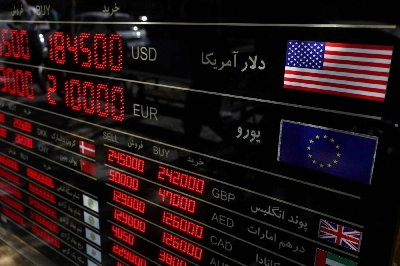
Iran rial tanks to record low as US sanctions and inflation bite

Iran’s currency depreciated to record lows against the dollar last week as multiple challenges including oil sanctions, regional tensions and spiralling inflation plague the economy.The greenback was trading at a little under 1.3mn rials on the unregulated, open market in Tehran late on Wednesday, according to the website Bonbast and the Telegram accounts of three foreign-exchange shops in the Iranian capital. That was just off all-time highs hit earlier in the week, the traders said.The rial has weakened dramatically over the past year, hitting successive record lows in the wake of broader international sanctions.Since 2018, when US President Donald Trump exited a landmark nuclear deal during his first term, the rial has lost more than 95% of its value versus the dollar. When he returned to office this year, Trump revived his “maximum pressure” strategy against Iran, which involves aggressive economic sanctions and culminated in June’s airstrikes on Iran.A drop in oil exports, the biggest single source of foreign currency revenue for Iran, the fact that importers want to settle outstanding foreign trade before the end of the Western calendar year, a recent increase in gasoline prices and persistently high levels of inflation have all weighed on the informal foreign-exchange market in Iran, the state-run Hamshahri newspaper reported, citing Kamal Seyyed Ali, former deputy governor of the Central Bank of Iran.Iran’s Minister of Economic Affairs and Finance, Ali Madanizadeh recently warned that while tensions with Israel remain high, the dollar is likely to only strengthen further, stoking faster inflation.He likened the task of managing inflation and market volatility in Iran to “performing surgery in a field hospital” during the war with Iraq “while under constant bombardment”, according to the state-run Islamic Republic News Agency.Iran has several parallel exchange rates including an official CBI rate, that is only accessible to a limited number of organisations and companies, and a much more expensive, unregulated rate that is used by the vast majority of the population and is a key economic bellwether. 

A gas torch is seen next to the Lukoil company sign at the Filanovskogo oil platform in the Caspian Sea, Russia. Russian export revenues hit their lowest in November since the full-scale invasion of Ukraine in 2022, the IEA said.
Business

IEA lowers 2026 oil glut forecast for first time since May

Surplus to reach 3.84mn bpd in 2026, down 250,000 bpd from last monthSupply growth forecast lowered on sanctions disruptionsBrighter macroeconomic outlook supports demand, IEA saysParallel markets of ample crude but tight fuel markets to continueThe International Energy Agency trimmed its forecast of next year's global oil supply glut for the first time since May on Thursday, flagging higher demand prospects due to a stronger world economy and lower supply from nations under sanctions.Oil prices have been under pressure for months due to predictions from the IEA, which advises industrialised countries, and other analysts of a looming glut.Global oil supply will exceed demand by 3.84mn barrels per day, according to figures from the Paris-based IEA's latest monthly oil market report, down from a 4.09mn bpd surplus estimated in November.A surplus of almost 4mn bpd is still equal to almost 4% of world demand and is at the higher end of analysts' predictionsSupply rose sharply this year boosted by output hikes from the Organisation of the Petroleum Exporting Countries and its partners — a group known as Opec+ — as well as growth in the US and other producers.Opec+ has now paused output increases for the first quarter of 2026.The IEA revised up its global oil demand growth forecasts for this year and next due to an improving macroeconomic outlook and with "anxiety about tariffs having largely subsided".World oil demand is expected to rise in 2026 by 860,000 bpd, up 90,000 bpd from last month's outlook, the IEA said. It raised its 2025 forecast by 40,000 bpd to 830,000 bpd."Falling oil prices and the lower US dollar, both currently near four-year lows, act as a further tailwind for oil demand next year," the IEA said, adding that demand growth in 2025 has come almost entirely from non-OECD countries, which are more reliant on macroeconomic conditions.A spate of breakthroughs with US trade deals had helped put economic sentiment back on track after tariff-related tensions hit consumption earlier this year, the IEA said.The agency expects supply growth to be slightly lower than previously anticipated in 2025-2026, as sanctions on Russia and Venezuela hit exports.The IEA expects global oil supply to rise by 2.4mn bpd next year, having last month predicted supply growth of 2.5mn bpd.The IEA revised down its 2025 and 2026 output forecasts for Opec+ producers, largely because of sanctions disruptions.Global oil supply fell by 610,000 bpd on the month in November, the IEA said, on declining output from sanctions-hit Russia and Venezuela.Russian export revenues hit their lowest in November since the full-scale invasion of Ukraine in 2022, the IEA said.The IEA kept its forecasts for non-Opec+ output stable for this year and next on rising production in the Americas, namely the US, Canada, Brazil, Guyana and Argentina.A trend of "parallel markets", where ample crude supply is juxtaposed with tight fuel markets, is likely to persist for some time, it said, amid limited spare refining capacity outside China and EU sanctions on Russian crude-derived fuel exports. 

File photo shows Sudan's army soldiers celebrating after entering Wad Madani, in January 2025.
International

UK foreign minister plans sanctions relating to human rights abuses in Sudan

Britain's foreign minister Yvette Cooper plans to introduce sanctions relating to human rights violations and abuses in war-torn Sudan, she said Tuesday, stressing the need for sustained efforts for a ceasefire. "I've instructed my officials to bring forward potential sanctions relating to human rights violations and abuses in Sudan," Cooper told lawmakers, amid global efforts to end the war in the east African nation.The conflict erupted in 2023 amid a power struggle between the Sudanese Armed Forces and the paramilitary Rapid Support Forces (RSF). RSF's recent takeover of Al-Fashir, one of Sudan's largest cities, has raised grave concerns about mass killings. Both sides have increasingly relied on drone strikes in recent months.Cooper said that the international community had turned its back on Sudan for "far too long". "We may need to make sure teams can get in to investigate these atrocities and hold the perpetrators to account," she said. Last year, Britain imposed sanctions on three businesses which it said were funding military groups behind the Sudanese war.