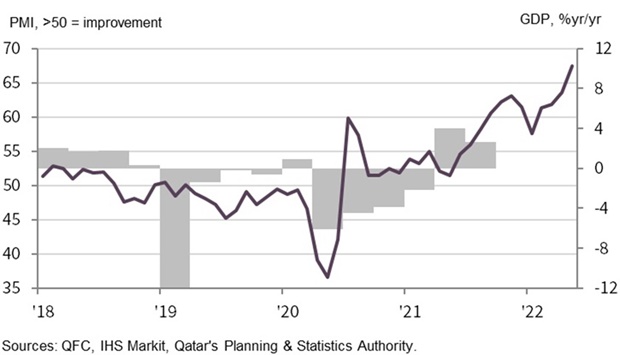
Doha signalled a "record" improvement in the operating conditions in the non-energy economy midway through the second quarter of the year, mainly due to the surging demand, according to the Qatar Financial Centre (QFC).
The latest Purchasing Managers’ Index (PMI) survey data from the QFC said output, new orders, purchasing activity and backlogs rose at the fastest rates since the survey began in April 2017, while employment expanded at a near-record rate.
Buoyant market conditions supported optimism, which improved from April's low, it said.
"Firms were optimistic that strong demand conditions would persist as we move closer towards the much-anticipated FIFA World Cup. Meanwhile, rising backlogs should support sustained output growth throughout the summer as firms work actively to clear outstanding orders that have built up especially over the last year or so," said QFC Authority chief executive Yousuf Mohamed al-Jaida.
The Qatar PMI indices are compiled from survey responses from a panel of around 450 private sector companies. The panel covers the manufacturing, construction, wholesale, retail, and services sectors, and reflects the structure of the non-energy economy according to official national accounts data.
The headline QFC PMI is a composite single-figure indicator of non-energy private sector performance. It is derived from indicators for new orders, output, employment, suppliers’ delivery times and stocks of purchases.
The PMI increased to a fresh record high of 67.5 in May, up sharply from April's previous peak of 63.6. This indicated the strongest overall improvement in business conditions in Qatar's non-energy sector since the survey began over five years ago.
A record uplift in new orders underpinned the strongest expansion in output in the survey's five-year history. There were also mentions of greater tourist activity, the upcoming FIFA World Cup, retreating pandemic restrictions and shorter lead times.
Manufacturers recorded by far the strongest uplift in output, followed by services, wholesale and retail, as well as construction, respectively.
The survey said sustained expansions in demand led to further capacity pressures at Qatari non-energy firms. Outstanding business rose at the quickest rate in the series history, accelerating sharply from the previous peak in April.
Firms sought to tame rising backlogs by lifting their headcounts at a near-record rate, it said, adding higher output requirements led companies to raise their buying activity at a survey-record rate. Stocks of purchases meanwhile rose at the fourth-strongest rate in the series history.
Firms were confident that workloads would rise over the coming 12 months, with sentiment improving in May. The upcoming FIFA World Cup and hopes of greater tourist activity were key drivers of optimism. By sub-sector sentiment was strongest among service providers.
The latest PMI data on Qatar's financial services sector signalled another sharp improvement in business activity, driven by a record uplift in new business in May.
As a result, business confidence improved to a three-month high. Supportive demand conditions encouraged firms to raise their staffing levels during the review period.
Headcounts have now risen continuously over the last nine months with the latest expansion the strongest since October 2021, it said.