



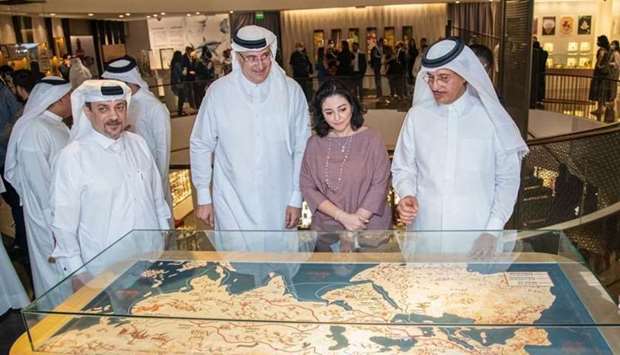
The Perfume Museum By Reem Abu Issa – the first in the region – was opened at The Pearl-Qatar recently, featuring thousands of unique collections dating back to the 1800s and 1900s.
“This is mainly a museum of commercial perfume bottles. We try to give people an idea about (perfume) ingredients and how the Arab world contributed to the development of perfumery,” museum owner Reem Abu Issa told Gulf Times.

She was speaking on the sidelines of the event, which was attended by Sheikh Hassan al-Thani, Qatar Museums (QM) CEO Ahmad Musa al-Namla, Abu Issa Holding chairman Ashraf Abu Issa, and Issa Abu Issa, as well as other dignitaries and guests.
Some of the collections include 1960 Rolex- and 1926 Rolls-Royce-inspired perfume bottles, as well as a miniature 1952 Rue de la Paix lamp post and several other French-inspired designs.
She said The Perfume Museum, which displays “valuable, rare and historically important perfumes of the past decades”, is a result of close collaboration between talented glassmakers and fashion designers “to create the most intriguing perfume bottles as objects of luxury, creativity and art”.

The museum gives visitors an opportunity to walk down memory lane “of scents and fragrance along the Silk Road – a network of trade routes connecting Asia and Europe with the Middle East as the crux”. They can also learn the process of perfume-making: “from raw ingredients to extraction, distillation, formulation, industrialisation and bottling”.
Apart from perfumes, a unique collection of early cosmetics - from Kohls and face powders to compacts and lipsticks - are also on show.

“It’s more of an interactive museum and then you get some collections and masterpieces from R Lalique and Baccarat,” Abu Issa said, adding that many items from the collection are French perfumes.
“As my family has always been in the perfume business, we were one of the first people to bring commercial perfume bottles to Qatar. As a child, I used to collect miniatures, and then I decided to collect bottles instead 20 years ago, and thought I would share it with people,” she recounted.

Abu Issa describes the museum, which she says is 20 years in the making, as “a work of art” – offering visitors an exceptional olfactory experience. “It’s nice to have something like this (The Perfume Museum) for people to maybe introduced to something different. For many, perfume is always a scent but there is more to it; so that is how it started, it is more of an artwork."
“I think it will be interesting and it’s nice to have something like this in our region, it is a special thing, I like my collection a lot and want to share it with people. It’s only for them to enjoy and I try to put as much information as I could about perfumes for them to come and maybe to learn something new,” she added.
“This is mainly a museum of commercial perfume bottles. We try to give people an idea about (perfume) ingredients and how the Arab world contributed to the development of perfumery,” museum owner Reem Abu Issa told Gulf Times.
(From left) Sheikh Hassan al-Thani, Abu Issa Holding chairman Ashraf Abu Issa, QM CEO Ahmad Musa al-Namla and Issa Abu Issa at the opening of The Perfume Museum recently
She was speaking on the sidelines of the event, which was attended by Sheikh Hassan al-Thani, Qatar Museums (QM) CEO Ahmad Musa al-Namla, Abu Issa Holding chairman Ashraf Abu Issa, and Issa Abu Issa, as well as other dignitaries and guests.
Some of the collections include 1960 Rolex- and 1926 Rolls-Royce-inspired perfume bottles, as well as a miniature 1952 Rue de la Paix lamp post and several other French-inspired designs.
She said The Perfume Museum, which displays “valuable, rare and historically important perfumes of the past decades”, is a result of close collaboration between talented glassmakers and fashion designers “to create the most intriguing perfume bottles as objects of luxury, creativity and art”.
The collections include 1960 Rolex- and 1926 Rolls-Royce-inspired perfume bottles
The museum gives visitors an opportunity to walk down memory lane “of scents and fragrance along the Silk Road – a network of trade routes connecting Asia and Europe with the Middle East as the crux”. They can also learn the process of perfume-making: “from raw ingredients to extraction, distillation, formulation, industrialisation and bottling”.
Apart from perfumes, a unique collection of early cosmetics - from Kohls and face powders to compacts and lipsticks - are also on show.
The Perfume Museum features thousands of unique collections. PICTURE: Shaji Kayamkulam
“It’s more of an interactive museum and then you get some collections and masterpieces from R Lalique and Baccarat,” Abu Issa said, adding that many items from the collection are French perfumes.
“As my family has always been in the perfume business, we were one of the first people to bring commercial perfume bottles to Qatar. As a child, I used to collect miniatures, and then I decided to collect bottles instead 20 years ago, and thought I would share it with people,” she recounted.
A miniature 1952 Rue de la Paix lamp post. PICTURE: Shaji Kayamkulam
Abu Issa describes the museum, which she says is 20 years in the making, as “a work of art” – offering visitors an exceptional olfactory experience. “It’s nice to have something like this (The Perfume Museum) for people to maybe introduced to something different. For many, perfume is always a scent but there is more to it; so that is how it started, it is more of an artwork."
“I think it will be interesting and it’s nice to have something like this in our region, it is a special thing, I like my collection a lot and want to share it with people. It’s only for them to enjoy and I try to put as much information as I could about perfumes for them to come and maybe to learn something new,” she added.