


Passengers who do not wear face mask could see their flying privileges revoked in future as some global airlines have begun vigorously enforcing policies, putting rigour around rules requiring them to wear facial coverings over their nose and mouth.
The latest to enforce face covering rules are the major carriers based in the US, who are part of the Airlines for America (A4A), the industry trade organisation representing the leading airlines in the world’s largest aviation market.
Alaska Airlines, American Airlines, Delta Air Lines, Hawaiian Airlines, JetBlue Airways, Southwest Airlines and United Airlines have announced they intended to more strictly enforce mask-wearing aboard their planes, including potentially banning passengers who refuse to wear a mask.
One airline said any passengers who don’t wear masks “will be placed on an internal travel restriction list” from June 18.
However, the rules exempt small children and people with medical conditions or disabilities that prevent them from wearing face coverings.
The announcement comes in lieu of a US federal regulation requiring all passengers to wear masks — the sort of enforceable measure that governs requirements to wear seatbelts and not smoke.
Following the outbreak of the Covid-19 pandemic, many airlines based in Europe and Asia have made it compulsory for passengers and customer-facing employees to wear facial coverings over their nose and mouth.
They have made known their intention to ban passengers who refuse to wear face masks on their flights, punctuating stricter approach to safety amid mounting concerns about the novel coronavirus infections.
A4A said those airlines will now “clearly articulate” their mask policies to customers, perhaps even requiring them to acknowledge the policy during check-in; and will make in-flight announcements about details of the policy – and the penalty for non-compliance. But the industry group did not set a uniform policy for enforcing face-mask rules.
“Each carrier will determine the appropriate consequences for passengers who are found to be in noncompliance of the airline’s face covering policy up to and including suspension of flying privileges on that airline,” A4A said.
Nicholas E Calio, A4A president and CEO, said, “US airlines are very serious about requiring face coverings on their flights. Carriers are stepping up enforcement of face coverings and implementing substantial consequences for those who do not comply with the rules.
“Face coverings are one of several public health measures recommended by the CDC as an important layer of protection for passengers and customer-facing employees.”
The measures are expected to remain in place throughout the Covid-19 public health crisis.
In general, carriers already require masks, but don’t enforce the requirements, according to The Forbes. Each day on social media, photos or reports circulate, portraying or describing aircraft filled with passengers who have decided to exercise their choice to fly mask-less, it said.
Airlines also have stepped up cleaning and disinfecting airport gate areas and aircraft interiors to help reassure passengers that it’s safe to fly, and some are even limiting the number of tickets sold to allow for distancing among travellers.
Leading global airlines have their aircraft now equipped with HEPA filters, which help generate hospital-grade air quality.
The Centers for Disease Control and Prevention (CDC), which is the leading, national public health institute of the United States, recently said, “Because of how air circulates and is filtered on airplanes, most viruses and other germs do not spread easily on flights.”
Carriers have implemented intensive cleaning protocols, in some cases to include electrostatic cleaning and fogging procedures. Carriers are working round the clock to sanitise cockpits, cabins and key touchpoints – including tray tables, armrests, seatbelts, buttons, vents, handles and lavatories – with EPA-approved disinfectants.
Airlines have increased the frequency of deep cleaning procedures for both domestic and international flights.
They have also implemented a range of policies – including back-to-front boarding and adjusting food and beverage services – to help allow for distancing between people.
Meanwhile, industry analysts say face masks are essential to keep passengers, flight attendants, and frontline aviation workers safe during the Coronavirus pandemic.
They see the hardline adopted by some major global carriers as one that underscores the airline industry’s push to ensure the use of masks as passengers start venturing back onto planes after a collapse in travel demand caused by the coronavirus pandemic.
“This may well become the new industry standard, new normal — globally,” an analyst said.
* Pratap John is Business Editor at Gulf Times. Twitter handle: @PratapJohn
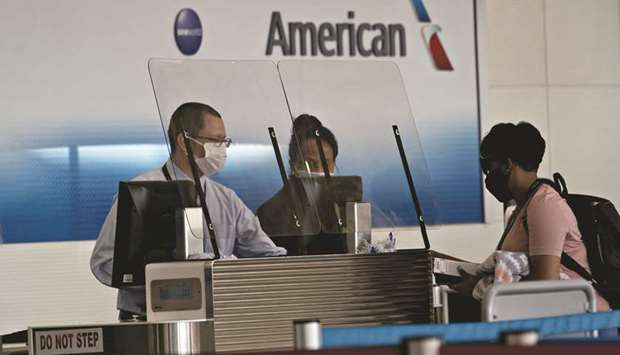
An American Airlines Group worker wears a protective mask and stands behind a protective barrier while checking in a traveller at Ronald Reagan National Airport in Arlington, Virginia, US. American Airlines, Alaska Airlines, Delta Air Lines, Hawaiian Airlines, JetBlue Airways, Southwest Airlines and United Airlines have announced they intended to more strictly enforce mask-wearing aboard their planes, including potentially banning passengers who refuse to wear a mask.