



The Qatar Renminbi Centre (QRC), a physical financial gateway to China, is all set to gain further traction as Qatar Inc is eager to establish a large commercial presence in China, especially in energy and aviation; even as it said the present pandemic will not impede Doha’s long term trajectory.
“As Qatar China relationship continues to blossom, the QRC will increasingly act as a financial intermediary between these vibrant and growing economies,” said the Qatar Financial Center (QFC), under which operates the QRC, which is the first in the Middle East and North Africa and the sixth oldest settlement and clearing facility of the Chinese currency in the world.
These direct investments are likely to include energy and aviation infrastructure as well as others that could directly complement Qatari investors’ overseas strategies as they expand commercially and deepen connections with key trading partners, it said.
“In the short-term, hiccups derived from the ongoing coronavirus (Covid-19) epidemic may slow down progress, however this will not impede its long-term favourable trajectory,” the report said.
Forecasting that QRC is primed for growth, as trade volumes increase and as it diversifies the type of transactions it hosts to include more investment activities; it said the projected uplift in transactions would not only introduce further vibrancy and liquidity into QRC, but it would also foster commercial ties between China and Qatar.
“The QRC is poised to enlarge as it branches out to cater to new and evolving client’s needs,” the report said.
Highlighting that one immediate area of potential growth is in goods and services, which is projected to expand robustly over the near-term horizon; it said by engaging in RMB invoicing, the Qatari corporates stand to grow their profits.
“As Qatar-China commercial links expand further, and trade volumes travelling through Qatari ports rise, there is destined to be more trade-related transactions hosted on the QRC,” it said.
As of 2019, only 0.76% of QRC transactions were connected to trade transactions, representing 1.5% of all Qatar-China goods trade in the same year. This is in contrast to the global benchmark, which as of August 2019 stood at 2.22% of RMB’s use in payments (for both goods and services).
The QRC allows Qatari establishments to directly access China’s onshore RMB, foreign exchange, and capital markets. “Qatari corporates stand to benefit directly from transitioning to the use of RMB in their transactions. It is proven that increased use of RMB results in reduced costs, facilitation of commercial discussions and relations, as well as enablement of access to a larger supplier base in China,” QFC said.
Qatari merchants stand to source existing and increasingly complex products directly from China through their use of RMB invoicing, it said, adding beyond the geographical limits of Qatar, merchants here stand to benefit from the country increasing re-exports to East Africa and beyond through agreements with MSC to use Hamad Port as a transshipment hub.
The Chinese focus on expanding trade flows to the wider region can complement simultaneous Qatari corporate and banking activity, according to the report.
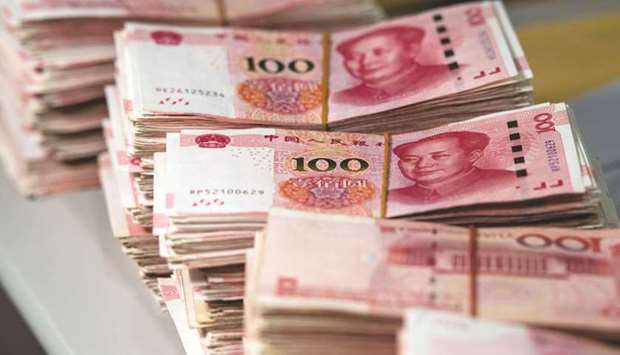
Chinese currency notes at a bank in Shanghai. The Qatar Renminbi Centre allows Qatari establishments to directly access China’s onshore RMB, foreign exchange, and capital markets.