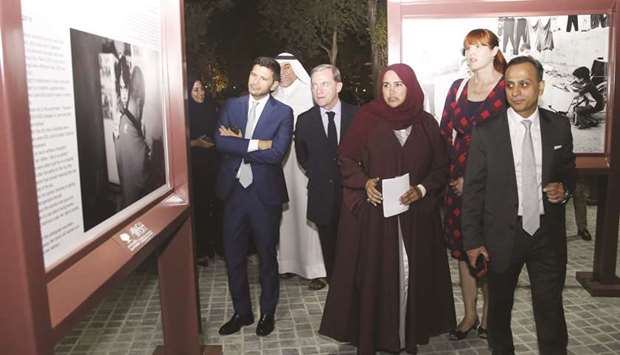


The World Innovation Summit for Health (WISH), an initiative of Qatar Foundation (QF), has opened the ‘Artistic Dimensions to a Healthier World’ exhibition at the Doha Fire Station yesterday, showcasing the works of award-winning British photographer Giles Duley.
Besides displaying the artworks created by refugee Rohingya children, as part of a project by UK-based humanitarian charity, Save the Children, the exhibition also witnessed the launch of the Arabic version of the Paediatric Blast Injury manual.
“Last November, to coincide with WISH 2018, we produced a report on Healthcare in Conflict Settings. That report emphasised the importance of giving a voice to people who are forced to suffer health challenges in war zones,” said WISH CEO Sultana Afdhal at the opening of the exhibition.
The event was attended by Sheikh Dr Mohamed bin Hamad al-Thani, director of Public Health Department at the Ministry of Public Health, Doha Fire Station director Khalifa al-Obaidly, officials from organisations including WISH, Save the Children, health charity Emergency ... and a number of diplomats from various missions in Doha. “Our new exhibition shines a spotlight on such people, their families, and their communities. It does so through the photography of Giles Duley, who himself suffered significant injury when he stepped on a landmine while on photographic assignment in Afghanistan,” she noted.
“From the very start of his recovery, and having lost both legs and one arm, Giles pledged to pick up his camera with his one remaining hand to document the lives of others around the world whom he considers to be worse off than himself,” Afdhal said.
The exhibition, which will run from today (October 2) until October 27, explores the relationship between art and health with Duley’s photographs, highlighting the long-term impact of war, particularly to children.
Among those who were photographed included Vanthy So, who lost both hands when handling an unexploded ordnance in 1989 (18 years old then) in Cambodia; Baraq Qahtan Dharee, who lost both legs when his parents stepped on a landmine in Iraq and died; and Sapalo (Angola), who also lost both his legs after an rocket propelled grenade he found in his uncle’s room exploded.
Duley’s work includes an indoor collection dubbed as ‘Iraq: An Open Wound’, which depicts healthcare and rehabilitation efforts in Mosul by health charity, Emergency; and an outdoor exhibit titled ‘Disability and Armed Conflict’, which provides an insight into the lives of people with disabilities during armed conflict. Afdhal also lauded the efforts of Save the Children saying it has been instrumental in producing a manual that helps doctors in the field treat children who suffer blast injuries.
She said that a very different perspective in health in conflict settings comes through the art of refugee Rohingya children forced to flee their homes and live in camps in Cox’s Bazaar in Bangladesh. “I’m delighted that some of the team from Cox’s Bazaar are here with us this evening and that we’ve managed to get some of the children’s original artwork out of the camp for you to see as part of the exhibition,” Afdhal said. “Increasingly ... tragically ... those who suffer through conflict are children.
“Their opportunity to play, to learn and to develop in a positive environment being cruelly taken from them through no fault of their own,” she said.
Qatar / Qatar
WISH exhibition highlights the works of award-winning photographer Giles Duley