



Many airlines seem to have hit the air pocket due to a rebound in jet fuel prices, which last week climbed to a six-month high of $85 per barrel.
Soaring jet fuel prices are obviously due to rising oil prices, which is dealing severe blows to the financial fortunes of the global airline industry.
Industry experts say fuel costs constitute roughly one-third of an airline’s operating costs. Hence, a marginal change in crude oil prices can significantly impact its profitability.
Jet fuel prices have long driven airline profitability and the aviation industry as a whole, representing between 14% and as much as 31% of airline operating costs in the past decade, an estimate shows.
Consequently, airlines hedge a large portion of their annual fuel consumption at lower oil prices in order to protect themselves from the volatility in oil prices.
As fuel costs rise, airlines globally may be forced into a difficult balancing act of trying to raise ticket prices to cover the extra costs without pricing themselves out of the generally price-sensitive market.
Last year, the airline industry would have forked out nearly $190bn on fuel costs, based on an International Air Transport Association estimate, which had made calculations on $70 per barrel average.
Early this month, the United States ended the waivers it had granted some countries that enabled them to continue to import crude oil from Iran, despite the US sanctions.
Immediately after the announcement, oil prices rose significantly, rising back to more than $75/b at one point, in response to the prospect of 1.2mn-1.3mn barrels per day (mbpd) of oil supply being removed from the market.
Some Opec producers have said they will add supply, but only after they see the impact of Iran losses on the market.
The consequence is “uncertainty, or rather more uncertainty than usual”, over the price of jet fuel this year, according to IATA, the global trade body of airlines.
Oil prices remain under pressure as the fears of supply disruption augmented amid heightened tensions in the Middle East.
However, finance managers at various airlines could heave a sigh of relief, if an IATA estimate is anything to go by.
According to economists’ at the trade body, the futures market still indicated oil prices to remain “relatively stable” for the rest of the year. The December 2019 future contracts hover around $69-$70, they said.
That said, the airline industry’s financial fortunes already suffered blows in the first quarter of this year from oil and jet fuel price increases and pressure on both premium and economy cabin yields.
In its December 2018 forecast, IATA said the airline industry profitability would stabilise this year close to 2018 levels. But that forecast was based on Brent crude oil prices averaging $65/b in 2019.
Currently, however, they are $5/b higher and have been more than $10/b higher recently.
The impact in 2019 of higher crude oil spot prices will depend on the crack spread, fuel hedging, the extent cost increases can be passed through to consumers and mitigating measures by airlines. IATA economists have assumed no change in the crack spread and that 50% of fuel consumption is hedged.
With no pass-through to consumers or mitigating measures, each $5/b increase in the price of jet fuel reduces industry net profit margins by around 0.5% points.
In a recent interview with Gulf Times, Qatar Airways Group chief executive Akbar al-Baker said his airline was keeping a “close watch” on the fuel price.
“At the moment, we are fine. But we don’t know what is in store, when it comes to fuel price,” al-Baker said when I had asked him whether the national carrier intended to pass on the rising fuel charge burden to passengers.
“The fuel price (in general) depends so much on both political and economic conditions around the world. We hope it won’t really rise too much to impact our performance,” the airline boss said.
Asked what the impact would be on jet fuel because of the rising tension between the US and Iran, he said, “I don’t want to talk about politics, but as an airline, I will keep a very close watch on fuel price.”
In a higher price regime, airlines tend to favour new generation fuel efficient aircraft to older big birds, which perhaps explains the resurgence seen in the orders of Airbus A320neo and Boeing 737 MAX families in the last few years.
But many airlines, which were relying on Boeing 737 MAX deliveries, got a jolt when regulators worldwide grounded the aircraft in the wake of the Max crashes in Indonesia in October last year and Ethiopia in March.
This has left some 400 Boeing 737 MAX planes idled around the world!
IATA’s Financial Monitor suggests that overall profits for the industry fell again in Q1, 2019, compared to the same period last year, in initial financial results.
However, the outcome was mixed at the regional level, the report says. North and Latin America both enjoyed “broad stability” while Asia Pacific saw its profits picture improve.
Europe, on the other hand, appeared to have suffered a significant weakening although the report noted that the sample to date was small.
* Pratap John is Business Editor at Gulf Times.
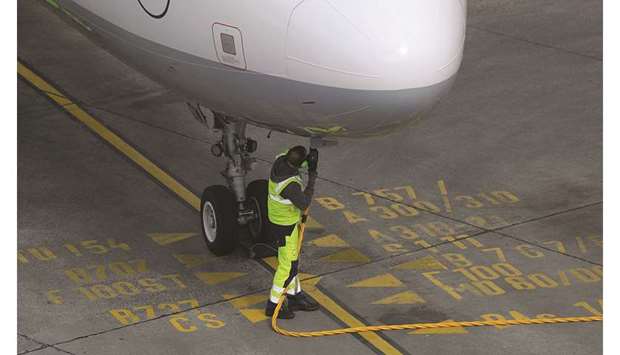
A ground crew member connects a fuel hose to an Airbus A321 aircraft at Tegel airport in Berlin, Germany. Jet fuel prices have long driven airline profitability and the aviation industry as a whole, representing between 14% and as much as 31% of airline operating costs in the past decade, an estimate shows.