



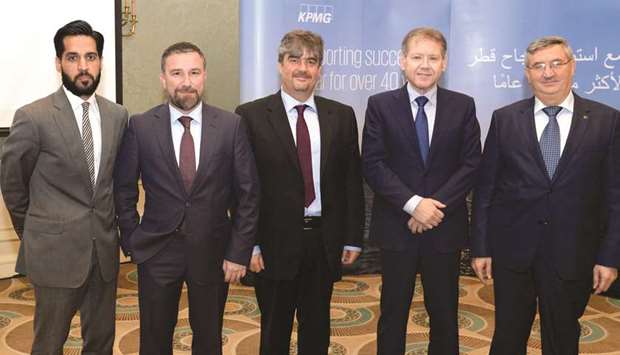
“We are aware of three” (Qatari companies pursuing stake purchase options in Turkish firms), KPMG in Qatar country senior partner Ahmed Abu-Sharkh told media on the sidelines of a Qatar-Turkey trade and investment opportunities seminar where the Turkish ambassador Fikret Ozer delivered the keynote address.
Among the top 10 foreign direct investment (FDI) in Turkey is the Qatar Investment Authority and BRF joint venture’s 92% stake in the food and beverage entity Banvit for $470mn.
Highlighting that Qatar’s investment focus has initially been on Turkey’s financial and real estate sectors; he said it is increasingly turning into food security and agriculture.
An investor may execute an acquisition in Turkey either through acquisition of a company (share deal) or acquisition of a certain business (asset deal). There are no general government controls or restrictions on investments in assets, business entities or acquisition of other rights in Turkey.
However, certain specific business activities require a regulatory approval before change of ownership (such as banking and insurance, telecommunications, production and distribution of energy). A merger or acquisition transaction may also trigger approval requirement from Turkish Competition Board based on certain criteria.
“With Qatar’s economy on a clear upwards trajectory, many businesses are looking overseas to bolster growth and for ways to enhance their local operations and Turkey’s economic and regulatory profile make the country an ideal destination for both investment and trading,” he said.
Abu-Sharkh said the proposed acquisition move is in agriculture and light industries. However, he refused to divulge further details citing confidentiality.
Highlighting that Qatari interests on acquisitions had seen a pause for a little while due to the economic blockade, he however said the interest has started to rise and will continue.
“Looking ahead, we believe strong fundamentals of the Turkish market will again support the M&A (merger and acquisition) landscape in the coming period,” he said in a presentation made at the seminar.
Total FDI inflows into Turkey were at about $11bn by the end of 2017, which however showed a 19% decline year-on-year. The majority of the deals in 2017 were in small and mid-market as 186 of 298 transactions was of size less than $10mn.
“Over the past years, we have been observing a significant increase in investments from Qatar and we are pleased that Qatar and Turkey are increasingly developing their business relations,” according to Eray Buyuksekban, head of International Tax (KPMG Turkey).
Most FDI come from the European region, but of late the relationship between Qatar and Turkey has become closer than ever, Tayfun Pisirir, deal advisory partner (KPMG Turkey) said, hinting at the greater potential for Qatar’s role in Turkey’s M&A landscape.
Investment incentives are applicable to foreign investors in Turkey’s free trade zones, technology development zones and in underdeveloped regions or incentivised sectors.