


HE the Minister of Foreign Affairs Sheikh Mohamed Abdulrahman al-Thani delivered a keynote speech at the opening of the two-day event.
HH the Emir also met dignitaries present during the event, including the Swedish State Secretary for Foreign Affairs Annika Soder, Somalia’s Minister for Foreign Affairs Yusuf Garaad Omar, High Representative of the UN Alliance of Civilisations and representative of the UN Secretary-General in the forum Nassir bin Abdulaziz al-Nasser, head of the Turkish Parliament's Foreign Affairs Committee Taha Ozhan and Brookings Institution executive vice- president Martin Indyk.

His Highness the Emir Sheikh Tamim bin Hamad al-Thani meets the delegates of US-Islamic World Forum.

His Highness the Emir Sheikh Tamim bin Hamad al-Thani meets Swedish State Secretary for Foreign Affairs Annika Soder.

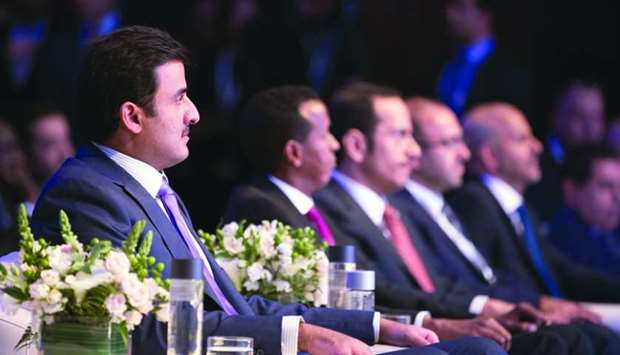
A view of the audience at the US-Islamic World Forum at Conrad Hotel, New York City

His Highness the Emir Sheikh Tamim bin Hamad al-Thani meets Somalia Minister for Foreign Affairs Yusuf Garaad Omar
HH the Emir’s meeting covered several issues of mutual concern, specifically the topics to be discussed at the forum such as ‘Stabilisation in the Middle East and North Africa (Mena)’; ‘The Future of Pluralism, Citizenship, and Religion in the Middle East’; ‘Refugees and Cities’; and ‘Counter-terrorism’.
In his speech, Indyk thanked His Highness the Emir for supporting the forum, which assembled some of the world's leading scholars and policy makers to deliberate on pressing global issues. He stressed on the need to “continue to build bridges” between the international communities to counter the negative impact of terrorism.
“It has been a long and difficult world and we still have a long way to travel before we could say that we have succeeded in building those bridges but we have not desisted from it,” Indyk pointed out.
The forum has come full circle as this year's annual gathering is being held just a stone's throw away from the 9/11 memorial. According to Indyk, the forum was established by Brookings scholars in the wake of the 9/11 attacks seeking to understand the dynamics that drive relations between the US and the Islamic world.
“World leaders at the UN will be meeting in the coming weeks to deliberate on major issues that confront us all. Among them, bringing an end to the ruinous wars raging in the Mena region, dealing with the immediate consequences of the region's instability, including local and transnational terrorism and large-scale refugee flows, and pursuing a dialogue about a more inclusive politics that can leave the region and the broader Muslim world less vulnerable to these convulsive forces.
“These are the subjects that we will focus on over the next two days in our deliberations in this forum. There could be no more important nor urgent task for all of us,” Indyk said.
He added: “We at Brookings believe that to do this, we need to start by listening to each other; and the purpose of this forum is to hear diverse points of views and listen to them and generate bridges of understanding out of that.
“If we've learned anything in the past decade and a half, it is that we're all affected by these issues whether we want to be or not and that they cannot be resolved without finding ways to work together.”
Bruce Jones, vice- president and director of the Foreign Policy programme at the Brookings Institution said: “This year, we are happy to bring the event to the sidelines of the UN General Assembly in New York, since these challenges are truly at the centre of world events. The Forum is an opportunity for frank exchange and thoughtful dialogue to help chart better ways to address some of the major issues we confront today.
The forum, which carries theme ‘Crisis and Cooperation’, brings together leaders in politics, business, media, academia, and civil society from across the Islamic world (including Muslim communities in Africa, Asia, Europe, and the Middle East) and the US.