


Saad Sherida al-Kaabi
Qatar will merge its two giant liquefied natural gas (LNG) producers Qatargas and RasGas to create a world-scale entity ‘Qatargas’ with a combined annual LNG production capacity of about 79mn tonnes, which could not only see substantial savings in operating costs but also reaffirm the country’s pre-eminent position in the global LNG business.
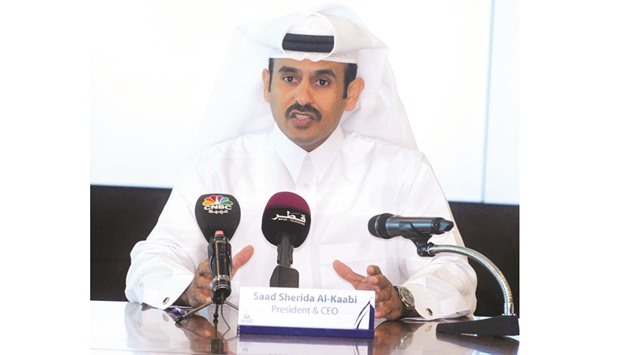
The integration, which will start soon, is expected to be completed in a year, after which a new chief executive would be appointed, said Saad Sherida al-Kaabi, president and chief executive of Qatar Petroleum (QP), which is the strategic shareholder of both the companies.
“It has been decided to merge RasGas and Qatargas into one company under the name Qatargas. The integration aims to create truly unique global energy operator in terms of size, service and reliability,” he told reporters in the presence of representatives of main global shareholders who part of the companies’ LNG trains.
Recently, al-Kaabi said QP is aiming at further reduction to its operating costs to improve efficiency as the hydrocarbon industry redefines itself in the wake of low oil economic order.
Qatargas has a production capacity of 42mn tonnes per annum from its seven LNG trains and RasGas, which also has seven trains, has approximately 37mn tonnes per annum capacity, according to their websites.
The integration, which would enhance cost efficiency per unit of output, comes in the wake of reorganisation of QP.
The idea (behind merger) is to ensure best business model for the LNG business, he said, adding the integration would lead to substantial savings in operating costs but that alone was not the key consideration.
Highlighting that only the operating companies would be integrated, he said it would in no way affect the relationships with global hydrocarbon majors such as Total, Shell, ConocoPhillips and ExxonMobil, which have stakes in the various LNG trains that fall under both Qatargas and RasGas.
“The existing operations group within both companies will not be impacted at all by the integration, as the highest priority is given to ensuring safe, seamless and risk-free business continuity,” he said, adding it would make Qatar more competitive in the global gas industry.
Al-Kaabi said there would not be any change in size of the personnel on the operation side is concerned, post integration of operations.
“The area where we are ring-fencing and we are not going to touch, as far as manpower is concerned, is the operations side. There is a very good reason for that,” he said, affirming that all Qatari nationals in both companies would be integrated into the new dispensation.
There may be areas that need lower number of people and there may be areas where it requires more and the objective is not to target any but to bring the best out of the existing resources and optimise, he said.
“The collective resources, talents and capabilities of two global leaders will be joined to create an even more effective and efficient organisation to uphold the best interest of Qatar, our customers and our shareholders,” he said.