



Unabated use of pesticides poses a threat to various species of falcons, according to a veteran zoologist who has produced a documentary on falcons, which was shot mostly in Qatar.
Dr Zubair Medammal, a falcon researcher and assistant professor of the University of Calicut’s Department of Zoology, told Gulf Times that in the wild, falcons are prone to the effects of pesticides.
“Falcons are carnivorous hence they are susceptible to feeding on pesticide-contaminated prey,” he said, explaining that pesticides could lead to thinning of the falcon’s eggshell.
“Thin eggshells will result in breaking or unhatched eggs, which would also affect the falcon’s breeding cycle and lead to a decline in the falcon population,” Medammal noted, adding that the life span of falcons in the wild is 12 to 15 years.
Arab falcon breeders, on the other hand, use “sophisticated” breeding facilities, Medammal said. “They will use these falcons during the winter for hunting and other competitions, while in the summer, they will start breeding.”
Also, their moulting season is during summer, said Meddamal, whose doctoral research was on the topic “Biology and Behaviour of Falcons with Emphasis on Breeding and Healthcare in Captivity.”
“During this season, owners take special care of their falcons and it is a costly process. In many cases, they will focus on the falcons and live in the desert,” said Medammal, who was the only Indian who participated in Qatar’s “7th International Falcons and Hunting Festival” (Marmi) in January.
Medammal emphasised that hunting “is an integral part of Qatari heritage.” He said Qataris “put a lot of importance” on falcon breeding.
“Qataris import many species of falcons to the country and breed them in many centres all around the country. There is big business in falcon breeding. Many Arabs from Gulf countries such as Qatar import these raptors from Europe and crossbreed them with different species,” he said.
“Arab sheikhs also compliment other sheikhs with very expensive falcon species. They are the costliest creatures in the world. In Kuwait, one raptor was purchased by the royal family for approximately QR2.7mn. To buy the most capable hunter, one has to spend a large amount,” he said.
Medammal also lauded the efforts of the Qatar Society of Algannas in Katara for helping promote falconry among Qatari youth. He is in talks with Algannas to produce 100,000 DVD copies of a 30-minute documentary on falcons and distribute them for free to students.
“I would like to supply my research for free to students to promote the importance of falconry and to preserve and conserve this endangered species,” he stressed, adding that the documentary entitled “Falcons and Falconry in the Arabian Gulf” is available in English, Arabic and Malayalam languages.
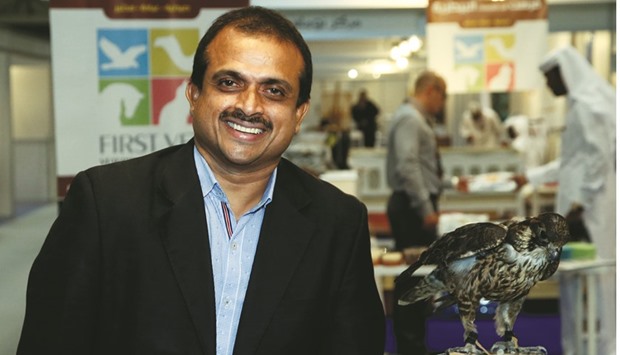
Falcon researcher Dr Zubair Medammal. PICTURE: Jayaram