Opinion

Saturday, February 14, 2026 | Daily Newspaper published by GPPC Doha, Qatar.
Gulf Times

Education Excellence Award: 20 years of outstanding contributions to Society

The State of Qatar believes that investing in human capital through education is the optimal and sustainable investment for present and future generations, as education is a fundamental pillar of the State’s Permanent Constitution and building educated individuals capable of achieving academic excellence, contributing to national development, and creating a prosperous future for all is among the foremost objectives of Qatar National Vision 2030.There is no doubt that the progress and renaissance of nations depend on the quality of their education and the strength of their educational systems. In embodiment of this vision, the Qatar Education Excellence Award was launched in 2006 to honour academically outstanding Qatari students, foster and reinforce a culture of excellence and innovation within society and the educational field, motivate high achievement, and improve educational outcomes in line with international standards.Academic honourThe award has become the highest academic honour in the country, aiming to build a knowledge-based human capital capable of meeting future challenges, while also promoting positive attitudes toward knowledge and scientific research. The award, whose 20th anniversary the State of Qatar, represented by the Ministry of Education and Higher Education, will celebrate next Sunday, is not merely a means of honouring outstanding and distinguished achievers. It also stands as a testament to the efficiency and quality of Qatar’s educational system, and as clear evidence of the capabilities of all its members.During the ceremony, 108 winners will be honoured across the award’s nine categories: the Excellence Award for Primary School Students, the Excellence Award for Intermediate School Students, the Excellence Award for Secondary School Students, the Outstanding Teacher Award, the Outstanding School Award, the Distinguished Research Award, the Excellence Award for University Graduates, the Excellence Award for Master’s Degree Holders, and the Excellence Award for Doctorate Holders.In this context, the Executive Committee of the Qatar Education Excellence Award announced on Jan 6 the results of the 19th edition, following their approval by the Award’s Board of Trustees, chaired by HE Minister of Education and Higher Education Lolwah bint Rashid AlKhater. The results revealed that 108 candidates were selected from a total of 371 applicants in this cycle, an indicator reflecting the rising level of competitiveness, the high quality of submissions, growing awareness of the award’s criteria and requirements, and a demonstrated commitment to meeting them, in alignment with Qatar’s vision of building a qualified and capable human capital.The results also reflected notable diversity in the educational institutions represented by the winners, including students from public, private, and specialized schools, as well as from civilian and military universities and various colleges, further highlighting the broad base of excellence and the widespread culture of achievement across the country’s educational institutions.The current cycle will witness the introduction of a gold medal in addition to the platinum medal for the doctoral category, which had previously been limited to the platinum medal only. Moreover, for the first time, a platinum medal has been introduced for master’s degree students, in addition to the gold medal that had already been awarded in previous cycles.As for the Research Award designated for secondary school students, a platinum medal has also been approved alongside the gold medal granted in past years. The Ministry of Education and Higher Education announced last September the adoption of the new title for the award in its 19th edition, which will henceforth be known as the Qatar Education Excellence AwardThe adoption of the new title coincided with the launch of a new visual identity under the slogan ‘A New Identity and Promising Horizons’, as well as an increase in the financial rewards starting from the current cycle.The award is also preparing to introduce three new categories: Educational Leader, the Diploma Holders, and the Educational Research categories. These will come into effect beginning with the twenty-first cycle in 2028. These additions represent a qualitative expansion in the scope of the award and serve to recognize educational leadership and research and applied contributions in the field of education.This year’s edition witnessed outstanding participation and high-quality contributions, which confirmed the status of the Qatar Education Excellence Award as a national platform that promotes the value of serious quality and innovation, and contributes to preparing distinguished national role models capable of contributing positively to the development process.The overall win rate in this round was close to the average win rates recorded during the past five rounds, which confirms the consistency of the adopted evaluation methodology. The award was limited to candidates who achieved the approved score for winning, following thorough and comprehensive evaluation processes that included carefully reviewing files, conducting interviews with candidates, and giving each candidate their full right to evaluation, thus ensuring the highest levels of fairness, objectivity, and equal opportunities, and enhancing confidence in the award’s outcomes and credibility.As in previous editions, the results of this round showed the impact of a supportive family environment on the continued excellence of some winners. In some cases, more than one person from the same family won the award, within the approved evaluation criteria for the award. The Qatar Education Excellence Award highlighted the role of parents in education and upbringing, especially in light of their contributions to their children’s education.Equal opportunitiesThe award, through the diversity of its categories, affirms the comprehensiveness of the concept of excellence and its extension across different educational stages, thereby promoting equal opportunities and motivating society to invest in education and knowledge as a fundamental pillars of development.For all these reasons, the 19th edition of the Qatar Education Excellence Award represents a milestone in the award’s journey since its establishment in 2006. The launch of a new visual identity for the award reflects both authenticity and modernity, while the adoption of its new official name reinforces its national dimension and enhances its regional and international presence.There is no doubt that what the Board of Trustees has approved by raising the value of the prizes for the winners starting from this edition represents an investment in the Qatari people. All these steps are part of a comprehensive development project launched in 2023, with the aim of making the award more consistent with Qatar National Vision 2030, and expanding its scope to include new segments of the educational community with a well-established arbitration system based on fairness and transparency.Since its inception in 2006, the award has honoured more than 1,300 distinguished individuals across various categories. The Ministry of Education and Higher Education affirms that the new identity, the updated name, the increased value of the rewards, and the introduction of new categories all represent a renewed launch for the award’s journey, consolidating its national and regional standing and making it a platform for creativity and inspiration for future generations.


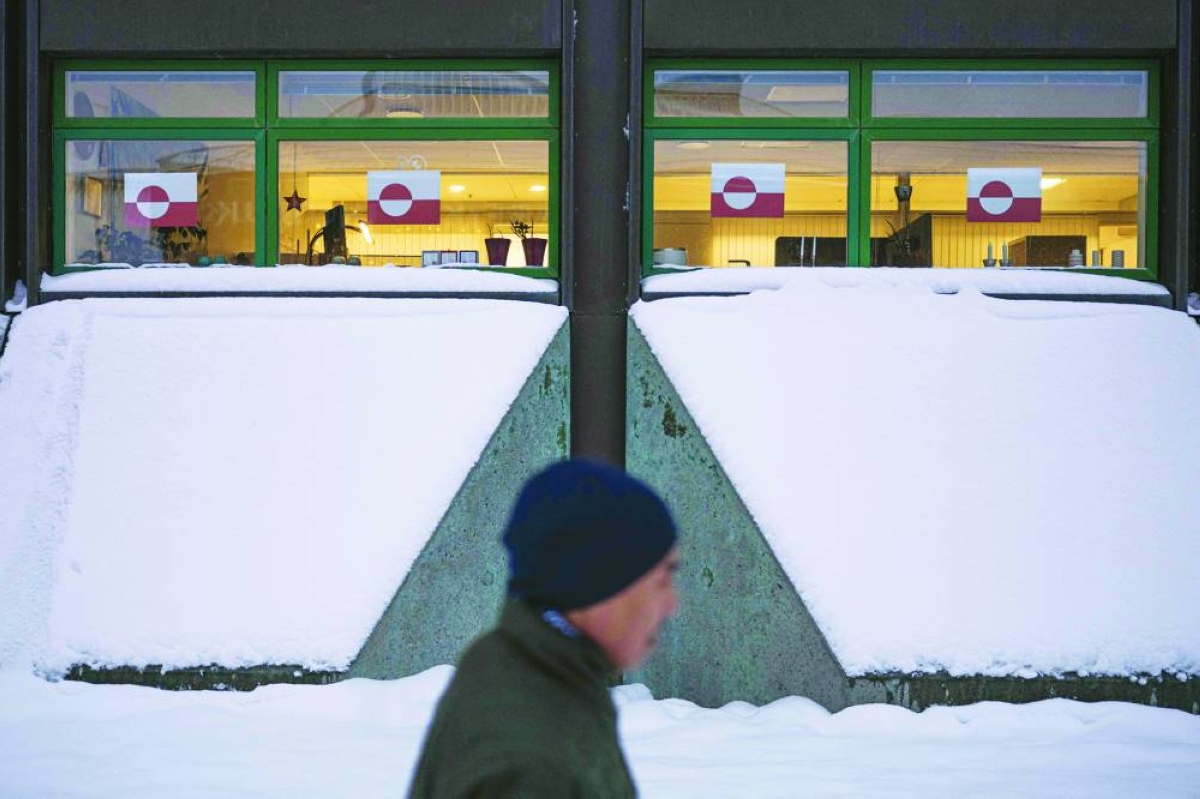
A man walks past a building with Greenland flags hanging in the windows in downtown Nuuk, Greenland.

Greenland villagers stay focused on ‘normal life’ amid stress of US threat

Proudly showing off photographs on her tablet of her grandson’s first hunt, Dorthe Olsen refuses to let the turmoil sparked by US president Donald Trump take over her life in a small hamlet nestled deep in a Greenland fjord. Sarfannguit, founded in 1843, is located 36km east of Sisimiut, Greenland’s second-biggest town, and is accessible by boat in summer and snowmobile or dogsled in winter if the ice freezes. The settlement has just under 100 residents, most of whom live off from hunting and fishing. On this February day, only the wind broke the deafening silence, whipping across the scattering of small colourful houses. Most of them looked empty. At the end of a gravel road, a few children played outdoors, rosy-cheeked in the bitter cold, one wearing a Spiderman woolly hat. “Everything is very calm here in Sarfannguit,” said Olsen, a 49-year-old teacher, welcoming AFP into her home for coffee and traditional homemade pastries and cakes. In the background, a giant flat screen showed a football match from England’s Premier League. Olsen told AFP of the tears of pride she shed when her grandson killed his first caribou at age 11, preferring to talk about her family than about Trump. The US president has repeatedly threatened to seize the mineral-rich island, an autonomous territory of Denmark, alleging that Copenhagen is not doing enough to protect it from Russia and China. He nevertheless climbed down last month and agreed to negotiations. Greenland’s health and disability minister, Anna Wangenheim, recently advised Greenlanders to spend time with their families and focus on their traditions, as a means of coping with the psychological stress caused by Trump’s persistent threats. The US leader’s rhetoric “has impacted a lot of people’s emotions during many weeks”, Wangenheim told AFP in Nuuk. ‘Powerless’Olsen insisted that the geopolitical crisis — pitting Nato allies against each other in what is the military alliance’s deepest crisis in years — “doesn’t really matter”. “I know that Greenlanders can survive this,” she said. Is she not worried about what would happen to her and her neighbours if the worst were to happen — a US invasion — especially given her settlement’s remote location? “Of course I worry about those who live in the settlements,” she said. “If there’s going to be a war and you are on a settlement, of course you feel powerless about that.” The only thing to do is go on living as normally as possible, she said, displaying Greenland’s spirit of resilience. That’s the message she tries to give her students, who get most of their news from TikTok. “We tell them to just live the normal life that we live in the settlement and tell them it’s important to do that.” The door opened. It was her husband returning from the day’s hunt, a large plastic bag in hand containing a skinned seal. Olsen cut the liver into small pieces, offering it with bloodstained fingers to friends and family gathered around the table. “It’s my granddaughter’s favourite part,” she explained. Fishing and hunting account for more than 90 percent of Greenland’s exports. No private propertyBack in Sisimiut after a day out seal hunting on his boat, accompanied by AFP, Karl-Jorgen Enoksen stressed the importance of nature and his profession in Greenland. He still can’t get over the fact that an ally like the United States could become so hostile towards his country. “It’s worrying and I can’t believe it’s happening. We’re just trying to live the way we always have,” the 47-year-old said. The notion of private property is alien to Inuit culture, characterised by communal sharing and a deep connection to the land. “In Greenlandic tradition, our hunting places aren’t owned. And when there are other hunters on the land we are hunting on, they can just join the hunt,” he explained. “If the US ever bought us, I can for example imagine that our hunting places would be bought.” “I simply just can’t imagine that,” he said, recalling that his livelihood is already threatened by climate change. He doesn’t want to see his children “inherit a bad nature — nature that we have loved being in — if they are going to buy us”. “That’s why it is we who are supposed to take care of OUR land.”