


Qatar, whose total insurance premium is $3bn, could expect to substantially enhance it only through increased penetration of life cover as mandatory health insurance alone is not sufficient, according to Switzerland-based Dr Schanz, Alms and Company.
Observing insurance as a striking example of low penetration in the financial services, Qatar Financial Center (QFC) chief executive Yousuf Mohamed al-Jaida said at annual premiums of close to $3bn, the sector accounts for just 1.5% of Qatar’s gross domestic product against the global average of more than 6%.
“The gap (between Qatar’s penetration level and global average) is due to lack of demand for life insurance,” Kai-Uwe Schanz , chairman of Schanz and Company, said at a function to launch the Middle East and North Africa (Mena) Insurance Pulse, sponsored by the QFC.
Highlighting that life insurance in Qatar constitutes far less than 10% of the total pie compared to 60% globally, he said unless this issue is addressed, it would be tough for Qatar to close the penetration gap. “A compulsory health insurance alone will not be sufficient,” he added.
The Pulse said the Mena region is a $54bn insurance market, of which Qatar’s share is 5%, but bigger than Egypt’s and slightly smaller than Morocco’s.
There are still major cultural and institutional obstacles to insurance growth that need to be dealt with through promoting Shariah-compliant takaful insurance and enhancing regulatory frameworks, al-Jaida said.
Highlighting that the “potential is undoubtedly there”, particularly in retail insurance, he said the (Qatar) government is committed to supporting the industry’s growth by transferring additional risk management and provisioning tasks to private insurers, for example in the area of healthcare.
Considering the huge funding needs for infrastructure and given that banks are under pressure to curtail long-term lending on regulatory and de-leveraging forces, he said insurers and pension funds are ideally suited to provide long-term asset base, filling the infrastructure financing gap.
Highlighting that insurers help to accumulate and invest almost $30tn globally, making them one of the world’s largest institutional investors, he said “this crucial role in financial intermediation is particularly relevant to Qatar, which is in the process of developing broader and deeper domestic capital markets as well as a stronger savings culture.”
Terming Qatar’s medium-term economic outlook as “positive,” al-Jaida said large infrastructure investments and increased production in non-hydrocarbons are set to support the continued economic expansion and strong fiscal reserves, and the ability to issue debt at attractive terms could generate additional resilience.
“This also augurs well for Qatar’s insurance sector as economic growth is arguably the biggest single determinant of insurance premium growth,” he said, adding the ongoing economic diversification would lead to a changing risk landscape and, accordingly, new opportunities for insurers and re-insurers.
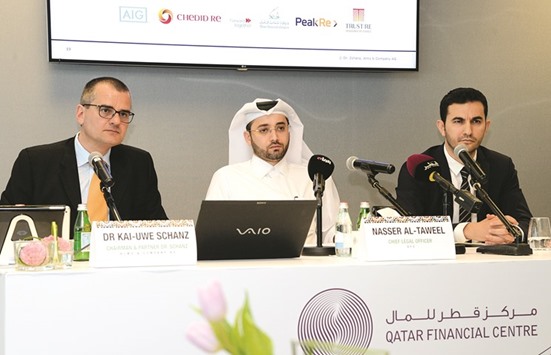
From left: Schanz; al-Taweel and Gokhan Celik, head of banking at QFC, unveil the Mena Insurance Pulse.