Opinion

Friday, February 27, 2026 | Daily Newspaper published by GPPC Doha, Qatar.
Gulf Times

Israel’s looming ban on 37 global NGOs a test case

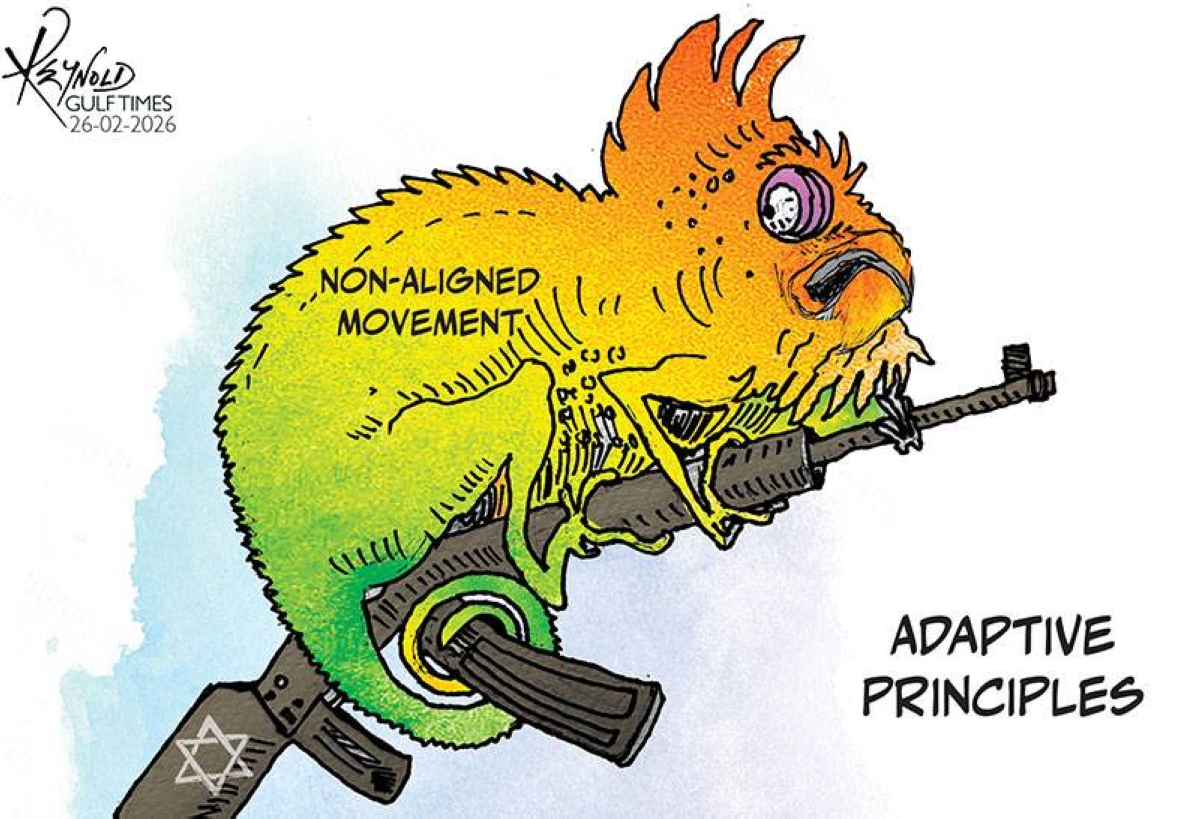
In the hierarchy of threats to humanitarian relief, administrative fiat rarely ranks first. War, blockade, and bombardment do the obvious damage. Yet bureaucracy, when turned into an instrument of policy, can be dangerously efficient. That is the danger unfolding in the occupied Palestinian territory, where Israeli authorities have set a deadline at the end of February or 1 March 2026 for 37 international nongovernmental organisations to cease operations unless they submit to onerous new registration rules. The stated aim, protecting national security, masks a choice with perverse consequences: to curtail independent relief at a moment when it is most needed. The legal vehicle for this policy, Government Resolution No. 2542, is sweeping. Adopted in December 2024, it compels all foreign groups providing aid to “Palestinian residents” to register with the Ministry of Diaspora Affairs and Combating Antisemitism by the end of 2025 or forfeit their licences. The law vests the state with broad discretion to deny or revoke registration on vaguely defined “public safety or state security” grounds. It conspicuously exempts organisations serving Israeli citizens, including residents of East Jerusalem. The result is a rule that is at once selective and instrumental: humanitarian work that benefits Palestinians is singled out for conditionality; humanitarian work that benefits Israelis is left untouched. Destructive by designFrom the humanitarian perspective, the new demands are destructive by design. At the heart of the dispute is a requirement that many organisations refuse to meet: the transfer of personal datalists of staff, including local employees and their biodata — to an authority that is a party to the conflict. For organisations that insist on neutrality and the protection of their teams, this is not a bureaucratic hurdle but an ethical and security red line. The disclosure of names, addresses and other personal details risks exposing staff to harassment, arrest or worse. For European NGOs it also raises legal alarms under EU data-protection regimes. In short, compliance would endanger people and expose organisations to legal liability; non compliance invites deregistration and closure. Many of the 37 organisations have proposed reasonable alternatives: independent sanctions screening, donor audited vetting and third party compliance mechanisms that filter potential security risks without handing over raw personal data to authorities. According to the petitioners, these offers have been largely ignored. Instead, Israel has proceeded with enforcement measures that have real-world consequences—denial of visas for foreign staff, stockpiling of essential goods at crossings and warehouses, and, for the minority that have complied, a process that appears selective rather than universal. Those consequences are not theoretical. International and Palestinian actors together deliver a very large share of vital services in Gaza and the West Bank. United Nations and aid agency data show that international NGOs run or support roughly 60% of Gaza’s field hospitals, operate all stabilisation centres for children with severe acute malnutrition, and deliver substantial shares of water, sanitation, and hygiene services. OCHA warns that the closure of these 37 groups could shutter one in three health facilities in Gaza immediately, cut off monthly specialised care for roughly 20,000 patients and leave severe gaps in malnutrition treatment and sanitation—outcomes that would translate quickly into excess mortality and morbidity. The ban is also the latest phase of a broader squeeze on the international presence in Palestinian areas. Restrictions on UNRWA, the suspension of aid consignments deemed “dual use”, and curbs on civil society actors point to a strategy that uses administrative levers to shrink independent relief and oversight. That is significant for two reasons. First, independent organisations do more than deliver goods; they monitor abuse, advocate for civilian protection and provide a protective visibility that deters some excesses of violence. Second, substituting state controlled or politically vetted aid for an independent humanitarian architecture risk politicising relief and eroding the impartiality that underpins international assistance. The government’s legal argument rests on domestic security prerogatives and a claim that it has authority to regulate foreign actors operating on territory under its control. The petitioners counter that Israeli bodies have exceeded their authority under arrangements deriving from the Oslo Accords,under which the Palestinian Authority retains competency over NGO registration in parts of the territory, and that, as an occupying power, Israel has positive obligations under international humanitarian law to facilitate relief for civilians. They also stress proportionality: the imposition of blanket data sharing requirements is, they argue, arbitrary and disproportionate to any legitimate security aim. Whatever the merits of the competing legal claims, the practical arithmetic is stark. Only 27 organisations have apparently satisfied the registration demands, leaving gaping holes in service provision. At the same time, aid consignments, food, medicines, shelter materials worth tens of millions of dollars, remain stockpiled at crossings and in warehouses. Humanitarian work in Gaza and the West Bank is already being performed under extreme strain: infrastructure damage is vast (the UN estimated that as of mid October 2025 some 81% of structures in Gaza had been damaged), health facilities and schools are largely destroyed or impaired, and food insecurity afflicts a large fraction of the population. Removing independent actors from that scene will not stop suffering; it will intensify it. Strategic ironyThere is also a strategic irony. If the declared aim of the policy is to safeguard Israeli security, the likely outcome is the opposite. A rapid withdrawal of international NGOs will create governance and service vacuums that aggravate instability, fuel grievances, and increase reliance on non-transparent networks for basic needs — conditions that tend not to make a conflict easier to manage. Moreover, the reputational and diplomatic costs are immediate. Donors, European governments, and the United Nations are being asked, in effect, to accept a diminished role for institutions they finance and in which they place considerable trust. Many of those governments will find that domestic pressure and legal obligations do not allow them to countenance acquiescence. What should be done? Short of a reversal of the policy, the immediate imperative is to prevent an abrupt collapse of services. Israel’s courts should consider, and could sensibly grant, an interim injunction to pause enforcement while the matter is examined. That is what the petitioners have asked for. Parallel diplomatic channels should press for practical compromises: credible, independent vetting mechanisms that address security concerns without wholesale transfer of personal data; guarantees that registration decisions will be transparent and subject to appeal; and, crucially, assurances that lifesaving supply chains will not be blocked. Beyond these crisis management steps, the episode raises a larger question about the role of humanitarian actors in contexts where state security narratives are mobilised to curtail independent action. Democracies have a legitimate interest in protecting themselves; they do not, however, win security by undermining institutions, domestic or international, that stabilise fragile environments. When politics, law and administration combine to shrink neutral humanitarian space, the people who suffer most are civilians who have no part in those machinations. The 37 organisations facing closure have framed their appeal in stark terms: allowing the closures to proceed will cause immediate and irreversible harm. That is at once a legal plea and a moral one. Judges, diplomats, and ministers should weigh that claim not only against abstract security rationales but against the practical consequences of a humanitarian squeeze in a territory already ravaged by conflict. Administrative power can be precise and bureaucratically clean; its effects on people are messy and lethal. This is not the occasion for neatness. It is a moment to choose relief over regulation. A prolific writer and senior TV producer, the British-Sudanese author has won several awards for his work.

Gulf Times

Tariff ruling restrains president’s leverage, keeps trade uncertain

The US Supreme Court’s decision to strike down a large swath of President Donald Trump’s tariffs has weakened his ability to threaten and impose tariffs at a moment’s notice, but it won’t end gnawing uncertainty for trade partners or companies.Trump responded within hours to the ruling on Friday, slapping ‌a new 10% tariff on all imports and ordering new trade investigations that could lead to additional levies in months, while insisting that trade and ​investment deals reached with nearly 20 countries - most with ‌higher tariffs - should remain untouched. Less than 24 hours later, he raised the rate of the new tariff to 15% - the maximum level allowed ‌under the law.Wendy Cutler, a former US trade official and senior vice president ‌at the Asia Society Policy Institute, said Trump’s rapid-fire change was emblematic ‌of the president’s desire - and ability - to keep trading partners on their toes.“The uncertainty, in his view, just gives him enormous additional leverage beyond the actual tariffs. Because people are worried about what he’ll do.”But Cutler and other trade experts agree Trump’s wings have been clipped. The 10% replacement tariff lasts only 150 days, and new tariffs imposed under other statutes will take longer to implement, robbing the president of the “anytime, anywhere for any reason” cudgel he used to impose tariffs before his use of the International Emergency Economic Powers Act was nixed.William Reinsch, a former senior US government official who is now with the Center for Strategic and International Studies, said the Supreme Court’s solid 6-3 ruling diminished Trump’s ability to threaten other countries.“It takes away his ability to wave ​the big stick around,” he said, although the economic impact will be limited, with the 10% tariff and other duties expected in coming months replacing some if not all the tariffs now deemed illegal.Michael Froman, president of the Council on Foreign Relations, said the ruling and the administration’s response left many questions unanswered, including how importers could get refunds for duties collected illegally, ‌and what further tariffs were still coming.That development could provide relief to countries scarred by Trump’s unpredictability and repeated use of tariff threats to punish them over non-trade matters, extract concessions and secure foreign investments.The US president had invoked IEEPA to impose tariffs over a range of non-trade issues, leaving countries bruised and skittish, and heightening uncertainty for companies around the world.He threatened tariffs against European countries over their opposition to his claims on Greenland, against Canada for allowing the importation of electric vehicles from China, and against Brazil for its treatment of far-right former President Jair Bolsonaro, a Trump ally.Josh Lipsky, chair of international economics at the Atlantic Council, cautioned that it was too early to predict the impact of the Supreme Court’s ruling on Trump’s leverage, given uncertainty about fresh tariffs and the president’s willingness to use a range of tools.It is also unclear what will happen to nearly 20 framework deals or firmer trade agreements that the Trump administration has reached with countries in recent months that were based on the IEEPA tariff threats.Trump, US Trade Representative Jamieson Greer and Treasury Secretary Scott Bessent insisted on Friday that the deals should remain in effect, even if those rates were higher than the temporary universal tax.Analysts said they doubted countries could seek to abrogate or renegotiate deals, out of concern of triggering Trump’s ire.Miriam Sapiro, a former senior US trade official and adjunct professor of international and public affairs at Columbia University, said Trump might have lost his “trade bazooka,” but she didn’t expect the existing deals to unravel.However, the ruling could give countries more leverage in new or ongoing negotiations with the Trump administration, Sapiro said. Initial reactions from overseas were measured as countries assessed the Supreme Court decision.South Korea said it would review the ruling and US response and planned to continue “amicable” talks over implementation of a tariff agreement finalised in November with $350bn in investment pledges. - Reuters