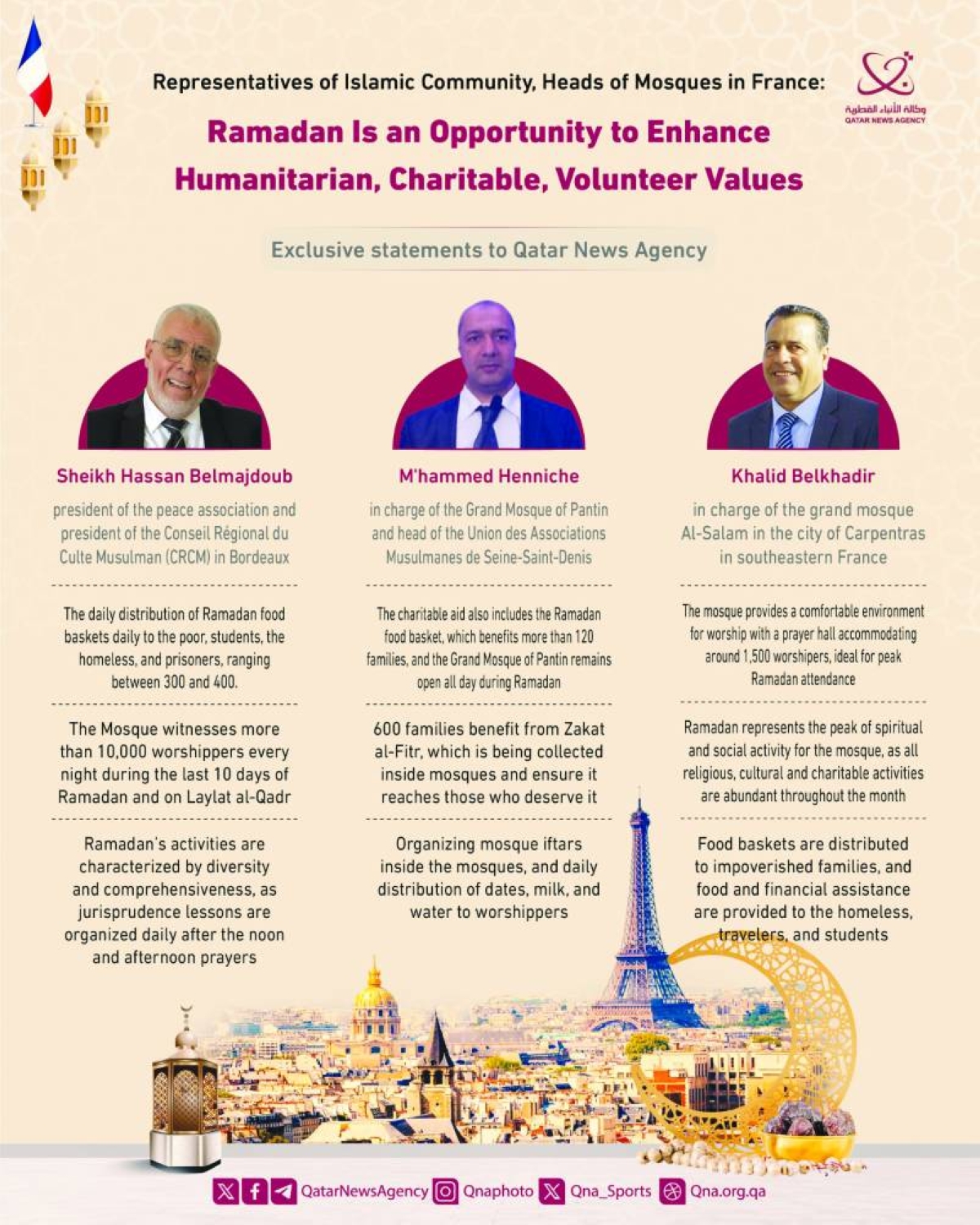
A number of representatives of the Muslim community, heads of mosques, and charitable associations in France affirmed that Ramadan reflects the humanitarian spirit of Islam and allows the Muslim community in France to demonstrate solidarity, do good, and promote the values of volunteering, religiosity, and commitment. In exclusive statements to Qatar News Agency (QNA), they explained that the holy month represents an annual tradition for mosques and charitable associations to intensify activities and volunteer work, and to provide social assistance to the Muslim community. They noted the remarkable turnout of young Muslims in France at mosques, Tarawih prayers, and a deepened interest in the religion, customs, and heritage of their parents and grandparents. Sheikh Hassan Belmajdoub, president of the peace association and president of the Conseil Regional du Culte Musulman (CRCM) in Bordeaux, explained that Al-Salam Mosque and Muslim Cultural Centre in Bordeaux represents the heart of the religious and cultural life of the Muslim community in the Gironde region, Nouvelle-Aquitaine, southwest France. The region includes 16 mosques and associations under the supervision of the CRCM, headed by Sheikh Belmajdoub. He noted that Al-Salam Mosque was founded in 2006 and belongs to the Muslim community of Merignac, and is celebrating its 20th anniversary. He said that the main prayer hall in the mosque is the largest of its kind in the region, accommodating about 3,000 worshippers, which reflects the interest in providing a comfortable environment for practicing religious rituals, especially during Ramadan, which witnesses a large turnout, especially during the last 10 days and Tarawih prayers. ACTIVITIES MARKED BY DIVERSITYBelmajdoub explained that the educational and cultural activities in the mosque and the Islamic centre vary to include an Arabic language school in eight classrooms that receives about 600 students, in addition to an institute for Islamic studies for French speakers, where intensive programmes in Hadith, jurisprudence and Islamic law are offered for three years, which contributes to the formation of new generations of specialised scholars and imams. He added that the mosque’s Ramadan activities are characterised by diversity and comprehensiveness, as jurisprudence lessons are organised daily after the noon and afternoon prayers, in addition to providing religious consultation and guidance before the evening prayer, bringing in a select group of jurists and imams from Morocco and several Arab countries to enrich the scientific and religious content during the holy month. These efforts culminate in the last 10 days by honouring the outstanding memorisers of the Holy Qur’an and the Prophet’s Sunnah and awarding them prizes and certificates. Regarding charitable and social activities, Sheikh Belmajdoub emphasised that the mosque places great importance on providing support to those in need, achieved through the daily distribution of Ramadan food baskets daily to the poor, students, the homeless, and prisoners, ranging between 300 and 400. In addition, the mosque organises weekly and communal Iftar meals, benefiting large numbers of students, travellers, and those in need, reflecting the mosque’s commitment to the principle of social solidarity and fostering a spirit of co-operation among community members. Furthermore, the mosque ensures the distribution of Zakat al-Fitr (charity given at the end of Ramadan) to eligible recipients. PROMOTES RELIGIOUS, CULTURAL DIALOGUEIn his remarks to the QNA, Sheikh Belmajdoub pointed out that the mosque’s role is not limited to the local aspect, but also seeks to promote religious and cultural dialogue, as it organises group Iftars for French officials and representatives of various religions in the region. He also pointed out that one of the most prominent annual social initiatives is the White March, organised by the CRCM, with the participation of about 2,000 people from different religions and cultures, in a clear message of tolerance, co-operation, and peaceful coexistence. He stressed that there is a remarkable phenomenon that began after the disappearance of the coronavirus (Covid-19), which is the return of people and members of the Muslim community to the Islamic religion and their great turnout at various mosques in the region, as well as the conversion of many French people to the Islamic religion, especially during the holy month of Ramadan. Sheikh Hassan Belmajdoub concluded his statement by pointing out that the Al-Salam Mosque witnesses an unprecedented attendance of more than 10,000 worshippers every night during the last 10 days of Ramadan, on Laylat al-Qadr, and during Eid prayers. For his part, M’hammed Henniche, who is in charge of the Grand Mosque of Pantin and head of the Union des Associations Musulmanes de Seine-Saint-Denis (UAM-93), Paris, affirmed that the month of Ramadan constitutes a central milestone during which religious, humanitarian, and social initiatives abound, aimed at serving the Muslim community and enhancing its positive presence within French society. He explained that the UAM-93’s activities during the holy month include organising mosque Iftars, as well as preparing ready-made meals to be distributed to those wishing to break their fast at home or with their children, and daily distribution of dates, milk, and water to worshippers, in addition to special Iftars organised for representatives of local authorities and leaders of other religions. Henniche said that, like most mosques in France, the Grand Mosque of Pantin radically changes its organisation during Ramadan, in which they carry out a general cleaning of the mosque, including the prayer rugs. The main charitable activity during the holy month is the communal Iftar (breaking of the fast) at the mosque, where about 100 people break their fast daily. The charitable aid also includes the Ramadan food basket, which benefits more than 120 families. He pointed out that during the last 10 days of the month, the Union counts the needy families in preparation for distributing Zakat al-Fitr. On Eid al-Fitr, the Pantin Mosque takes care to bring joy to the hearts of children by acquiring toys that are distributed to them when they come with their families to perform the Eid prayer. M’hammed Henniche explained that the Union, which includes more than 100 mosques in the Seine-Saint-Denis region known as 93, has developed an integrated religious programme that includes sermons, jurisprudence lessons, and awareness lectures, in addition to organising the five daily prayers, Tarawih prayers, and Tahajjud prayers during the last 10 days. He also noted that 80% of mosque funding throughout the year comes from Ramadan donations. URGENT ASSISTANCE FOR SUFFERINGThe head of UAM-93 of Paris stressed that the Union has recently dedicated several evenings to collecting donations for the benefit of the affected Arab and Islamic people, especially in Palestine, Sudan, and some African countries, where these funds are transferred to humanitarian organisations. Henniche added that support efforts have doubled since the outbreak of the war in Gaza, in co-operation with associations active on the ground in Palestine, to provide urgent assistance and to alleviate the suffering of the population. Khalid Belkhadir, who is in charge of the grand mosque Al-Salam in the city of Carpentras in southeastern France, within the Vaucluse region (84), which is part of the Provence-Alpes-Cote d’Azur region, and president of the Regional Council of the Muslim Religion, explained that the holy month of Ramadan represents the peak of spiritual and social activity for the mosque. Belkhadir explained that the religious and cultural activities range from lessons in Islamic jurisprudence and Sharia law to religious consultations offered by the imam before the Isha prayer, as well as training programmes for new imams aimed at honing their skills in leading prayers and managing religious activities within the community. The mosque also organises competitions and awards for memorising the Holy Quran, the Prophet’s Sunnah, and Islamic teachings. These events culminate in the distribution of prizes on Laylat al-Qadr, marking the pinnacle of celebrating knowledge and learning during the holy month. On the charitable and social front, Belkhadir emphasised that the mosque prioritises supporting those in need. During Ramadan, food baskets are distributed to impoverished families, and food and financial assistance are provided to the homeless, travellers, and students. Additionally, Zakat is also distributed to the needy during Eid al-Fitr.
Opinion



Monday, February 23, 2026
Monday, February 23, 2026
Monday, February 23, 2026
Tuesday, February 24, 2026
Monday, February 23, 2026


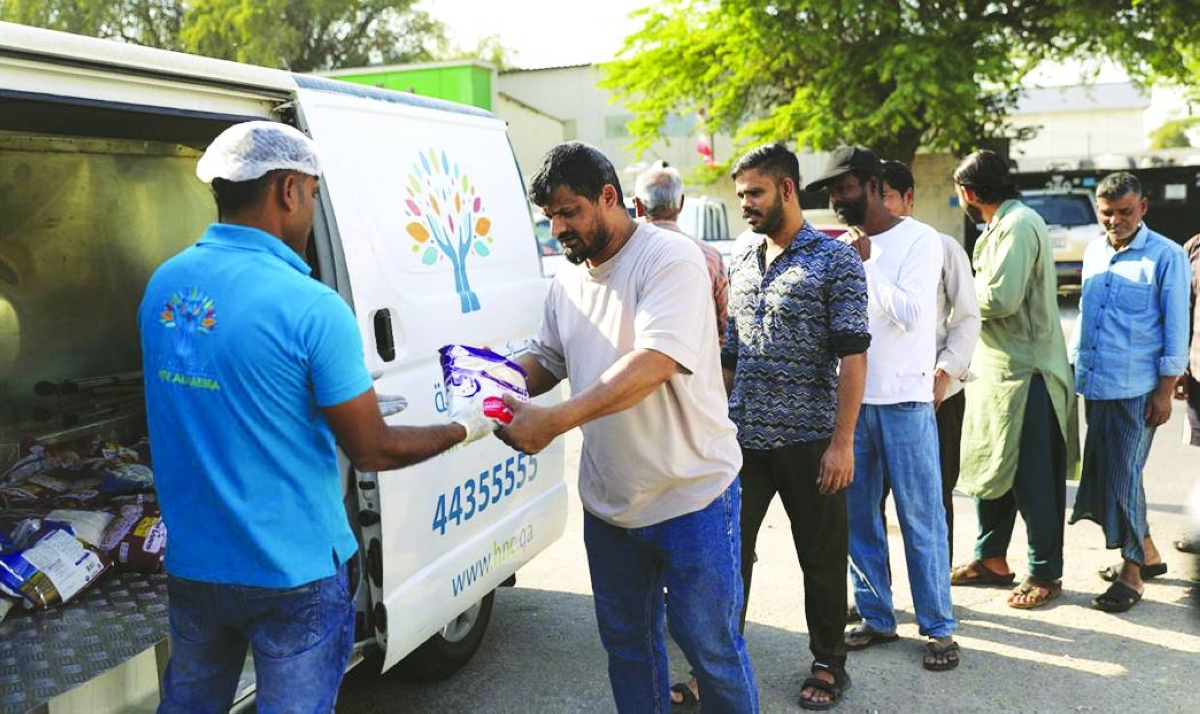


China’s retreat from US Treasuries amid tensions over trade, technology
Wednesday, February 18, 2026
Training the Nafs: Why self-control matters and how Ramadan rebuilds it
Wednesday, February 18, 2026
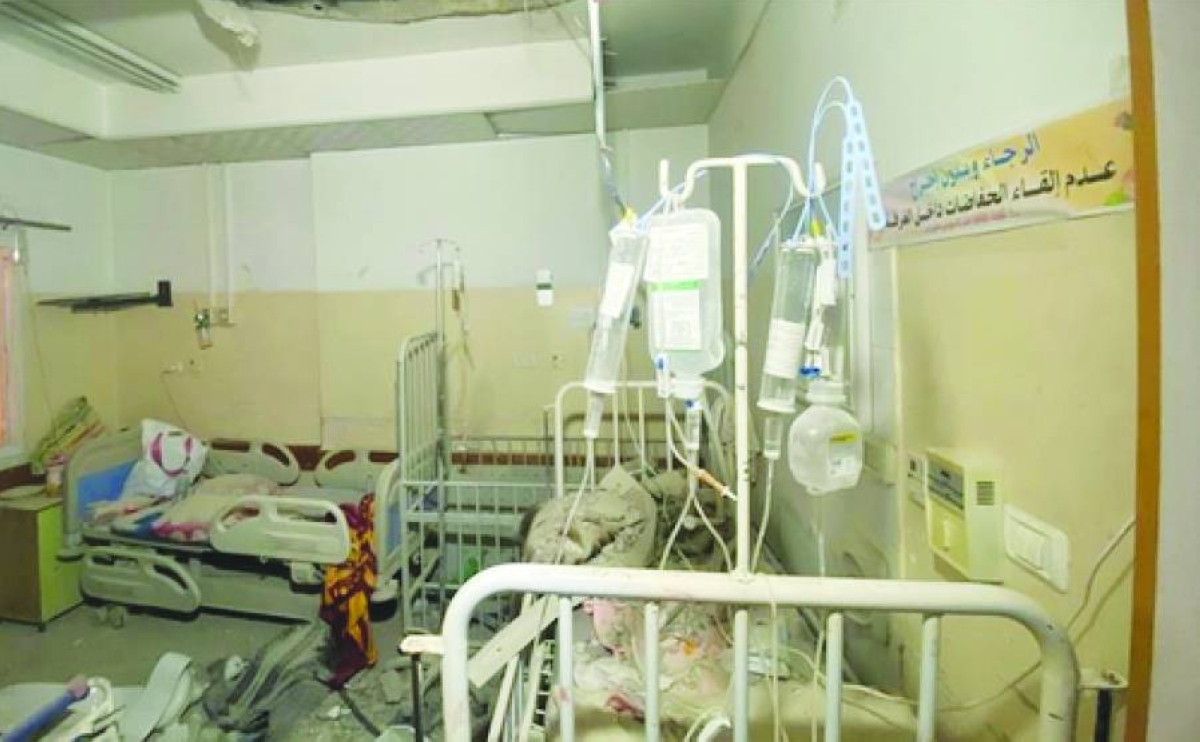
‘Serious degeneration in health system due to Israeli-imposed Rafah crossing restrictions’
Monday, February 16, 2026