
tag

Saturday, June 20, 2026 | Daily Newspaper published by GPPC Doha, Qatar.
Tag Results for "fuel supply" (2 articles)

Stefano Baronci, director general, ACI Asia-Pacific & Middle East.
Business

Regional war costs Middle East airports $1bn amid fuel, policy risks

The Gulf conflict has inflicted a revenue shortfall of up to $1bn on nine major Middle East airports in just two months, creating structural cash flow challenges and exposing vulnerabilities in fuel supply chains, according to the Airports Council International Asia Pacific & Middle East (ACI APAC & MID).In a comprehensive assessment conducted with Flare Aviation Consulting, the ACI APAC & MID detailed the financial toll of the conflict from its onset through April 30, 2026, warning that the disruption has placed the global air transport network under acute stress.ACI APAC & MID, which represents more than 600 airports across 45 countries, said the financial impact of the conflict from March to April 2026 was exceptional in magnitude for an industry characterised by regulated margins, fixed costs, and long term capital commitments.The nine airports collectively handled 324mn passengers in 2025, accounting for approximately 70% of total Middle East traffic, making disruptions in the corridor consequential for the global aviation network.The revenue shortfall of $900mn to $1bn over March and April 2026 was set against a budgeted target of $1.3–1.4bn, representing a gap equivalent to 55% of anticipated revenues.The rise in airfares is evidence of how the imbalance between supply and demand drives prices upward, according to the ACI APAC & MID. On the contrary, it noted that airport charges remained unchanged throughout the period, as regulated instruments under established frameworks, and did not contribute to elevated fares.With capacity constraints and rising volumes, airports must prioritise capital expenditure to ensure continuity and prepare for decades of growth. Given the current capacity constraints and rising passenger volumes across Asia Pacific and the Middle East, airports must prioritise committed capital expenditure to ensure operational continuity and prepare for the decades of growth ahead, the council stated.The region served 3.9bn passengers in 2024 and is projected to exceed 11bn by 2054, requiring investment that cannot be deferred.Fuel costs have emerged as the principal challenge. An ACI APAC & MID survey of 28 major airport operators found jet fuel prices nearly double pre conflict levels, even as stocks remain stable.Airports have introduced mitigation measures including contingency planning, supplier coordination, and reserve stocking, though government support remains limited.Stefano Baronci, director general, ACI Asia-Pacific & Middle East, said: “Against a backdrop of renewed upward pressure on jet fuel prices, longer routings driven by geopolitical tensions, persistent supply bottlenecks, and chronically elevated inflation, public policy should not add yet another layer of cost to air travel.”He added: “Further increases in government imposed taxes, such as the latest taxation applied to passengers departing Australia, directly undermine connectivity, tourism, and trade and consumer welfare.”ACI APAC & MID cautions that the next few months will be critical and urged airports and governments to strengthen fuel security, improve contingency planning, and diversify supply chains to reduce single region dependency. 

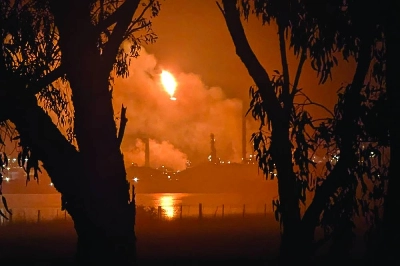
A fire at the Viva Oil Refinery in Geelong. Emergency crews were responding early Thursday to a fire raging out of control at one of Australia's two remaining oil refineries which supplies 10% of the country's fuel. (AFP)
International

Fuel supply fears after blaze tears through crucial Australian refinery

Columns of fire engulfed a crucial Australian oil refinery after a chain of explosions, authorities said Thursday, as they warned of disruptions to domestic fuel supply.Flames as high as 60m (200 feet) erupted late Wednesday after a gas leak ignited at the Viva fuel plant in Victoria state, firefighters said, one of only two working oil refineries in Australia.The refinery, about an hour's drive southwest of state capital Melbourne, pumps out about 10 percent of Australia's fuel, according to energy company Viva.Fire Rescue Victoria said Thursday the blaze had been contained, although it could smoulder throughout the day."The whole sky was lit up with the bright flame," Geelong resident Wayne Gardiner told AFP.The refinery is capable of processing up to 120,000 barrels of oil each day, company figures stated.Analysts said that, together with the Ampol refinery in Brisbane, it produces about 10-20 percent of Australia's total fuel supply."This is not a positive development," Energy Minister Chris Bowen said as the nation's fuel supplies are under pressure due to war in the Middle East.Bowen said he had spoken to Viva and the firm was "very confident they can replace the petrol with imports".Prime Minister Anthony Albanese, currently visiting Malaysia, said Australia had secured an additional supply of some 100 million litres of diesel from Brunei and South Korea."This is the first of many expected shipments secured, under the government's new strategic reserve powers," he told a news conference.The fire ripped through a section of the refinery responsible for the production of high-octane petrol, Bowen earlier said.By triggering isolation valves, other parts of the plant producing jet fuel and diesel had been spared the worst of the blaze.Geographically isolated and with only two oil refineries, Australia is heavily exposed to disruptions in global fuel supply and imports most of its petrol.Canberra urged Australians to ignore the impulse to rush out and panic buy more fuel."It's important that people buy as much fuel as they need. But no more, no less," Bowen said.Incident controller Mark McGuinness said a "significant leak" of highly flammable gases and liquid hydrocarbons had triggered the inferno."It was quite ferocious. It went from a small fire through several explosions to a large, intense fire," he told reporters.Images taken Thursday morning showed thick clouds of smoke billowing over the industrial complex.Viva Energy boss Scott Wyatt said it was a "very challenging incident"."Production is not our primary priority today," he told reporters. "Today it is getting the site safe."Australia holds roughly 38 days' worth of petrol in reserve, according to government figures, far below the 90-day minimum dictated by the International Energy Agency.While the government has so far resisted moves to ration fuel, it has urged drivers to conserve petrol where they can and to favour public transport if possible.Like most nations in Asia and the South Pacific, Australia is heavily reliant on oil shipped through the Strait of Hormuz, which at one point carried one-fifth of the world's oil and gas.Shipping traffic through the vital waterway has essentially ceased since the United States and Israel launched strikes against Iran on February 28.