tag

Saturday, July 25, 2026 | Daily Newspaper published by GPPC Doha, Qatar.

Tag Results for "Hormuz" (141 articles)


Ships move through the Suez Canal, in Ismalia, Egypt. With two of its key oil export routes — the Hormuz and Bab el-Mandeb straits — disrupted by Iran and Iran-allied Houthis, Saudi Arabia has to resort to exporting oil via Egypt’s Suez Canal.
Business

Add a month at sea and $2.5mn: What it costs oil tankers to avoid Hormuz and Bab el-Mandeb

With two of its key oil export routes — the Hormuz and Bab el-Mandeb straits — disrupted by Iran and Iran-allied Houthis , Saudi Arabia has to resort to exporting oil via Egypt’s Suez Canal. While the kingdom has previously used the Suez route to export some of its oil, it has not tested it as the main export outlet for decades. Unlike in the 1970s and 1980s, when Saudi Arabia’s top oil buyers sat in Europe and the US, the majority of its buyers today are in Asia. To get to Asia, tankers with Saudi oil will have to circumnavigate the whole of Africa, adding around a month to their journey. It takes only 19 days for a tanker to sail from Saudi Arabia’s Red Sea port of Yanbu to Taiwan via Bab el-Mandeb. A route via Suez, the Mediterranean and Gibraltar and then around the Cape of Good Hope takes 48 days, according to Kpler and LSEG shipping data. The journey would double fuel costs alone to around $2.87mn from $1.26mn, according to Reuters calculations using LSEG data. Crossing the Suez Canal adds $1mn in fees, according to LSEG. Saudi Arabia re-routed most of its oil exports from the Gulf to the Red Sea when the US-Iran war disrupted shipments via Hormuz in February. The Houthis attacked ships in the Red Sea this week making the workaround unsafe and encouraging the kingdom to send oil via the Suez Canal. Big tankers will need to sail via the Suez half empty due to restrictions and top up in the Mediterranean, according to Energy Aspects. To achieve that, Saudi Arabia could partially unload tankers into the Sumed pipeline, a 320-km (200-mile) oil link bypassing the Suez and connecting Ain Sokhna oil terminal on the Red Sea to Sidi Kerir on the Mediterranean. The pipeline can transport up to 2.5mn barrels per day out of the kingdom’s total exports of 7mn bpd. 

Oil and gas tanks are seen at an oil warehouse at a port in Zhuhai, China. Some Chinese refiners have ramped up purchases of sanctioned Russian crude despite shrinking discounts, as an escalation in the Iran war disrupts exports from the Middle East, sources familiar with the situation said.
Business

China refiners snap up September Russian crude, eye Iranian oil as supply risks grow

Some Chinese refiners have ramped up purchases of sanctioned Russian crude despite shrinking discounts, as an escalation in the Iran war disrupts exports from the Middle East, sources familiar with the situation said. Chinese independent refiners made rare purchases of non-sanctioned Middle East crude at wide discounts when exports gushed out during the short-lived truce between the US and Iran. A resumption of attacks and shipping blockades in the Strait of Hormuz is again throttling oil shipments through the crucial waterway, and Yemen's Iran-aligned Houthis are also threatening to block Saudi oil exports from the Red Sea.Faced with disruptions, Chinese refiners recently snapped up crude from their biggest supplier Russia and resumed talks to buy Iranian oil, traders said.Two major Chinese refiners bought most of the Russian ESPO Blend crude loading from the Pacific port of Kozmino in September, three trade sources said.Two of them said the cargoes were sold at a discount of $1 to $3 per barrel to ICE Brent, compared with a discount of around $4 per barrel for August-loading ESPO. Robust demand from India, another major Russian oil buyer, has supported prices. An executive at India's Bharat Petroleum Corp said on Thursday that the refiner has raised Russian oil processing in the June quarter and added that traders are not offering discounts on Russian crude sales."Given the uncertainty in the Middle East, ESPO is a safer bet, and it is also cheaper," said one of the sources who is a trader with a Chinese refiner.Independent refiners, also known as teapots, in eastern China's Shandong refining hub are discussing deals with Iranian oil sellers, the sources said. This week, Iranian Pars crude, a heavy grade, was sold at a discount of about $8 a barrel to ICE Brent for delivery to Shandong, widening from an earlier offer of about $6, one of the traders said. Offers for Iran Light have also slipped to discounts of about $3 to $4 a barrel compared with about $3 last week. Teapots are not in a rush to buy crude as their refining margins have worsened with Brent surging to nearly $100 a barrel, the sources said. The independent refiners had previously bought around 20mn barrels of Middle Eastern crude for loading in July to August, with some of them looking to resell the oil this week for profits, traders said. The cargoes had been offered to end-users in neighbouring countries including Taiwan and Republic of Korea at premiums of $6 to $9 per barrel to Dubai benchmark on delivered basis, two traders said. It was not immediately clear if any deals were concluded.

Flames rising from oil refinery pipes in Basra, Iraq. Vortexa estimated Iraq's crude exports posted the largest month-on-month increase, while UAE exports eased from record June levels.
Business

Gulf crude exports jump in July but shipments slowing on renewed hostilities

Gulf countries boosted crude oil and condensate exports in the first half of July to the highest levels since before the Iran war began in late February, shipping data showed, although flows through the Strait of Hormuz are now slowing as fighting escalates.Crude and condensate exports from Saudi Arabia, the United Arab Emirates, Iraq, Kuwait and Iran rose about 16% from the whole of June's daily average to 12mn barrels per day (bpd) in the first half of July, Kpler data showed.Vortexa estimated exports during the period at an even higher 13.06mn bpd.Saudi Arabia, Iran and Iraq led the increase in the first half of July, Kpler said, while Vortexa estimated Iraq posted the largest month-on-month increase, while UAE exports eased from record June levels.The rise in Gulf exports prompted a fall in oil prices as supply worries eased after the US and Iran reached an interim deal in mid-June to reopen the strait, the world's most important shipping route for oil and gas, and pursue a broader settlement to end their war.The interim accord unraveled in early July over disagreements about the waterway's administration.Shipments through the strait are already declining as strikes by both sides have re-escalated, dropping to just three commodity tankers on Thursday, the fewest daily transits since May, shipping data showed."We’re seeing a slowdown in activity, which means that countries will have to reduce output, which decreases the amount of crude that will be shipped," Kpler analyst Johannes Rauball said.Even after the rebound, exports remained about 32% below February's pre-war peak of 17.6mn bpd.Creating a potentially significant extra risk to global oil supplies, Iran has instructed Yemen's Houthis to be prepared to disrupt traffic through the Red Sea if the US targets Iranian energy infrastructure, sources told Reuters on Thursday.Saudi Arabia has diverted most of its energy exports through its Red Sea port of Yanbu. So far in July, 75% of its 5.29mn bpd crude and condensate were exported from Yanbu, Kpler data showed. 

People queue up to buy kerosene for domestic use at a supply station in Colombo (file picture). If the US and Iran do not increase oil flowing through the Strait of Hormuz soon, the world should worry about energy security, International Energy Agency Executive Director Fatih Birol has said.
Business

Global energy security at risk if Strait of Hormuz does not open in weeks, says IEA chief

If the US and Iran do not increase oil flowing through the Strait of Hormuz soon, the world should worry about energy security, International Energy Agency Executive Director Fatih Birol has said."Oil security is still a critical issue," Birol told a Council on Foreign Relations event. "We should be worried, and I am worried, if the situation does not improve in the next few weeks."The Strait of Hormuz, a narrow waterway between Iran and Oman that normally carries about one-fifth of the world's energy shipments, has been mostly blocked since the conflict began on February 28 with US and Israeli strikes on Iran.Despite sharp energy price increases, Birol said several factors have moderated the rise. These include China's stockpile, which totaled more than 1bn barrels of oil before the war, its oil conservation through increased use of electric vehicles and public transport and an IEA-coordinated release of up to 400mn barrels of oil.But those fixes "can't last forever," said Birol, who has said the Iran war is the worst energy disruption in history.Birol said a boost in production by the US, the world's top oil and gas producer, has helped. "The US increase in production is very good... The US increased 1mn, 2mn but it cannot increase 10mn," barrels per day of crude oil output, he said.The oil and gas supply crisis has hurt economies around the world, but in an asymmetric way, he said."It is mainly Asia, because Asia was getting 80% to 90% of this energy from the Strait of Hormuz," he said. Japan and South Korea have suffered, but developing countries including Pakistan, Bangladesh and India have been hit hardest, he said.Birol highlighted potential health risks for people in developing countries, especially women, who have turned to alternative cooking fuels including dung and wood with more hazardous emissions as petroleum products have become unaffordable.Oil prices fell about $20 a barrel after the coordinated IEA release in March, and the action signaled to markets that the organization representing more than 30 countries could tap reserves again if things get worse. "Even though it was huge," Birol said of the up to 400mn-barrel release, "It was only 20% of the stocks we have, 80% is still in the pocket."

Boats float near the coast of Bab el-Mandeb. Closure of the Bab el-Mandeb strait — gateway to the Red Sea — would open a new front in the energy crisis and Iran's overarching conflict with the US.
Business

Why Iran, Houthi threats to Red Sea shipping matter more for oil now

Iran has warned that its campaign to throttle global energy markets could be expanded from the Strait of Hormuz to the vital Red Sea route if US attacks continue, a threat that depends on its Houthi allies in Yemen.This is why it matters and what it means for the Iran war and the global energy crisis: How big is the risk to global energy markets?Closure of the Bab el-Mandeb strait — gateway to the Red Sea — would open a new front in the energy crisis and Iran's overarching conflict with the US.With Hormuz already disrupted, the Red Sea is now a critical alternative outlet for Gulf oil and other products. Any serious interference at Bab el-Mandeb would raise the prospect that both of the region's major oil export routes could be shut simultaneously.Iran's partial blockade of Hormuz after Israel and the US attacked it on February 28 disrupted most oil and other exports from the Gulf, raising prices and delivering a global energy shock.Saudi Arabia responded by diverting more than 70% of its normal daily crude exports to the Red Sea port of Yanbu. Shipments from Yanbu averaged 4mn barrels per day in recent weeks according to data from Kpler and Signal Ocean, up from around 973,000 bpd in the same period last year.Total volumes of petroleum transiting Bab el-Mandeb amounted to 7.4mn bpd in June, or about 7% of global oil output according to Kpler data, up from 4.2mn bpd last year.That has been a lifeline for the energy market, helping to keep down global oil prices, and Saudi Arabia is considering an expansion of its crude oil pipeline to the Red Sea coast, Reuters reported last week. Any sustained Houthi disruption to Red Sea shipping including potential attacks on vessels or ports could be a big problem. When the Houthis launched attacks on Red Sea shipping in November 2023, Gulf oil exports were flowing freely, so cargoes were not halted. This time, they are being loaded there. Who are the Houthis and can Iran make them close Red Sea energy routes?The Houthis emerged as a military, political and religious movement in north Yemen in the 1990s, fighting guerrilla wars against the government in Sanaa.They have been in a civil war against the Saudi-backed, internationally recognised, government for more than a decade and attacked Gulf neighbours with missiles and drones.However, a 2022 truce between the country's warring sides has largely held until this week, when Yemen's internationally recognised government said it had struck Sanaa airport to stop an Iranian plane landing.The Houthis said Saudi Arabia was responsible and fired missiles at Abha airport in the kingdom's mountainous southwest.A senior Houthi official, politburo member Mohammad al-Farah, then warned in an interview on Iran's Press TV website that if the situation kept escalating, Bab el-Mandeb would be closed.Iran champions the Houthis as part of its regional "Axis of Resistance", which includes Lebanon's Hezbollah and Iraqi militias, though its ties with the Yemeni movement are less clear than with those other groups. The Houthis do not recognise Iran's supreme leader as their ultimate religious authority in the same way Hezbollah and the Iraqi groups do. Their motivations are mainly domestic, though the group is ideologically aligned with Iran.The US says Iran has armed, funded and trained the Houthis with help from Hezbollah. The Houthis deny being an Iranian proxy and say they develop their own weapons. It is not clear how far the group would go purely on Iran's behalf. What happened when the Houthis attacked Red Sea ships before?After the October 7, 2023, Hamas attack on Israel, and Israel's devastating campaign in Gaza, the Houthis began firing at Israel and on shipping in the Red Sea, saying they were doing so in support of Palestinians. The attacks severely disrupted global shipping, prompting Maersk, Hapag-Lloyd and other major companies to divert around Africa — a far longer, more expensive route. A US-led mission to restore free navigation in the Red Sea involved repeated strikes on Houthi targets and a defensive campaign that shot down hundreds of drones and missiles.But some Houthi attacks continued until last summer, only ending completely with the Gaza ceasefire in October. Last month they said they would ban ships linked to Israel from the Red Sea after Israel renewed military attacks on Iran. However, that threat was never acted on and shipping groups Maersk and Hapag-Lloyd are resuming some Red Sea routes that they had abandoned during the Houthi attacks last year, Maersk said last week. What have they done during the latest Iran war?While Hezbollah and the Iraqi groups joined the war early with rocket and drone fire after the first US and Israeli strikes on Iran, the Houthis have been comparatively quiet.The group's leader said on March 5: "Our fingers are on the trigger at any moment should developments warrant it".Iranian commanders have repeatedly warned the Houthis could join the war.But the Houthis have mainly been quiet, with a few missile and drone attacks on Israel in late March and early April.That may have been to hold the threat of a Red Sea closure in reserve for any wider escalation, or because the group was reluctant to enter the war and end its own long ceasefire with Saudi Arabia. 

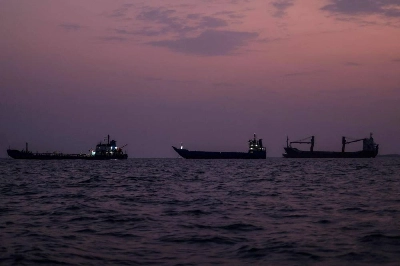
This picture shows ships sailing near the Strait of Hormuz off the eastern coast of the United Arab Emirates at Khor Fakkan on Monday.  In recent days, ‌the US renewed strikes, while Tehran attacked Gulf nations and ‌ships passing through the Strait of Hormuz near Oman.
Business

Spot Mideast crude prices strengthen after Iran attacks UAE tankers

Prompt Middle East spot crude prices rebounded to higher levels compared with future months as escalating attacks between ‌the US and Iran raised concerns about a disruption to oil exports and shipping through the Strait of Hormuz, ​industry sources said on Tuesday, prompting Asian buyers ‌to seek alternative supplies.The latest wave of attacks in the five-month-old war started with a US strike on ‌Iran after a ship ⁠attack last week. In recent days, ‌the US renewed strikes, while Tehran attacked Gulf nations and ‌ships passing through the Strait of Hormuz near Oman.Iran attacked two Emirati oil tankers, part of Abu Dhabi National Oil Co's (Adnoc's) fleet to ⁠shuttle crude out of the Gulf, for transhipments off the United Arab Emirates and Oman for supplies to customers.The latest attack on the tankers is likely to deter shippers from entering the Gulf to load oil, with companies that have already chartered vessels closely monitoring the situation, trade and shipping sources said. It has raised concerns among refiners about whether their cargoes will be delivered in the coming weeks, they added.Prompt monthly spreads for Middle East benchmark Dubai crude flipped into backwardation of nearly $1 a barrel on Tuesday, traders said, after staying in contango for three weeks. Prompt month prices are higher than those in future months in a backwardated ​market, indicating tight supplies, while contango is the opposite."There is a possibility that even the UAE will find it difficult to get crude out," said a shipping source in India."The war premium will go up significantly high."The sources cited in this article ⁠declined to be named publicly ​as they are not authorised to speak to media.Global crude supplies had improved over the past three ​weeks after a flurry of tankers passed through the strait amid an interim peace deal between the US and Iran.However, just five oil, chemicals and dry bulkers transited the strait on Monday, mostly using the Iranian route, ship-tracking data from Kpler showed. There were no oil and liquefied natural gas tankers entering the strait."The mini-glut of oil has now evaporated, with a fresh eye of a potential of disruptions from the Bab el-Mandeb Strait if Houthis are joining the attacks," said June Goh, a senior oil analyst at Sparta Commodities.Yemen's Houthi movement fired missiles at Saudi Arabia on Monday, breaking a four-year truce in the conflict between the kingdom and the Iran-aligned group.Adnoc, which has already committed to sales of more than 70mn barrels of crude between June and August, is expected to tap into its inventories from Fujairah to meet demand, although a slowdown of its ‌shuttle service could mean delays for some cargoes, traders ‌said.The producer is expected to award a tender ⁠later this week which could see discounts for its cargoes narrowing and also more demand for cargoes loading in September and October given the ⁠latest development, an Indian refining source said."The situation is ⁠fluid (and) uncertain. We cannot plan properly," he added.Asian refiners would have to tap arbitrage supplies from West Africa and Latin America to replace Middle Eastern crude, with Indian buyers set to increase their Russian oil purchases, trade sources said. An Indian refining source said refiners have sufficient inventories for now, but supply could tighten towards September if the disruption lasts 10 to 15 days.The latest round of tensions has also strengthened spot prices and refiners' margins for refined products in Asia.Diesel and jet fuel markets saw prompt monthly spreads and refining margins jump ​to near two-month highs on Tuesday, while refiner margins for 380-centistoke high-sulphur fuel oil edged higher to a four-week high, LSEG data showed.Asian naphtha crack climbed to $184 per metric ton over Brent crude on Tuesday, the highest level since May 19.Tankers carrying fuel oil last transited the strait in early July, with no more visible exits seen after the latest round of attacks, Kpler data showed.Meanwhile, US President Donald Trump said on Monday that the US was reinstating a naval blockade on Iran and would be reimbursed for 20% of all cargo shipped through the Strait of Hormuz after Tehran claimed it had closed the vital waterway.The United Nations' shipping agency said on Monday that it opposes fees on ships passing through maritime waterways, but would await more details."I believe all of this is posturing ‌and brinkmanship," said Simon Wong, a ​portfolio manager at Gabelli Funds, in an email.

Gulf Times
Qatar

Qatar strongly condemns attack on two UAE oil tankers in Strait of Hormuz

The State of Qatar strongly condemned the attack targeting two UAE oil tankers as they transited the Strait of Hormuz, describing it as a serious violation of the safety of international navigation, a direct threat to global energy supplies, and a clear breach of international law. In a statement issued on Tuesday, the Ministry of Foreign Affairs stressed that the continuation of such unacceptable attacks represents a dangerous escalation that threatens regional security and stability and undermines efforts to promote regional peace and stability. The Ministry reiterated the State of Qatar's call on the Islamic Republic of Iran to immediately cease any practices that undermine regional security, refrain from jeopardizing the security of international navigation and global energy supplies, fully comply with international law and United Nations Security Council Resolution 2817, and take urgent measures to prevent the recurrence of such attacks.

Gulf Times
International

Hormuz traffic slows to multi-week low as renewed US, Iran strikes raise safety risk

The number of vessels transiting the Strait of Hormuz fell to multi-week lows on Sunday, shipping data showed, ‌as renewed strikes between the U.S. ​and Iran and ‌attacks on ships in the Middle ‌East ⁠heightened safety ‌concerns.Six vessels transited the ‌strait on Sunday, ship-tracking data from Kpler showed, ⁠the lowest number in five weeks.Tankers that exited the strait included the Very Large Crude Carrier Humanity, laden with 2 million barrels of Iranian oil and another tanker, Capetan Andreas, carrying about 500,000 barrels of ​Kuwaiti oil products, the data showed, while three empty tankers entered the Gulf to load oil. Most ‌of the tankers switched ⁠off their ​transponders when crossing the strait.There were ​no liquefied natural gas tankers that entered the strait over the weekend that were visible on ship-tracking data.One tanker controlled by the Abu Dhabi National Oil Co exited the strait between July 10 and July 12, Kpler data showed. The vessel is heading for Dahej port ‌in India. U.S. forces ‌completed another wave ⁠of strikes against Iran on Sunday, hitting dozens ⁠of targets ⁠at multiple locations with precision munitions, the Central Command said.U.S. President Donald Trump said on Sunday that the Strait of Hormuz is open to commercial traffic, although Iran declared earlier that ​it closed the strait after a vessel travelled on an unapproved route and was struck. Iran's Revolutionary Guards said on Monday that its navy stopped two ships in the Strait of Hormuz last night by shutting down their systems. It did not name the ships involved.

A Saudi investor monitors stock prices at the Saudi Stock Exchange, or Tadawul, in the capital Riyadh (file picture). Saudi Arabia’s benchmark index edged 0.1% higher on Sunday, ​helped by a 0.2% rise in oil giant Saudi Aramco.
Business

Gulf bourses subdued as US and Iran exchange strikes

Gulf stock markets were subdued on Sunday as US and Iranian forces traded heavy missile and drone strikes, with Tehran hitting US facilities across the ‌region and again shutting the Strait ‌of Hormuz. A wave ‌of strikes exchanged between ‌the US and Iran over recent days prompted President Donald Trump to announce that their ceasefire was over, though he signalled that talks could still resume. The escalation followed several attacks on commercial vessels in the region. Iran stated it had shut the strait after firing a warning shot at a ship on an “unauthorised route” and on Sunday reported ‌it had disabled a second vessel. Saudi Arabia’s benchmark index edged 0.1% higher, helped by a 0.2% rise in oil giant Saudi Aramco. The kingdom is considering expanding capacity of its crude oil pipeline to the western Red Sea coast, five sources close to the matter said, enabling the kingdom and possibly neighbours to transport more oil without crossing the ‌Strait of Hormuz. Outside the Gulf, Egypt’s blue-chip index eased by 0.1%, with Talaat Moustafa Group Holding down 0.6%. Egypt’s current account deficit more than doubled to $5.1bn in the January-March quarter, from $2.3bn a year earlier, central bank data showed on Sunday. Elsewhere in the Gulf, Bahrain inched 0.1% higher to ‌2,011; Oman added 0.1% to 7,652, while Kuwait eased 0.1% to 9,082 points. 

Gulf Times
International

Oman and India discuss Hormuz security and regional developments

Oman's Foreign Minister Badr Albusaidi has held talks with his Indian counterpart Subrahmanyam Jaishankar on regional and international developments, including maritime security in the Strait of Hormuz.Jaishankar, who is on an official visit to Oman, discussed with Albusaidi on Friday the situation affecting shipping and navigation through the strategic waterway, as well as the implications for global trade, energy supplies and international supply chains.The two ministers stressed the importance of continued coordination and consultation on these developments, and expressed support for efforts to promote dialogue and cooperation with all parties in line with international law and the interests of countries in the region.They also reviewed ways to strengthen the strategic partnership between Oman and India, with discussions focusing on expanding cooperation in trade, investment, energy, logistics and emerging technologies. 

People pass by in front of the Oil and Natural Gas Corporation Limited (ONGC) office in New Delhi. The state-run firm in a stock exchange filing said its board of directors had "accorded an in-principle approval for the development of 1.75 MMT capacity strategic petroleum reserves as a project of national importance" in the southern Mangalore region.
Business

India approves plan to expand strategic oil reserves

India's largest state-run oil and gas producer has approved plans to develop a 1.75mn metric tonne strategic petroleum reserve, as New Delhi seeks to bolster energy security after being hit hard during the Middle East war.India, the world's third-largest importer of oil and the second-largest buyer of liquefied petroleum gas, has faced major disruptions due to restrictions on the Strait of Hormuz during the conflict between the US and Iran.State-run Oil and Natural Gas Corp (ONGC)in a stock exchange filing said its board of directors had "accorded an in-principle approval for the development of 1.75 MMT capacity strategic petroleum reserves as a project of national importance" in the southern Mangalore region.Minister of Petroleum and Natural Gas Hardeep Singh Puri told AFP last week that India was aggressively pursuing new avenues of domestic production."We are putting fiscal resources into oil and gas exploration in a very big way — with a $10 bn programme," he said.India is a modest producer in global terms.Domestic crude production in 2025-2026 was 25.98mn metric tonnes, according to the oil ministry.That meets just 10% of India's crude needs, equivalent to roughly 522,000 barrels per day (bpd) — a figure well below its production peak of just more than 900,000 bpd in 2011.India survived the energy crunch by expanding its crude suppliers from 27 to 41 countries, including Iran, Venezuela, greater purchases from Russia and several African nations.New Delhi has previously been criticised by both the US and Europe for its purchase of Russian oil, with critics arguing that it bankrolled Moscow's war against Kyiv. 

Gulf Times
Qatar

PM, UAE, Jordan Dy PMs push for de-escalation

His Excellency Prime Minister and Minister of Foreign Affairs Sheikh Mohammed bin Abdulrahman bin Jassim al-Thani received separate telephone calls Saturday from UAE Deputy Prime Minister and Minister of Foreign Affairs Sheikh Abdullah bin Zayed al-Nahyan and Jordan's Deputy Prime Minister and Minister of Foreign Affairs and Expatriates Ayman Safadi.In both calls, the prime minister underlined the importance of all parties adhering to dialogue and diplomacy and implementing what had been agreed within the framework of the Memorandum of Understanding between the US and Iran, including ensuring freedom of navigation in the Strait of Hormuz to safeguard regional security, preserve the gains achieved, and enhance regional stability. He reaffirmed Qatar's full support for all endeavours to de-escalate tensions and reach a comprehensive agreement that achieves lasting peace in the region.With Sheikh Abdullah, the prime minister discussed strengthening and expanding bilateral co-operation between Qatar and the UAE, along with the latest regional developments, particularly ongoing diplomatic efforts and joint co-ordination aimed at de-escalating tensions.With Safadi, he discussed co-operation between Qatar and Jordan and ways to strengthen it, along with the latest regional developments, particularly diplomatic efforts and joint co-ordination to de-escalate tensions.