tag

Saturday, July 18, 2026 | Daily Newspaper published by GPPC Doha, Qatar.

Tag Results for "#defence" (46 articles)

Gulf Times
Region

Kuwait says Air Defences intercept Iranian missile and drone attacks

Kuwait's General Staff of the Armed Forces said on Saturday its air defense systems were responding to hostile Iranian missile and drone attacks.The General Staff said in a statement that any explosions heard across parts of the country were the result of its air defense systems intercepting hostile missiles and drones, urging the public to follow safety instructions issued by the relevant authorities.Earlier on Saturday, the General Staff said Kuwait's air defenses had intercepted Iranian drone attacks.

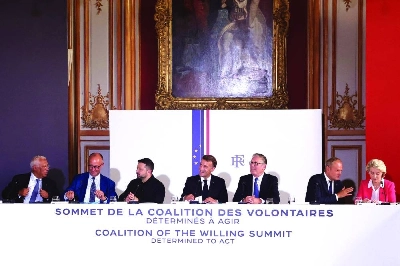
From left: European Council President Antonio Costa, German Chancellor Friedrich Merz, Ukrainian President Volodymyr Zelensky, French President Emmanuel Macron, British PM Keir Starmer, Polish PM Donald Tusk, and European Commission President Ursula von der Leyen attend take part in a summit of the Coalition of the Willing to support Ukraine at the Hotel des Invalides in Paris Monday. (AFP)
International

Ukraine’s allies meet in Paris to boost air defence

Ukraine’s allies gathered in Paris Monday to ramp up support for Kyiv, particularly in air defence, and increase pressure on Russia to end the war, which is well into its fifth year. Representatives of the 37 coalition members, including Ukrainian leader Volodymyr Zelensky, arrived at Les Invalides in the French capital for the summit of the Coalition of the Willing, launched by France and the United Kingdom to provide military support to Ukraine after Russia’s full-scale invasion in February 2022. The coalition is expected to announce the first joint exercises of the Multinational Force for Ukraine, to demonstrate its readiness to deploy once the fighting has ended, military sources said. Leaders are also expected to focus on co-operation on air and missile defence with Ukraine, whose air defences have come under strain from repeated Russian ballistic missile strikes in recent weeks. The meeting is “to make sure that the commitment is still there from all nations”, Sweden’s top military commander Michael Claesson told journalists. Before the summit, nine European countries and Ukraine announced the formation of a coalition to develop “purely defensive” anti-ballistic capabilities for Europe, citing a growing threat from such missiles. “We do this not against any people, but in defence of our own,” said the joint declaration by Denmark, France, Germany, Italy, Netherlands, Norway, Spain, Sweden, Ukraine and the United Kingdom. “We are stepping up our support for Ukraine. Strengthening its defences, increasing the pressure on Russia and building the security guarantees of tomorrow,” added French President Emmanuel Macron on X with a photo of assembled attendees. The meetings come the day before France’s national public holiday Bastille Day, which includes a military parade that this year will highlight support for Ukraine. During the traditional speech delivered to the armed forces before Bastille Day, Macron said Europe was “in the process of becoming a power” ready to “defend itself”. “The message we send to the world is this: Yes, peace is our goal. Yes, we cherish freedom and the rule of law. And yes, we stand ready to fight to defend them. Always, and at the cost of blood if necessary,” Macron said. Macron in his speech also called for more European defence industry partnerships, despite France and Germany last month abandoning a joint fighter jet programme. ‘Coalition of warmongers’Moscow Monday dismissed the summit as a gathering of leaders who “do not want peace”. “This is a coalition of warmongers,” Kremlin spokesman Dmitry Peskov said. The summit comes at a “powerful moment of renewed transatlantic convergence and unity”, but also of “more favourable developments on the ground” for Kyiv, the Elysee said. 

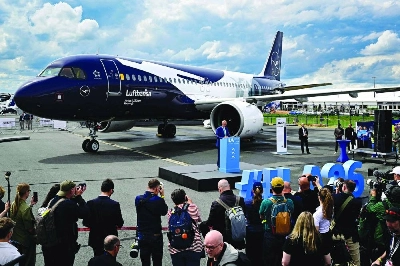
Germany's Chancellor Friedrich Merz (right) speaks at the opening day of International Aerospace Exhibition in Schoenefeld, near Berlin Wednesday.
Business

German air show opens under shadow of Iran war, fighter project collapse

Germany's ILA air show, among Europe's premier aerospace showcases, opened on Wednesday under the twin ‌shadows of the Iran war and the collapse this week of a flagship Franco-German fighter jet ​project.A large slice of Europe's defence ‌industry is on display at the Berlin event as manufacturers, aiming to narrow the gap to US ‌rivals and cash in ⁠on a boom in defence ‌spending, pitch new technology to governments and military buyers.The ‌build-up to the show, however, was dominated by the scrapping of Franco-German collaboration on the Future Combat Air System (FCAS) jet, long ⁠billed as Europe's most ambitious defence project but ultimately undone by a rivalry between developers Airbus and Dassault Aviation.Its demise has underscored the difficulty Europe faces in building military capacity at scale even as Western officials warn of the growing threat from Russia and the US presses Europe to ramp up its defence capabilities.Speaking on the issue for the first time since he and French President Emmanuel Macron scrapped the jet project, German Chancellor Friedrich Merz told the air show the two countries would still co-develop a joint defence system.Such a scaled-back and potentially face-saving plan could focus ​on systems like the so-called combat cloud, or digital backbone, that would enable data exchange between jets, drones and other sensors such as ground radar."This presents a great opportunity for a central Franco-German defence industry project of the future, one that we intend to realise together," ‌he said."Our defence ministers will now ⁠work out how this can ​be implemented in the run-up to the next Franco-German intergovernmental meeting in Germany, which we will be ​holding in July," Merz added.Germany and France would also proceed with cooperation on nuclear deterrence, he said.Speaking just before Merz, Michael Schoellhorn, president of the German Aerospace Industries Association, said the deadlock over FCAS was broken and future development was still possible."We possess the expertise, the technologies, the capacity, and the clear will to develop and build FCAS and the sixth-generation fighter jet for and with Europe," said Schoellhorn.He called on the government to provide a "clear mandate" on FCAS's future."We are not advocating for Germany to go it alone. We think in European terms, and we want to see German industry significantly and responsibly involved," he said.Schoellhorn is also CEO of Airbus Defence and Space, which had represented Germany and Spain in FCAS.As companies jostle to ‌reshape industrial alliances, Airbus is increasingly looking to ‌Sweden's Saab as a preferred partner, three people familiar ⁠with the matter told Reuters.MTU Aero Engines Head of Programmes Ottmar Pfaender said decisions on how to proceed with the project ⁠must be taken in the coming weeks, adding the ⁠engine maker was open to working with other companies.And Stephanie Lingemann, a senior executive at defence startup Helsing, said technologies such as software-driven defence systems and autonomy in warfare could now be folded into whatever follows the FCAS fighter project."There's always a chance in these kinds of endings," she said.The Iran war, which has exposed strains in transatlantic ties and even raised questions about NATO's future, has only added to the sense of unease at the air ​show over Europe's defence stance. And it is also hitting commercial airlines as flights are cancelled and jet fuel costs rise.Emirates President Tim Clark is using the air show to press the German government for landing rights in Berlin, with one of the Gulf airline's A380 jets on display.The opening day was disrupted by protesters who blocked roads to the venue while chanting slogans including "Free Palestine".Running from June 10 to 14, the ILA show will host more than 750 exhibitors from 37 countries.Coinciding with its opening, Germany's cabinet approved a new 15-year aviation strategy aimed ‌at cutting costs and boosting research ​to tackle rising expenses and intensifying foreign competition. 

Gulf Times
Qatar

Children of Qatari moms, Qatar-born residents can apply for national service

Qatar has widened the gates of its national service programme, inviting a new generation of young men into uniform: the children of Qatari mothers and the foreign-born sons of long-settled residents.  The Ministry of Defence announced the change in a post on X Tuesday, opening a door that until now had been restricted to those without Qatari fathers.  To walk through it, applicants must have been born in Qatar, be at least 18 years of age, carry a clean record of good conduct and reputation, and hold a valid Qatar residency permit.  The fine print sets out the rest. Candidates must not have been convicted of crimes involving dishonesty or breach of trust unless they have since been rehabilitated, nor have been dismissed from service before.  They must be medically fit and clear the admission interview. For those who make the cut, the rewards are tangible.  Service may run for up to five years and carries a financial incentive of as much as QAR7,000 a month.  Recruits will enjoy priority consideration for a place in the Qatar Armed Forces, and once their term is done, priority in securing permanent residency, a prize coveted across the Gulf's expatriate communities.  Applications are to be filed electronically through the ministry's website under the recruitment option. The paperwork is straightforward: a copy of the Qatar ID card, a valid passport and, for those born here, a birth certificate. Children of Qatari mothers must add copies of the mother's passport and birth certificate.

Recipients of the annual Green Airports Recognition during the 10th edition of the 'GAR2026' programme.
Business

Airports across Asia-Pacific, Middle East step up climate defences

Airports across Asia-Pacific and the Middle East are taking concrete steps to protect their infrastructure from climate change, moving beyond emissions reduction to address risks like flooding, extreme heat, and water scarcity, according to the Airports Council International Asia-Pacific & Middle East (ACI APAC & MID).“It is encouraging to see airports across Asia-Pacific and the Middle East responding proactively through smarter infrastructure planning, comprehensive risk assessments, resilient design, and stronger collaboration with governments and industry stakeholders,” said Stefano Baronci, director general of ACI Asia-Pacific & Middle East.Baronci was referring to the 12 airports across the two regions that were recognised for outstanding work in climate adaptation during the 10th annual Green Airports Recognition (GAR2026) programme. The awards were presented recently during the ACI Asia-Pacific & Middle East Regional Assembly, Conference and Exhibition (RACE2026) in Bangkok, Thailand.He noted that ACI had initiated a landmark Climate Adaptation study to give airports tools for assessing climate-related risks, adding that adaptation was “not only critical for maintaining operational resilience but also for safeguarding the connectivity, economies, and communities that rely on aviation every day.”This year’s theme was ‘Climate Change Adaptation’. Winning projects included raising critical electrical infrastructure above flood levels, fitting heat-resistant runway materials, redesigning drainage systems to handle heavier rainfall, and securing alternative water supplies during droughts.The 33 submissions received this year were the strongest indicator yet that airports in both regions are treating climate adaptation as an operational priority, not just an environmental one, the organisation stated.According to the ACI APAC & MID, the submissions strongly indicate that airports in Asia-Pacific & Middle East are now leading the way not only by cutting carbon emissions but also by preparing for climate impacts such as flooding, extreme weather, storm surges, and water scarcity.The recognition was awarded under Platinum, Gold, and Silver categories across four passenger traffic segments. In the over-40mn passengers per annum category, Hong Kong International Airport took Platinum, Taoyuan International Airport took Gold, and King Abdulaziz International Airport in Saudi Arabia took Silver.The following were recognised under the 15-40mn category: Auckland International Airport (Platinum), Melbourne Airport (Gold), and Kansai International Airport (Silver). Among airports handling five to 15mn passengers annually, Kaohsiung International Airport earned Platinum; Cochin International Airport, Gold; and Jaipur International Airport, Silver.In the under-5mn category, the winners are Nadi International Airport (Platinum), Sunshine Coast Airport (Gold), and New Plymouth Airport (Silver).The judging panel included Christopher Paling of Manchester Metropolitan University, Christopher Surgenor of GreenAir Online, Jennifer Desharnais of ACI World, aviation environmental consultant Dr Panagiotis Karamanos, and Baronci.The Green Airports Recognition programme was established by ACI Asia-Pacific with the support of the ACI Asia-Pacific & Middle East Regional Council. 

Gulf Times
International

Poland, Britain to sign defence treaty

Poland and the United Kingdom will sign a defence treaty in London today, Polish Prime Minister Donald Tusk said yesteray."This is a historic moment because, after having signed a treaty in Nancy with the French Republic, Poland will sign this treaty with the United Kingdom tomorrow," Tusk told reporters in Warsaw.The security and defence pact, which Tusk will sign with his British counterpart Keir Starmer, paves the way for joint military exercises and information-sharing, and will also cover co-operation in cyber and health security, according to the Polish government.Poland — an EU and Nato member state — shares its eastern border with Russia, Belarus and Ukraine.But that geography means instability has become a reality for the former Warsaw Pact country, Tusk said."Certainly not for a month, but for years, given the neighbourhood," he added.As a result, Poland's defence pacts with European countries, alongside its alliance with the US, are designed to guarantee "total security", he added.Poland, the most populous country on Nato's eastern flank, spends the most in the alliance on defence — more than 4.8% of its gross domestic product this year alone.At the beginning of May, Warsaw signed a loan agreement with the European Commission to finance the modernisation of its army and arms industry, under which it will receive nearly 44bn euros.Last year, Poland and France signed a treaty of friendship and enhanced co-operation, which includes defence and mutual assistance clauses that France, a nuclear power, reserves for its closest allies. 

Gulf Times
Qatar

Deputy Prime Minister meets Uzbek Defence Minister

HE Deputy Prime Minister and Minister of State for Defence Affairs, Sheikh Saoud bin Abdulrahman bin Hassan Al-Thani, met on Thursday with  Minister of Defence of the Republic of Uzbekistan, Lieutenant General Shukhrat Kholmukhamedov and the accompanying delegation, during his visit to the State of Qatar.During the meeting, they discussed the latest developments and security updates in the region, along with aspects of military cooperation and joint coordination in light of the current circumstances.The meeting also witnessed the signing of a memorandum of understanding on military cooperation between the Qatari Ministry of Defense and the Uzbek Ministry of Defence.Several senior officers and officials from both sides attended the meeting. 

President of the United Arab Emirates Mohamed bin Zayed al-Nahyan and Indian Prime Minister Narendra Modi inspect the UAE Armed Forces honour guards during an official visit at the Presidential Airport, in Abu Dhabi, yesterday. (Reuters)
International

India deepens defence, energy ties with UAE during PM Modi visit

India and the ​United Arab Emirates agreed the ‌framework for a strategic defence partnership  the Indian foreign ministry ‌said, as they seek ⁠to deepen ties ‌amid the Iran war. The two countries ‌also signed pacts on strategic petroleum reserves and supply of liquefied petroleum gas during ⁠a visit by Prime Minister Narendra Modi to the UAE, it added. "The two sides have agreed on deepening defence industrial collaboration and co-operation on innovation and advanced technology, training, exercises, maritime security, cyber defence, secure communications and information exchange," the ministry said in a statement. Ahead of the visit, Indian sources told Reuters that Modi was likely to discuss long-term energy supply deals and also seek support to expand New Delhi's ​strategic oil reserves. The UAE's decision last month to leave Opec is expected to boost its output and help importers such as India. The Iran war has roiled global energy markets with ‌the closure of the Strait of ⁠Hormuz, disrupting transportation ​and business across the region as Iranian strikes hit Gulf states, including the ​UAE, before a fragile ceasefire last month. The oil pact announced on Friday includes a potential increase of Adnoc's crude oil storage in India for up to 30 mn barrels, Abu Dhabi's state oil firm said in a separate statement, adding the deal also explores potential crude storage in the UAE's Fujairah as part of India's strategic reserve. Adnoc said that it would explore expanded LPG supply and trading opportunities with Indian Oil Corp. "India's scale and growth trajectory make it one of the defining energy markets of our time. As demand accelerates alongside a rapidly ‌expanding population, the strength of ‌the UAE India energy partnership becomes ever ⁠more critical," Adnoc managing director and CEO Sultan Ahmed al-Jaber said. EYEING CLOSE SAUDI-PAKISTANI ⁠TIESNew Delhi and Abu Dhabi ⁠signed a $3bn deal for India to buy LNG from the UAE, its third-largest trading partner, in January, as well as a letter of intent to work towards forming a strategic defence partnership. That followed a mutual defence accord that Pakistan, India's arch-rival neighbour, signed with Saudi Arabia last year. Pakistan has emerged as the key mediator between Washington and Tehran to ​end the war which began with US and Israeli strikes on Iran on February 28. It has also moved to shore up Saudi Arabia's defences after the kingdom came under hundreds of Iranian missile and drone attacks. Riyadh said last month it would provide $3bn in additional support to help Pakistan bridge a multi-billion-dollar financing gap linked to a debt repayment to the UAE. The Indian ministry also announced UAE investments worth $5bn yesterday, pointing to past deals including Emirates NBD's acquisition of a 60% stake in ‌RBL Bank last ​year for $3bn, and Abu Dhabi's IHC $1bn Sammaan investment. 

Gulf Times
Region

UAE says air defences intercept Iranian missiles and drones

The United Arab Emirates (UAE) said its air defence systems intercepted two ballistic missiles and three drones launched from Iran on Friday, as regional tensions continued to escalate. In a statement carried by the Emirates News Agency, the UAE Ministry of Defence said the latest attack resulted in three people sustaining moderate injuries. The ministry added that the country's air defences had intercepted 551 ballistic missiles, 29 cruise missiles and 2,263 drones since the beginning of the Iranian attacks on the UAE. According to the statement, the total number of injuries linked to the attacks has now risen to 230, including Emirati nationals as well as Arab and foreign residents. The UAE armed forces said they remained on "full alert" and were prepared to respond to any threats targeting the country’s security and stability. The ministry stressed that the military would respond firmly to any attempt to undermine national security, while ensuring the protection of the country's sovereignty, strategic interests and critical capabilities 


A man walks past a Mitsubishi Heavy Industries (MHI) logo outside the company’s headquarters in Tokyo. (AFP/File Photo)
International

Japan eyes slice of rising global defence spending

Long-pacifist Japan has shed its self-imposed ban on lethal weaponry exports, gunning for a prominent place in the global defence trade — a challenging feat that analysts say could take years to achieve. Under Japan’s once-strict stance adopted following its World War II surrender and the atomic bombings of Hiroshima and Nagasaki, it has generally restricted arms exports in recent times to non-lethal categories like rescue, transport and surveillance. Prime Minister Sanae Takaichi’s government scrapped these constraints last month, allowing firms to supply lethal weaponry to any of the 17 countries where Japan has defence cooperation agreements. Prohibitions on sales to nations at war remain but can be circumvented under special circumstances. Five Japanese firms, including Mitsubishi Heavy Industries and Kawasaki Heavy Industries, are already in the top 100 global defence companies, according to the Stockholm International Peace Research Institute (SIPRI). But they have largely lived off domestic demand from Japan’s military, often in cooperation with US defence firms. Analysts say a focus on high-tech sectors could help the transition, but caution that it could take years for defence exports to become a big contributor to economic growth, hampered by capacity and workforce shortages. Bloomberg Intelligence analyst Ian Ma said it was a “transition from a domestic, ministry-led procurement model to a normal practice which companies could drive business opportunities just like other global companies are doing.” He added that as newcomers on the global market, Japanese firms should focus on “higher-tech niches” like naval and propulsion systems, advanced missiles, sensors and electronics. No ‘immediate impact’With conflicts raging around the world, the international defence market is huge and fast growing, soaring by 41% between 2016 and 2025 to almost $3 trillion, according to SIPRI.While Japanese firms may only export to 17 countries, those include some of the world’s biggest defence spenders like the United States, Germany, India and Britain. Evolutions in technology and the way wars are fought — notably with drones — are also making the global arms market more diffuse, which could benefit Japan, according to analysts at the Stimson Center. Along with a steep decline in Russian arms exports, Washington’s “increasingly unpredictable, extractive, and at times confrontational approach” has also pushed importers to seek alternatives to the United States, the Stimson Center said in a research note. “Though the trend remains nascent, for Japan, the wandering eyes of traditional US defence partners could add to the demand for the sorts of sophisticated capabilities Tokyo is well-prepared to offer.” Even before the new changes, Japan has been no slouch. Last year Mitsubishi Heavy Industries won a landmark order for 11 warships from the Australian navy. Japan is also developing a new fighter jet with Britain and Italy, and countries in Southeast Asia are reportedly interested in acquiring used Japanese submarines and warships. But Mitsubishi Electric, which supplied a radar system to the Philippines and may soon make air-to-air missiles with US partners, told AFP that the new rules would not have a “significant immediate impact on our business”. Rival IHI said that the changes “will not lead to an immediate acceleration of our defence equipment business”, but “will have a significant impact on creating a market environment that accelerates international cooperation”. ‘Homework’Ma cautioned that Japan has “homework” to do, including on production capacity, skilled labour, second and third-tier suppliers, certification, testing, maintenance support and the ability to “deliver on time”. Beyond the economic stakes, deepening security ties is also a strategic necessity for Japan, said Heigo Sato, a professor at Takushoku University, in a region where China is flexing its muscles and home to nuclear-armed North Korea. “When it comes to defence industry cooperation, Japan is by no means a country with the world’s most advanced weaponry; therefore, we must actively work to build relationships with other nations,” Sato told AFP. The Japanese public is not at all comfortable with the new strategy, with 55 % of respondents in a recent Nikkei poll saying that they were opposed to the expansion of arms exports.Days after Takaichi announced the new rules, dozens of protestors rallied in Tokyo. In World War II, “Japan committed acts of aggression, and in turn suffered enormous damage from the atomic bombs,” demonstrator Yura Suzuike told AFP. Japan’s pacifist constitution that followed had been drafted “with the resolve that we must never again wage war or kill people”, she said. 

Gulf Times
Qatar

Civil Defence swiftly contains warehouse fire in Industrial Area, no injuries reported

The Ministry of Interior announced via its official social media platforms that Civil Defence teams have brought a warehouse fire in the Industrial Area under control, confirming that no injuries were reported. 

Gulf Times
Qatar

HH the Amir, Italian minister mull defence ties

His Highness the Amir Sheikh Tamim bin Hamad al-Thani received at his office in the Amiri Diwan Thursday, Italian Minister of Defence and the accompanying delegation, following their visit to the country. **media[438264]**Both sides discussed the latest regional and international developments, particularly the current situation in the Middle East and its repercussions on the region.  They also discussed bilateral co-operation between Qatar and Italy, especially in the fields of defence and military co-operation and explored avenues for developing and strengthening this co-operation.