


Agencies/New Delhi
India and China plan to restart joint military exercises soon, Indian officials said yesterday, as visiting Chinese Defence Minister General Liang Guanglie sought to soothe New Delhi’s nerves about Beijing’s growing footprint in South Asia.

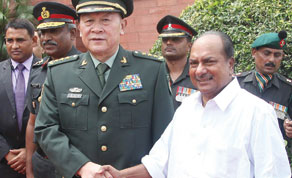
Chinese Defence Minister Liang Guanglie shakes hands with his Indian counterpart A K Antony in New Delhi yesterday
On the first trip by a Chinese defence minister to New Delhi in eight years, Liang and his counterpart A K Antony discussed security in the Asia-Pacific region, where India’s competition for resources and influence has added to Chinese concerns about the US ‘pivot’ to Asia.
Liang’s visit comes at a time when Beijing is grappling with a change of leadership and friction in the South China Sea. It should help avoid flare-ups along China’s long and heavily fortified border with India.
“We have reached the very important consensus of further promoting the friendly, strategic and co-operated partnership between the two countries and promoting friendly exchanges and co-operation between the two armed forces,” Liang told reporters outside the Indian defence ministry.
Nuclear-armed neighbours India and China - the world’s largest countries by population - disagree on where their Himalayan border lies and fought a brief war 50 years ago. As rising superpowers with large and fast-growing militaries, their relationship and ties to Washington influence Asian security.
Over the past two decades, economic relations have normalised. The defence relationship has improved but remains prickly. After two rounds that started in 2007, joint military exercises of around 100 personnel were suspended four years ago after a spat over visas.
Antony said the exercises will resume “at the earliest,” but didn’t give any timeline. Indian and Chinese ships conducted their first joint naval practices in June, but they were not considered part of the regular joint military exercises.
Antony also said he had accepted an invitation to visit Beijing.
“We covered a lot about the situation in the South Asia, Asia-Pacific region,” Antony said.
“We had a very frank and heart-to-heart discussion on all the issues... including in the border areas.”
Liang confirmed that there was now a mutual desire to move forward.
“We have reached a consensus on high-level visits and exchange of personnel, maritime security... and co-operation between the two navies,” Liang said after yesterday’s talks.
“I had candid and practical discussion with the defence minister,” he added.
During a week-long tour that included a stop in Sri Lanka, Liang sought to calm India’s fears about Chinese military and infrastructure aid to other countries in the region, and he denied rumours of a Chinese army presence in parts of Pakistan claimed by India.
“I’d like to take this opportunity to clarify to you once again: the PLA (People’s Liberation Army) has never deployed a single soldier in Pakistan-controlled Kashmir,” he told The Hindu newspaper.
While in Sri Lanka, he said China’s efforts to build close ties with South Asian nations were not aimed at any third party.
Both China and India say they are committed to attaining prosperity via peaceful means. Business relations are booming and trade flows have reached an annual $75.5bn, up from just $3bn a decade ago. Trade is skewed in China’s favour.
India courts close ties with Vietnam. Its exploration of an oil block in the South China Sea has needled Beijing, which claims the sovereignty over almost all of the sea and has stepped up its military presence there.
Police detain Tibetan protesters
Police yesterday detained eight Tibetan protesters who were demonstrating against the visit of China’s defence minister near the prime minister’s residence. The young protesters from India’s large Tibetan exile community shouted anti-China slogans and waved Tibetan flags before being bundled into police vehicles. A Delhi police official said there were eight demonstrators at the protest who were all detained. The protesters were marching towards Prime Minister Manmohan Singh’s house after India and China announced they would resume joint military exercises. Tibetans have long chafed under China’s rule over the vast Tibetan plateau, saying Beijing has curbed religious freedoms and their culture is being eroded by an influx of Han Chinese, the country’s main ethnic group. Beijing, however, insists Tibetans enjoy religious freedom and have benefited from improved living standards as a result of China’s economic expansion.