


Agencies/New Delhi

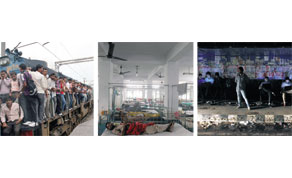
Train commuters travel on a diesel locomotive engine of a local train in New Delhi. Centre: The power cut brings misery to patients at Siliguri hospital. Right: Commuters work on their laptops as they wait for the bus at Noida
A massive power failure hit India for the second day yesterday as three national grids collapsed, blacking out more than half the country in an unprecedented outage affecting over 600mn people.
Metro services were stopped temporarily in the capital and hundreds of trains were held up nationwide.
Federal Power Minister Sushilkumar Shinde told reporters that the monster outage, which struck around 1pm (0730 GMT) in the middle of the working day, was caused by states drawing power “beyond their permissible limits”.
There appeared to have been a domino effect, with the overloaded northern grid drawing too heavily on the eastern grid which in turn led the northeastern network to collapse.
An area stretching from the western border with Pakistan to the far northeastern state of Arunachal Pradesh next to China was affected, with the huge cities of New Delhi, Kolkata and Lucknow suffering without supplies.
“Half the country is without power. It’s a situation totally without precedent,” said Vivek Pandit, an energy expert at the Federation of Indian Chambers of Commerce and Industry.
It took five hours to get the northeastern grid wholly back on line, while the eastern and northern networks were operating at 35% and 45% respectively by 6pm, Shinde said.
In New Delhi, the metro train system came to a standstill for a few hours and traffic lights went out, causing chaos for a second day after a failure on the northern grid on Monday which caused the worst outage in more than a decade.
Even as Shinde struggled to explain how such enormous power failures could occur in successive days, news broke that he had been promoted to home minister in a cabinet reshuffle.
Meanwhile, on the streets, people seethed over the lack of air conditioning, crashed computer systems and missed deliveries.
“I had been waiting for a shipment of stock to arrive since morning and now I’m told it will be delayed indefinitely,” said furious Delhi businessman Anshul Aggarwal.

Heavy traffic moves along a busy road during the power cut at Gurgaon
“The stock was coming on a goods train which is now stuck in the middle of nowhere,” Aggarwal said.
About 400 trains on the national rail network were hit, a railways spokesman said, with all operations stopped in Uttar Pradesh.
In Jaipur, renowned internationally as a jewellery centre, gem cutters and polishers were forced to put down their tools.
“We have almost 200,000 workers engaged in the trade and most of them operate from their houses. They don’t have power back up, so it’s obviously a major problem,” said Vivek Kala, a former president of Jaipur Jewellers Association.
In the east, West Bengal went without power as the eastern grid, which supplies five states, failed under the stress of over-demand.
“This is the worst power crisis in the region. We were supplying power to the northern grid and this power sharing has led to the collapse,” West Bengal state Power Minister Manish Gupta said.
Monday’s outage had seen the northern grid, which supplies nine states including Delhi, collapse for six hours shortly after 2am.
In total, 20 out of 29 states were affected yesterday.
The growing gap between electricity demand and supply in India has been highlighted by business leaders as a major obstacle to maintaining growth in Asia’s third-largest economy.
The government has set a target of $400bn of private and public investment over the next five years, but its track record is abysmal.
India has undershot every electricity goal it has set for itself in its economic plans for the past six decades—and in the last three plans has missed capacity addition targets by 50 percent, according to the government Planning Commission.
Residents sweat and seethe
Anger and frustration boiled over on the streets of as the second mass power cut in as many days paralysed transport networks and hit small businesses across the country. After a grid failure the day before knocked out power in nine states, yesterday’s monster outage hit 20 states in the northern half of India, from Rajasthan in the west to eastern Arunachal Pradesh bordering China.
As well as covering a much wider region, the second blackout had a far greater impact as it occurred in the middle of the working day. “I can understand this happening once in a while but how can one allow such a thing to happen two days in a row?” complained Anu Chopra, 21, a saleswoman in a cosmetics shop in New Delhi.
“It just shows our infrastructure is in a complete mess. There is no transparency and no accountability whatsoever,” Chopra said.
The Indian capital’s always hectic transport system slipped into chaos, with traffic light failures triggering snarls and lengthy tailbacks, while its metro trains, which carry around 2mn passengers daily, ground to a halt. Hundreds of inter-city goods and passenger trains were also left stranded by the outage.
“I had been waiting for a shipment of stock to arrive since morning and now I’m told it will be delayed indefinitely,” said furious Delhi businessman Anshul Aggarwal. “The stock was coming on a goods train which is now stuck in the middle of nowhere,” Aggarwal said.
Smriti Mehra, a teller in a Bank Of India branch in the capital, said the latest outage had caused total confusion at work. “Our main server is down. We have had to send back so many of our customers. There is no Internet, nothing is working,” Mehra said. “It is a total breakdown of everything in our office,” she added.
While the situation fuelled frustration in Delhi, it threatened to have more deadly consequences in West Bengal, where hundreds of miners were trapped underground when their lifts broke down.
“Around 200 miners who had been trapped inside the Eastern Coalfields Ltd mines in Sodepur and Satgram in the district following power failure were rescued after emergency power supply was arranged,” an officer said.
Limited power cuts are almost a daily occurrence in much of India. For businesses and households who can afford them, the only back-up comes from power inverters that can keep basic electrics like lights and fans working, or expensive diesel-guzzling generators.
“Inverters don’t last long and running a generator is costly,” said Jaidev Singh, 65, the owner of a stationery shop in Delhi.
“The generator makes so much noise and there is so much smoke. Customers want to shop in a relaxed atmosphere, this is not what they want when they come out,” Singh said.
Vivek Pandit, an energy expert at the Federation of Indian Chambers of Commerce and Industry, said it was still too early to put a figure on the financial cost of the two successive outages. “The particular problem with the second blackout is that it’s slap-bang in the middle of the day, so there will probably be a significant economic fallout,” Pandit said.
Meanwhile, the power watchdog has summoned top officials of five errant states to appear before it on August 14, holding them personally responsible for not adhering to an earlier order of not to overdraw electricity. Those summoned for the August 14 hearing by the Central Electricity Regulatory Commission are Uttar Pradesh, Haryana, Punjab, Uttarakhand and Jammu and Kashmir. “In our order dated July 10, 2012, we had directed that it would be the personal responsibility of the officers in overall charge of the state utilities/state load dispatch centres to ensure compliance of our direction,” Central Electricity Regulatory Commission (CERC) said. “Since the situation has not improved despite our directions, we direct the officers-in-charge of the state utilities/state load dispatch centres of the states of Uttar Pradesh, Haryana, Punjab, Uttarakhand and Jammu and Kashmir to personally appear before the commission on August 14, 2012,” the CERC said in the order released July 30. The power outage for the second successive day has been attributed by Power Minister Sushilkumar Shinde to overdrawing of electricity by some states.
The world’s worst power cuts
Here is a list of the worst power cuts around the world in recent history:
Asia
India - January 2, 2001: More than 200mn people in northern India are left without power after a power station in Uttar Pradesh breaks down.
July 30, 2012: A massive power cut blacks out northern India, leaving more than 300mn people without power, after the entire northern grid collapses. Yesterday a massive power failure hits India for the second day as three national grids collapse, blacking out more than half the country.
Latin America
Brazil - March 11, 1999: Some 75mn to 90min people are deprived of electricity in the south of Brazil for from two to four hours.
Chile - March 14, 2010: More than half of the country, including the capital Santiago, are left in the dark for several hours after a power cut blamed on damage from the deadly earthquake of February 27.
North America
United States - November 9, 1965: A blackout plunges 30mn people in seven northeastern US states and part of Canada into darkness after a sharp upsurge in output overburdens a power relay station near the Canadian border.
August 14, 2003: New York, much of the northeastern US and southeastern Canada are hit by the biggest power blackout in US history, apparently due to a break in a circuit in a power unit in Cleveland, Ohio.
Europe
Germany-France - November 4, 2006: A sudden surge in Germany’s demand for electricity due to freezing weather plunges much of Europe into blackness as France and other power-exporting countries find their grids overtapped.