


IANS/Kolkata
The discovery of a new subatomic particle, possibly the Higgs boson considered “a key to the cosmic riddle,” has put the spotlight once again on Satyendra Nath Bose, the Indian scientist from whose surname the word ‘boson’ is derived.

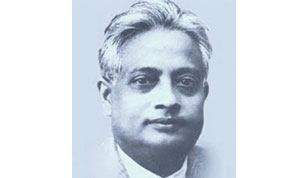
Bose: pioneering work
“India is like a historic father of the project,” said Paolo Giubellino, spokesman of the Geneva-based European Organisation for Nuclear Research (CERN), which conducted the experiments to find the elusive ‘God’ particle.
Bose (1894-1974), a physicist from Kolkata (erstwhile Calcutta) and a contemporary of German scientist Albert Einstein, did path-breaking work on quantum mechanics in the early 1920s, using mathematics to describe the behavioural pattern of the bosons - one of the two families of fundamental particles that the universe is classified into.
The other family of fundamental particles - fermions - is named after Italy-born American physicist Enrico Fermi.
Bose worked with Einstein in the 1920s, providing the foundation for Bose-Einstein statistics, and the Bose-Einstein condensate. He is also acknowledged as the person who laid the foundation of quantum statistics.
However, Bose never won the Nobel Prize, even though in later years the award was given several times for research on bosons.
“He laid the base through his work. He definitely deserved the Nobel Prize. Definitely,” said Archan Majumdar, an astrophysicist at S N Bose National Centre for Basic Sciences here.
“However, at the same time, some kind of historical justice has also been done. His name has been immortalised in bosons,” Majumder said.
“And while it is always good to recognise past achievements, it does not take the sheen away from the present successes. What the CERN scientists have done is great. It’s a great leap forward in the fundamental research and knowledge of human civilization,” he said.
Majumdar said Bose’s name would be better known if his discoveries hadn’t been made during the colonial era. “If India had been an independent nation he could have got more recognition than he has,” Majumdar said.
“Also, if he had the Nobel Prize which he deserved more than many others he would have been more known, but unfortunately it didn’t happen.”
In 1954 Bose awarded the Padma Vibhushan - India’s second highest civilian honour.
Milan Sanyal, director of Saha Institute of Nuclear Physics, though delighted at the discovery, rued the fact that while the Higgs (named after British physicist Peter Higgs) in Higgs boson was in upper case, the boson was in lower case.
“I shall write to CERN on this. It is not a complaint. But I will point it out. I have already received many e-mails and calls on this. I don’t want to shoot any letter now as they are celebrating. But I shall write to them soon,” Sanyal said.
However, he said scientists of his institute had collaborated with CERN for the crucial Compact Muon Solenoid (CMS) experiments.
“On August 26 last year, we signed three memorandums of understandings with CERN, one of which was on CMS,” he said.
Five faculty members from the institute were part of the core CMS team. “Besides, we have 20 Ph D students who are part of the project,” he said.