


 |
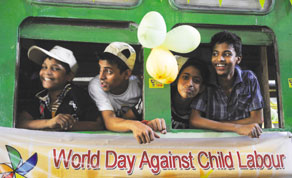
| Rescued child labourers sit inside a tram during a ‘city ride’ in Kolkata yesterday. Non-governmental organisation Child In Need Institute (CINI) organised the excursion for the children to mark the World Day Against Child Labour |
“We call for a review of the existing anti-child labour legislation and policies and adapting them to the Right of Children to Free and Compulsory Education Act, 2009 (RTE) and the Juvenile Justice Act, 2000,” the National Commission for Protection of Child Rights (NCPCR) and the United Nations Children’s Fund declared in a joint statement here.
The statement was released at a function organised by NCPCR on World Anti-Child Labour Day here.
The labour ministry has given a new set of recommendations aiming to make the existing anti-child labour law in tune with the International Labour Organisation (ILO).
While the current Child Labour (Prohibition and Regulation) Act, 1986 allows employment of children of 14 years of age in industries that are not categorised “hazardous,” the reforms seek complete ban on any form of child labour.
“We also call for universalisation of secondary education for all children in the age of 14-18 years,” the statement added.
Shanta Sinha, NCPCR chief, said other than the reforms, the country also needs the “right atmosphere in schools” to make education lucrative for children and reduce drop-out rate.
“To get an adolescent child to school, away from work, we have to create the right kind of atmosphere also. Schools need to be more student-friendly and environment in compliance with RTE,” Sinha said.
Another child rights group said children should not do any work except homework and the minimum age for employment should be increased from 14 to 18.
“On the one hand, the government says that children in the country shall have the Right To Education and, on the other, it allows children to be employed in so-called non-hazardous activities, depriving them of their right,” Soha Moitra, director of Child Rights and You (CRY), said.
“There has been some talk of a cabinet-level proposal that aims at making these amendments. However, the government also has to ensure proper education facilities. Then, even the poor will not deny their children the right to education,” she added.
CRY yesterday initiated an online campaign that will allow people to take photographs of instances of child labour and post it online, helping to catch the guilty.
According to Sanjay Gupta of the Delhi-based Childhood Enhancement through Training and Action (CHETNA), the need of the hour was to ensure life skills for “rescued children.”
“The government should increase the age limit in the Child Labour (Prohibition & Regulation) Act but only if it can ensure alternative modes of education which also provide the so-called rescued children with appropriate life skills,” Gupta said.
“The age of 14 to 18 is very conducive to learning new skills. Often, working children have mastered some trade so when they are rescued their education must be such that they don’t lose their skills that could be very important for their livelihoods once they turn 18.”
Further, policymakers have to take into account the invisible population of child workers, said Gupta, who claimed many child workers were not accounted for and ineffective policies were made due to faulty statistics.
CHETNA, along with the organisation Badhtey Kadam, on Monday organised a Ghost Parade, where some 50 street children urged the government to either ensure their rights or declare them ghosts.
“It is disheartening to know that the government can afford to spend Rs35 lakhs for the maintenance of toilets at the Planning Commission’s office but is not willing to invest in matters relating to children who are the future of the country,” said 16-year-old Shanno, the president of Badhtey Kadam.
“To make matters worse, law enforcement is very weak. Little has been done so far to rescue and rehabilitate child workers and to punish their employers. The law needs to be strictly enforced and culprits should not be allowed to get away with exploiting children,” said Shireen Vakil Miller of Save the Children.
According to Unicef, India has 447mn children, of which 12% are child labourers.