


AFP/Mumbai
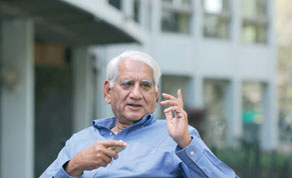
There’s a note of despair in his voice as Charles Correa, India’s most famous modern architect, discusses the multiplying shiny high-rise apartment blocks sprouting across the nation.

You can’t go on overloading these existing cities. They will break down
“You see the big ads - ‘Buy your house, it’s time you moved up in life’ - and it’s a horrible project. Twenty-five identical buildings, some swimming pools somewhere, and the angle is such that you see all 25 of them,” he says.
“They’re the kind of cloned building that used to be done by Stalin and the Russians or in the Bronx that people just hate and dread,” adds the celebrated Modernist.
The reason, he believes, is that people think tower blocks are “progressive” and “modern” - a perception derived from cities such as Dubai and Singapore which are visited and admired by India’s new elite.
In a career spanning five decades, the Mumbai-based architect and planner from the former Portuguese colony of Goa has passionately advocated buildings adapted for their climate and environment and shaped by local culture and history.
Asked about the generic glass-fronted office blocks that line the streets of new towns like Gurgaon, the booming outsourcing and IT hub outside the Indian capital, he has no answer.
“What should I do? Go and throw stones at them?” he says.
While the battle for good design might be lost, Correa has not given up on his campaign for more livable cities in India as overcrowding, pollution and the destruction of open spaces gather pace.
At a recent conference in New Delhi, the sprightly 81-year-old could be found speaking to city planners from all over, stressing the need to protect forest areas and other public spaces for citizens to meet and socialise.
“They (India’s cities) are mostly getting worse, but the good thing is that they are a system of cities. It’s not like Lagos dominates Nigeria, London dominates England and Paris in France. That’s deadly,” he said.
Correa’s hope is that small and medium-sized towns can be developed and grown, integrating efficient public transport and proper planning which are missing in the current urban centres of Delhi, Mumbai, Kolkata or Bangalore.
Medium-density residential buildings of five to six storeys are ideal structures, not the vanity high-rise projects whose occupants overwhelm local infrastructure and public amenities.
“You can’t go on overloading these existing cities. They will break down,” says the former chairman of the National Commission on Urbanisation and one-time Harvard professor.
“I do worry and despair that our government won’t understand that you need a proactive role,” he sighs, holding his round thick-framed spectacles which recall one of his heroes, the French master Le Corbusier.
The scale of the task - and the stakes for the hundreds of millions involved - could not be larger.
India is a land of gigantic, often alarming numbers, but those available for the predicted explosion in the urban population are truly arresting.
Only 30% of India’s 1.2bn population live in cities currently, far lower than the 50.6% in China or the 70-80% in developed countries, according to the UN’s 2011 World Urbanisation Prospects report.
It forecasts India’s urban population will grow 28% from its current level of 377mn to 483mn by 2020. By 2030, it will have grown 60% to 606mn.
Correa’s hometown of Mumbai with its 20,000 inhabitants per sq km on average has vastly exceeded the limits of its infrastructure, as demonstrated by its astronomical property prices and dangerously overloaded trains.
In the early 60s, Correa worked on a plan called the New Bombay which proposed opening up areas for office and residential space across from the main landmass that forms the heart of the city.
“When we were working on the New Bombay, the city was just 4mn. It was going to be 8mn and we said it’s never going to work if we are 8mn,” he says.
The plan was mostly ignored and today Mumbai has a population of 12.5mn according to the 2011 census.
Migrants must be diverted away from the main cities to second or third-tier towns where planners have an opportunity to anticipate the changes ahead and build better public transport for instance.
“They come to the cities for jobs. If you can find ways to employ more people in the villages, that’s wonderful, but if they are coming for jobs they don’t have to come to Delhi and Bombay.”