


Agencies/Sriharikota, Andhra Pradesh
India successfully put into orbit the first radar-imaging satellite of its own construction yesterday, which will provide crop information and help predict disasters, officials said.

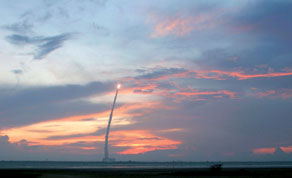
The Polar Satellite Launch Vehicle blasts off, carrying the country’s first radar imaging satellite Risat-1 from the Satish Dhawan space centre in Sriharikota yesterday
The Radar Imaging Satellite Risat-1 took off at 5.47am from the spaceport in Sriharikota, aboard a 321-tonne launch rocket.
The radar technology can function through clouds, in fog and in darkness, Indian Space Research Organisation spokesman S Satish said.
Images from the 1,858kg satellite would be used for agriculture and disaster management, Satish said. “This is the heaviest satellite put into orbit by the PSLV (Polar Satellite Launch Vehicle),” Satish added.
“With Risat-1 we can now forecast Kharif season,” ISRO chairman K Radhakrishnan said.
Kharif refers to the crop planted during the rainy season. Evaluation of the crop from the air is difficult due to frequent cloud cover at that time of year.
With a rich orange flame at its tail and a plume of white smoke, the rocket ascended towards the blue sky amidst the resounding cheers of ISRO scientists and media team assembled at the launch centre.
People perched atop nearby buildings too happily clapped as PSLV-C19 went up.
Space scientists at the new rocket mission control room of the ISRO were glued to their computer screens watching the rocket escaping the earth’s gravitational pull.
The ISRO-made Risat-1 is the heaviest luggage so far ferried by a PSLV since 1993.
At around 17 minutes into the flight, PSLV-C19 delivered Risat-1 into a polar circular orbit at an altitude of 480km and an orbital inclination of 97.552 degrees.
The ISRO, with its network of ground stations, monitored its health.
“PSLV-C19 mission is a grand success. This is the 20th successive successful flight of PSLV. India’s first radar imaging satellite was injected precisely into orbit,” Radhakrishnan said after the launch.
The solar panels of Risat-1 were deployed successfully soon after it was injected into the orbit.
According to Radhakrishan, in three days the satellite will be taken up to its intended orbit at an altitude of 536km by firing the on-board motors.
With this launch India joins a select group of nations like the US, Canada, Europe and others to have such an advanced technology. It is a 30-year effort, Radhakrishnan added.
According to Radhakrishnan, the space agency is planning some more satellite launches - communication and remote sensing satellites - this year.
He said the space agency would launch a communication satellite weighing 3.5 tonne through the Ariane rocket from French Guiana and two PSLV mission later this year.
He said ISRO will send SARAL satellite - an Indo-French initiative - using its PSLV rocket from here. There will also be the launch of first Indian regional navigational satellite this fiscal year.
China’s official Xinhua news agency reported India’s launch of a “spy satellite” which could be used “for defence purposes” as well as for the applications listed by Indian authorities.
Sources at India’s space agency said there was no plan to use the Risat-1 for defence purposes.
India has several optical imaging satellites in orbit, but these do not work through clouds or at night.
The country also launched an Israeli-made radar-imaging satellite, the Risat-2, in April 2009, reportedly to meet security requirements.