


 |
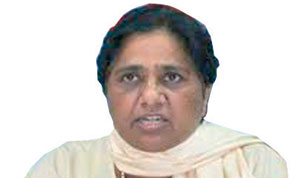
| Mayawati |
Former Uttar Pradesh chief minister Mayawati yesterday warned that any move to raze towering statues she built of herself and other low-caste icons could create law-and-order problems in the country.
The firebrand leader was speaking to party workers after being dethroned last month as chief minister of Uttar Pradesh following a colourful and scandal-tainted term running the country’s most populous state.
While in power she spent billions of rupees concreting green areas to build huge marble, granite and sandstone statues of herself and other Dalit leaders as well as hundreds of stone elephants, her Bahujan Samaj Party’s symbol.
“We never tried to disturb memorials and parks named after their (the new ruling Samajwadi Party’s) icons. We honoured their feelings and I hope the new government will do the same,” Mayawati said.
Any attempt to touch the so-called “memorial parks” could “lead to law-and-order problems, not only in the state but also in the country,” Mayawati, 56, said in Lucknow.
She was referring to media reports the new government, led by charismatic 38-year-old engineering graduate Akhilesh Yadav, may open hospitals and schools in the parks she built on a scale to rival the monuments of ancient Rome.
Uttar Pradesh - which would rank as the fifth most populous nation in the world if it were a country - badly needs hospitals, schools and other public services for its 200mn people.
India’s 160mn Dalits were once known as “untouchables” and given the most menial jobs. Many are still forbidden to use communal wells and excluded from social events, despite anti-discrimination laws.
But the estimated Rs20bn ($500mn) Mayawati spent on the memorials, according to a Supreme Court suit challenging the construction, appalled critics and was seen as a factor in her loss of power.
Hours after Mayawati’s warning, the Congress Party said the feelings of all classes should be respected, and added that no one should play with the statues.
“As far as the statues are concerned, this is our strong opinion that the feeling of all classes should be respected. And of course, no one should play with their statues,” said Congress spokesman Rashid Alvi.
Asked whether Mayawati was trying to revive her lost power through the Dalit icons, Alvi said: “You should ask this to Mayawati.”
Meanwhile, the stage is set for Mayawati to make her first public appearance after her defeat in the Uttar Pradesh assembly elections, at the 121st birth anniversary celebrations of Dalit icon Bhimrao R Ambedkar.
The former chief minister will do the honours today at the annual Ambedkar Jayanti celebrations at the newly-created Bheem Nagri in Dhanuali, 10km from Lucknow. It will be an ambitious programme that will also see Mayawati attempt to win over Dalit vote bank.
“Everyone is waiting to hear Mayawati, what she will say and if she will spell out the party line for future action programmes,” said Geetam Singh, a BSP activist.
The meeting today will be preceded by an Ambedkar Jayanti procession with brass bands, tableaux depicting the life and message of the Dalit messiah, who is the chief architect of the constitution of India, a glittering march of horses and maybe even elephants if the forest department permits.
More than 400 buses will ferry people to the venue of the spectacular Dalit show today.
The backdrop of the massive stage will be a 80x40ft replica of parliament. Opposite that will be a replica of the India Gate.
Political observers say she will use the platform to mobilise her vote bank and the rank and file of the party with an eye on the 2014 Lok Sabha elections.
“She is set on parliament and that is why the backdrop shows the Sansad Bhavan (parliament) in glorious splendour. The Dalits have to ensure now that she rides to power in New Delhi,” commented a BSP worker, Arvind Pushkar.
Ambedkar Jayanti celebrations in Agra, called the Dalit capital of north India because of the huge concentration of Dalits, are grand and unique. They were initially aimed at showing Dalit empowerment as a response to the Ram Lila celebrations of the upper castes.