


Agencies/New Delhi
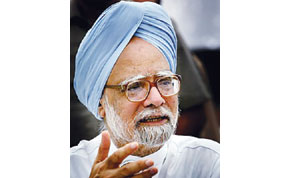
Prime Minister Manmohan Singh yesterday blamed his unruly coalition for difficulties in passing economic reforms as he reacted to the resignation of Railway Minister Dinesh Trivedi over a proposed hike in train fares.

“This is an occasion when we must eschew narrow partisan ends and stand united as a nation
“The difficult decisions we have to make (in ushering in economic reforms) are made even more difficult because we are a coalition government,” Singh told the Lok Sabha, the lower house of parliament.
“We have to formulate policy with the need to maintain consensus,” the 79-year-old Congress leader added. “This was sharply brought out in the presentation of the railway budget.”
Trivedi quit late Sunday after facing a mutiny in his Trinamul Congress Party whose leader and West Bengal Chief Minister Mamata Banerjee blasted the proposed fare hikes as “anti-poor.”
Singh told parliament he accepted “with regret” the departure of Trivedi, who has been in office for less than a year.
He noted the minister had promised to carry out a “modernising” vision for the railways laid out by Banerjee, who served as the previous rail minister.
“A new railway minister will be sworn in shortly. He will have the onerous duty of carrying forward the challenging task of modernising our railway system,” Singh said.
He appealed to fractious coalition allies to back reforms to spur growth of Asia’s third-largest economy.
“This is an occasion when we must eschew narrow partisan ends and stand united as a nation,” Singh said.
Banerjee’s Trinamul Congress is an increasingly unreliable government ally, which sank plans last year to allow foreign supermarkets into India.
The storm over rail fares is the latest in a series of embarrassing internal policy disputes that have paralysed the government’s liberalisation programme.
The government in its main budget last week steered clear of contentious economic liberalisation measures in what it conceded was a deliberate move to ensure it won parliamentary passage.
Trivedi, 61, later paid a farewell visit to railway ministry staff and said he had only been seeking to make India’s notoriously dangerous rail system safer by proposing the fare increase.
“Even China is 50 years ahead of us in rail safety,” he said. “But in India, unfortunately, we do not value life...”
The train system has a notoriously bad accident record, with a recent official report revealing almost 15,000 people are killed a year crossing rail tracks - a figure the government described as a “massacre.”
“One single death is not acceptable,” Trivedi said.
Trivedi’s proposed modest rail fare hikes now hang in the balance with analysts suggesting the government may roll back rises for second-class passengers but keep them for first-class.
The first-class journey between Mumbai and Delhi would rise by Rs415 ($8.30). For bottom-rung second-class customers, the Mumbai-Delhi fare would rise by Rs27.68.
Even the country’s militant unions have backed the fare hike to improve safety.
The railways - India’s main form of long-distance travel – carry millions of people daily. But derailments, collisions and other accidents are common.
Train doors are normally open to the elements to combat extreme temperatures with many passengers hanging out of carriages.
Asked what he did wrong, Trivedi told reporters: “It is up to the people to ask.”
Meanwhile, the Communist Party of India (Marxist) said the “drama” of Trivedi’s resignation shows the Trinamul Congress was not concerned about the railways’ safety aspects.
“The drama of the resignation after the presentation of the railway budget reflects badly on the Trinamul Congress and the functioning of the UPA government,” the party said in a statement.
Referring to Banerjee, it said she had no concern for “the perilous state of the railways which is in a financial mess and where safety aspects are being neglected.”