


Agencies/New Delhi
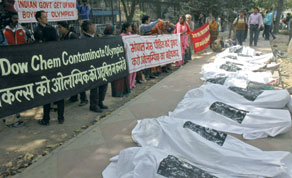
Activists and victims of the Bhopal gas tragedy submitted a petition signed by 20,000 people yesterday calling on British authorities to drop Dow Chemical as sponsor of the London Olympics.

Survivors of the 1984 Bhopal gas tragedy stage a mock funeral during a protest against Dow Chemicals’ sponsorship deal with the 2012 London Olympics Games, in New Delhi yesterday
About 60 campaigners handed over the petition to the British High Commission in New Delhi before holding a protest outside the office of the Indian sports minister where they shouted slogans and staged a mock funeral.
Campaigner Rachna Dhingra said that the British government had been “pumping money into building the stadiums. They can’t shy away from their responsibility.”
US-based Dow is the parent company of Union Carbide, whose pesticide plant leaked gas into the central city of Bhopal in 1984, killing tens of thousands of people.
Separately, the sports ministry said in a letter to International Olympic Committee (IOC) President Jacques Rogge that it was “dismayed” with Dow’s sponsorship of the event, a ministry spokesman said yesterday.
“We are dismayed that the IOC has not respected the sentiments of a large group of stakeholders including Olympians and withdrawn its association with Dow Chemical,” said the letter, which was sent on Friday.
The Indian Olympic Association had previously sent a letter of protest to its British counterpart, but stopped short of calling for a boycott.
The IOA has maintained that India will not boycott the London games.
“We are still protesting ... we will decide on the form of protest. It will hurt the players who have qualified if we tell them that they are not going,” IOA’s acting president V K Malhotra told the CNN-IBN network.
London organisers have entered a $11mn sponsorship deal with Dow including a decorative wrap to be installed on the Olympic Stadium.
Bhopal activists have been campaigning against Dow’s role at the 2012 Olympics since last year, but the International Olympic Committee earlier this month insisted that the company would remain as one of the sponsors.
“The Indian government is spineless. They just want to protect the interests of the big multinational companies. They have not even issued a proper threat of a pullout,” said Balkrishna Namdeo, another campaigner.
The Indian government in May filed a petition in the Supreme Court asking for higher compensation from the company, which was initially set at $470mn in a settlement reached in 1989.
Dow, which bought Union Carbide after the disaster, insists that all of the company’s liabilities were settled in the 1989 agreement.
Millions of workers
to stage strike today
Today’s strike is not expected to significantly affect banks and financial markets, but traders say there could be some volatility in the bond market if volumes are lower than normal
Agencies
New Delhi
Millions of workers of all political hues will go on strike across India today to express their anger at soaring prices and to back demands for improved rights for employees, trade unions and political activists said.
The strike, which will include workers from state-run phone companies, bus drivers and postal workers, is a new headache for Prime Minister Manmohan Singh’s government as it grapples with weakening economic growth and faces elections in several states.
Workers linked to the ruling Congress Party will join the protest and have promised further action if their demands are not met.
The protests are not expected to significantly affect banks and financial markets in Asia’s third-largest economy, but traders said there could be some volatility in the bond market if volumes are lower than normal.
“Volumes could be lower, but settlement should happen,” said a senior dealer at a state-run bank.
The country’s largest lender, the State Bank of India, has informed the Bombay Stock Exchange (BSE) that its operations would be affected by the strike.
In the transport sector, national carrier Air India said its operations would not be hit, as its unions have not given any notice to the management.
The Indian Railways said its operations will be normal. But it is widely expected that rail tracks may be blocked affecting services. Also road traffic on national and state highways could be hit as various unions are known to target these.
States like Kerala, Tripura and West Bengal, where the communist parties have a greater hold, are likely to be affected the most.
The strikers have a long list of demands. Among them, they want the government to take measures to contain inflation, provide universal social security cover for workers in the vast unorganised labour sector, and to stop selling stakes in state-run companies.
“We will have to think about our future course of action if the government does not come forward with proposals on how it will react to our demands,” G Sanjeeva Reddy, president of the Indian National Trade Union Congress, the ruling party’s trade union, said.
Singh had appealed to Reddy to call off the strike, but was ignored, according to a report in the Hindu newspaper yesterday.
Hit by high interest rates, stubborn inflation and a stuttering reform agenda, India’s economy is expected to grow by about 7% in the fiscal year ending March, compared with earlier expectations of about 9% growth.
Singh’s government, which is also beset by multi-billion dollar corruption scandals, has faced a slew of protests since winning a second term in 2009, denting the Congress Party’s image as a defender of the poor.
The party is currently fighting five state elections, including one in Uttar Pradesh, the country’s most populous state.
In Kolkata, West Bengal Chief Minister Mamata Banerjee appealed to the masses to foil the strike.
“We (Trinamul Congress) had earlier done the same mistake by calling for strikes and shutdowns. We later realised that a problem cannot be solved by calling a strike. In the last two years, we have not called a single strike,” Banerjee said.
“We committed a mistake and have rectified it. We think the people have forgiven us for our mistake. I appeal to the masses of my state not to respond to this strike. A strike will rob daily labourers of their earnings,” she said.
Today’s strike will be the 14th general strike since India opened up its economy with major reforms in 1991.
Malayali prisoners return from Saudi Arabia
By Ashraf Padanna
Thiruvananthapuram
Four Keralites, trapped in Saudi Arabian jails after completing their terms, reached home early yesterday thanks to philanthropist-entrepreneur Siddeek Ahmed.
This is the second batch of Kerala expatriates languishing in the kingdom’s jails whom Ahmed had promised to take home.
The repatriation is part of Kerala Chief Minister Oommen Chandy’s ‘Swapna Safalyam’ project that he launched after the recent conclave of Kerala expatriates held here.
Indian parliament was recently told that some 1,400 Indians, more than 60% of them believed to be Keralites, are languishing in Saudi jails and most of them are victims of recruitment fraud who do not possess valid passports and resident permits.
“I feel proud and happy that due to our efforts and the publicity it received, diplomatic missions of other countries are also adopting similar programmes to bring back their citizens detained in Saudi Arabia. I came to know that the Egyptian embassy has already started working on it,” said Ahmed, who heads the ITL-Eram conglomerate which has presence in the entire Gulf region and in India.
In all, there were five prisoners released from a deportation centre in Dammam. But one of them, Nazeer Shihabudheen, could not board the flight as he was unwell and was admitted to Dammam’s Amal Hospital.
Others, Purushothama Kurup, Ramanandan Sajeev, Rafi Mohamed and Raveendran Vipin Roy landed at the Thiruvananthapuram International Airport here.
Ahmed handed over the tickets to them at a simple ceremony held at Paragon Auditorium in Dammam on Saturday evening as recommended by NORKA-Roots, the field agency of Non-resident Keralaites Affairs (NORKA) Department of the state government.
“According to police records, they all landed up in jail as the sponsors reported they were missing when they were caught by the police,” said Ahmed, who is also the producer of Veeraputhran, a film based on the life of legendary freedom fighter and social reformer Mohamed Abdurrahman Sahib.
The scheme was officially launched by Chandy here on February 8 by accepting an enlarged replica of the air ticket from Ahmed on behalf of Kallacheri Mathew, one of the beneficiaries recommended by the chief minister who is already back home.
Company launches
India’s costliest soap
Selling India’s costliest soap at Rs720, Karnataka Soaps & Detergents hopes to earn around Rs350mn from this newly-launched super premium product next year, a senior company official said yesterday. The Mysore Sandals Millennium soap is made of vegetable oil, special conditioners, moisturizers, vitamin-E, Jojoba-Mimosa, sandal oil, almond oil, hydrolysed milk protein and other specially-selected ingredients. “We plan to sell around 600,000 pieces of the soap next year,” an official said. “We have sold 18 pieces in 18 days,” M Seshagiri Babu, managing partner at Kamachi Foods, a franchise of Nilgiris departmental store in Chennai, said.
Rahman performs
at Oscars again
Indian composer A R Rahman performed at the 84th Academy Awards in Los Angeles as part of the Oscar band in his third performance at the prestigious award ceremony. “Oscar sangamam - if you are watching the Oscars live, catch our Oscar superband headed by Hans Zimmer perform tonight,” Rahman posted on his Facebook page for his fans. Last year Rahman had sung his tracks from 127 Hours at the Oscar ceremony. In 2009, the 46-year-old performed for the first time at the Oscar stage and in the same year he won two golden statuettes for best original score and best original song (Jai ho) for the movie Slumdog Millionaire.
Mullaperiyar panel
gets two-month extension
The Supreme Court yesterday gave two more months to an expert committee headed by former chief justice of India A S Anand to submit its report on the safety of the Mullaperiyar dam in Kerala. A five-judge bench headed by Justice G K Jain accepted the request by the committee for extension time to submit its final report on the core sample of the dam structure. While granting the extension, the court expressed its displeasure over the non-co-operation of the Tamil Nadu and Kerala governments with the expert committee. The state governments are at loggerheads over Kerala’s decision to dismantle the dam, holding that its structure was not safe.
Italian company denies
shady deals in India
Italian aerospace and defence company Finmeccanica yesterday defended itself against press reports of corrupt dealings in the sale of helicopters to India by one of its subsidiaries. “Finmeccanica declares that AgustaWestland is not involved in any irregularity concerning the supply of helicopters in India,” the company said in a statement. “No notice related to the purported investigations has been served to companies and officers of the Finmeccanica Group neither in Italy, nor in India,” it added. Italian media reported that Indian authorities have opened an investigation into suspected corruption in the sale of 12 helicopters to India in 2010.
Krishna to head to
post-revolution Egypt
In the first high-profile visit from India to post-revolution Egypt, External Affairs Minister S M Krishna is expected to travel to Cairo early next month to scale up economic ties and to forge equations with the new leadership in North Africa’s most influential country. While the agenda for the talks is being firmed up, Krishna is expected to go to Egypt on a three-day visit beginning March 3, a senior official said. He will hold wide-ranging talks with Egyptian Foreign Minister Mohammed Kamel Amr with the focus on expanding bilateral trade and investment and building a rapport with the transitional military-dominated Egyptian government.