


Reuters/Ludhiana
Punjab made Sunil Jain’s family rich, but now he wishes he could afford to leave.

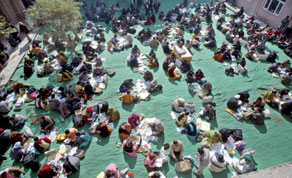
Election officials collect their documents and Electronic Voting Machines (EVM) before moving to their respective polling stations ahead of assembly elections in the northern city of Amritsar yesterday. Elections for 117 assembly seats in Punjab will be held today
Almost every day, the lights go out and machines shut down at the two factories of his $3mn-a-year packaging business in the northern state. When the power goes out, the plants have to use generators, at up to three times the cost.
Profits at Oswal Polypack shrink every year, says Jain, a 49-year-old with a penchant for fat gold jewellery and chewing tobacco. The state government seems not to care and has even raised taxes on the raw materials he needs.
“How can we survive?” Jain said from his factory office in an industrial park in Ludhiana whose roads are dotted with potholes.
“How can industry remain here, when there is no power, when you face labour shortages?” he said. “The government has been promising power for the past five years, but what we have got instead is power cuts of up to 12 hours a day.”
While much of India has galloped ahead in recent years on the back of a reform drive that began two decades ago, Punjab has somehow been left straggling behind.
The Congress Party, which leads the federal government, has leapt on that lag to woo Punjab’s voters for a return to power in the state of 27mn people in elections there today.
Firms like Sunil Jain’s are moving to neighbouring states where land is cheaper and labour is more readily available, he says. Another gripe is that states such as Himachal Pradesh next door have been granted long tax holidays as part of a federal assistance programme, putting Punjabi firms at a disadvantage.
In the 1960s and 1970s, Punjab was a rare Indian success story. A star of former prime minister Indira Gandhi’s Green Revolution - a massive farm programme credited with ending famine in the country - Punjab drove growth at a time when India was throttled by the “Licence Raj”, an all-pervading system of permits and quotas.
But after reforms in 1991 unleashed a boom in Asia’s third-largest economy, Punjab was unable to capitalise. Its economy grew at an average annual rate of 6.6% over the past decade against a national average of about 8%. High-flyers such as Gujarat and Maharashtra grew at about 10%.
The state government’s focus on farming may have earned Punjab the label the “bread basket of India,” but it has stifled the growth of manufacturing industries that the state needs to catch up with the strongest performers.
Farmers sitting on some of India’s most fertile land are reluctant to sell their fields to make way for industry, and politicians are wary of upsetting the state’s most powerful vote bank.
Slowing growth, a ballooning subsidy bill for power and food staples, and ineffective tax collection have plunged Punjab into debt, forcing the government to sell off state property.
“The crisis in Punjab is very deep,” said Sanjay Sharma, the regional bureau chief for the Times of India newspaper.
Since the early 1990s, successive state governments had failed to grasp the importance of industrialisation, he said.
“Somehow there was an impression with the rulers here that Punjab is a surplus agriculture state, and that it can survive on this model. They didn’t try new things.”
Punjab offers a snapshot of the ills that are putting the brakes on India’s economic expansion, from chronic power shortages to tussles between industry and farmers over land and policy decisions held hostage by political compulsions.
After two decades of rapid economic growth, India has struggled to develop a manufacturing base to match its world-renowned IT and services companies. Tucked on India’s northwest border with Pakistan, hundreds of miles from a port, Punjab has been especially poor at attracting big-ticket foreign direct investment (FDI).
“This is one region that has been just bypassed by FDI,” said Sucha Singh Gill, head of the Centre for Research in Rural and Industrial Development (CRRID) in the state capital Chandigarh.
Punjab used to enjoy the highest per-capita income in the country. It has now slipped to eighth place, and many trace the origins of that decline to the Sikh separatist militancy that killed thousands of people in the 1980s, including Indira Gandhi who was assassinated by two Sikh bodyguards in 1984.
Grappling with the threat of bomb blasts and massacres, Gill said, Punjab’s government diverted investment from new infrastructure, schools and research and development to beefing up its security.
Companies such as SEL Manufacturing Company Limited, a textile exporter of the sort that once propelled Punjab’s boom, are investing elsewhere. It is setting up a $385mn plant in the central state of Madhya Pradesh, where land costs a tenth of the price, CEO V K Goyal said.
Reforming Punjab has always been a tough sell. Manpreet Singh Badal, the nephew of the state’s octogenarian chief minister, resigned as finance minister last year in a row over slashing subsidies and cutting the state’s debt.
Even a reform that seemed tailor-made for an agrarian state - allowing foreign retailers such as Wal-Mart Stores Inc to set up shop in India - was hijacked by politics.
Supporters championed the plan because it would cut out middlemen and give farmers better prices as well as draw foreign investment in storage chains. But the state government, although it initially supported Prime Minister Manmohan Singh’s policy when it was cleared in late November, distanced itself from the reform when it triggered protests from small-time retailers.
Optimists say life in the state might soon improve. Major power projects are under development and, if the government meets its aim, will make Punjab a power-surplus state by 2013.
Punjab could also be the chief beneficiary of a thaw in relations between India and Pakistan, which could unleash a trade boom between the traditional foes.