


Agencies/Mumbai
Police yesterday said the banned militant group, the Indian Mujahideen, was behind last July’s bomb attacks in Mumbai that killed 27 people.

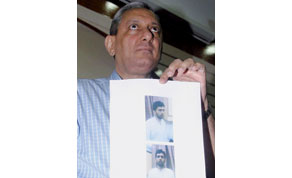
Anti-Terrorism Squad chief Rakesh Maria holds photograph of Indian Mujahideen operative Yashin Bhatkal
Three alleged members of the extremist group were arrested in connection with the attack, Mumbai’s Anti-Terrorism Squad chief Rakesh Maria told a press conference.
Naqi Ahmed and Nadeem Akhtar were arrested on January 15 for providing help to survey the blast sites, carrying explosives and arranging scooters and mobile phone cards to other militants, Maria said.
Another suspect, Haroon Rashid Naik, was arrested on charges of securing finances for the attacks.
“Success was achieved and we were able to pinpoint the perpetrators of the crime,” Maria told reporters. “We can now say that the financial trail of the blasts has been uncovered.”
But the attack’s alleged mastermind, Indian Mujahideen commander Yasin Bhatkal, was still on the run, Maria said.
Three explosions rocked Zaveri Bazar, Opera House and Dadar in south and central Mumbai on July 13, killing 27 people and injuring 127.
“Naqi is originally a resident of Darbhanga in Bihar, but had been in Mumbai since September-October 2010. Nadeem is from Deora Bandhauli, also in Darbhanga district, and has been staying in Mumbai since around the same time,” Maria said.
“Yasin Bhatkal is the main accused in this case. He started the Darbhanga (terror) module where he held programmes to indoctrinate young boys and used them in such blasts,” Maria said.
Ahead of the serial blasts, Bhatkal had given Nadeem a cloth packet, containing the explosives and detonators, to hand it over to Naqi. Naqi passed on the packet to another suspect, the police officer said.
Bhatkal gave Naqi Rs150,000 to assist in the execution of the serial blasts, he said.
Naqi, whose association with Bhatkal dates back to 2008, also conducted a reconnaissance of the blast sites, he said.
The ATS chief said two scooters were stolen by the suspects from Mumbai and these were used in the blast. “In addition to these two scooters, they had also stolen two motorcycles for future use. These two motorcycles were recovered from Darbhanga last year,” he said.
Maria said that the ATS recovered duplicate keys used to steal the scooters. “A helmet belonging to the original owner of the scooter has also been recovered at the instance of the accused,” he said.
“In the investigations conducted so far, we need Haroon Rashid Naik’s custody for investigation into the economical (financial) trail and the conspiracy in this case,” he added. Haroon was arrested last year in a counterfeit currency case.
A lot of stress and importance was given to tracing the financial trail of the serial blasts. “Where did the money come from, who sent it, who received it, and who helped get the money. We can now say that the financial trail of the blasts has been fully covered,” he said.
Maria said that Naqi was also a suspect in a SIM card fraud. “Naqi provided SIM cards to other accused which were used during the commission of the blasts,” Maria said.
The ATS chief also thanked all the central and state agencies which extended help to the Mumbai police during investigation.
“Our teams visited 18 states and a lead was obtained by the ATS in last week of November,” he said, adding that a total of 12,373 witnesses were examined in the case.
The investigation was being conducted by teams of Mumbai police, Maharashtra’s criminal investigation department, the National Investigation Agency and others, with support from security agencies in many states, he said.
Investigators say the Indian Mujahideen has been behind a number of bombings in India since 2005, which have killed hundreds.
The group, which has not claimed responsibility for the July bombings, is thought to have close ties to terrorist groups in Pakistan, including the Lashkar-e-Taiba.