


 |
|
|
India yesterday vowed to ban offensive material from the Internet after Facebook, Google and other major firms told the government they were unable to screen content before it was posted.
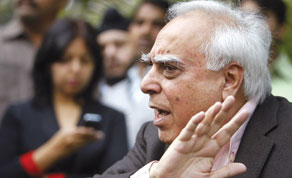
Communications Minister Kapil Sibal said talks with the Internet giants had failed to come up with a solution following complaints that he had lodged three months ago over “unacceptable” images.
“My aim is that insulting material never gets uploaded,” Sibal told reporters in New Delhi. “We will evolve guidelines and mechanisms to deal with the issue.
“They will have to give us the data, where these images are being uploaded and who is doing it.”
Sibal said the government supported free speech and was against censorship but that some material on the Internet was so offensive that no one would find it acceptable.
He said he had shown some of the worst images to the Internet companies, who had said they could not control all distribution.
“Three months back we saw that Google, Yahoo!, Facebook had images which could be an insult to Indians, especially religious-minded people,” Sibal said.
“We told them to find a way that such insulting images are not uploaded. We gave them some time... but there was no response.”
Sibal said the firms had shown that their “intention was not to co-operate” and that they had explained they were only “platforms” on which people could display material.
“I feel that this in principle was not correct but it is very clear that we will not allow such insults to happen. We are thinking and will take the next step,” he said. “We will not allow our cultural ethos to be hurt.”
Facebook, which has 25mn users in India, released a statement saying it “recognised the government’s interest in minimising the amount of abusive content” online and would continue to communicate over the issue.
Google confirmed Monday’s meeting with Sibal but made no further comment, while Yahoo! and Microsoft were not immediately available.
Sibal showed some of the offending material to journalists, including fake images of naked politicians and religious figures.
He added that “sometimes when asked for data in respect to terrorists... there is hesitation (by Internet companies) to provide that data.”
The Hindustan Times yesterday said the Internet companies had rejected Sibal’s appeal for screening, saying a huge volume of information was uploaded on to the Internet and that they were not responsible for judging its content.
The paper added that Sibal had earlier complained about a site that targeted ruling Congress Party president Sonia Gandhi.
The government is very sensitive to criticism of Gandhi. Officials are often keen to be seen as protectors of the family. Last year there were moves to block the English translation of a Spanish novel about Gandhi’s life.
Congress spokesman Abhishek Manu Singhvi said the government was only acting “in respect of absolutely illegal, defamatory, pornographic or other similar kind of material.”
BlackBerry maker RIM has been embroiled in a similar wrangle with India over access to encrypted e-mail and instant message services that the government says could be used by extremists to plot attacks.
The move unleashed a storm of criticism from Internet users complaining of censorship in the world’s largest democracy.
It was not clear if Sibal was proposing stiffer regulation, but Law Minister Salman Khurshid later said his colleague was calling for dialogue about offensive content, not censorship.
Despite the rules in place, India’s Internet access is largely unrestricted, in contrast to tight controls in fellow Asian economic powerhouse China. But in line with many other governments around the world, India has become increasingly edgy about the power of social media.
India’s bloggers and Twitter users scorned the minister’s proposals, saying a prefiltering system would limit free expression and was impossible to implement. The phrase #IdiotKapilSibal was one of India’s most tweeted yesterday.
“The idea of prescreening is impossible. How will they do it?...There is no technology currently that determines whether content is ‘defamatory’ or ‘offensive’,” India-based cyber security expert Vijay Mukhi said.
Authorities were taken aback in the summer by an anti-corruption campaign that multiplied on Facebook and Twitter, drawing tens of thousands of people to street protests and forcing the government to agree to new anti-graft laws.