


 |
|
|
Plans to revive Nalanda University in India, one of the world’s oldest seats of learning, as a totem of Asia’s renaissance are facing trouble as supporters admit to little progress in fund-raising.
The Indian parliament passed a bill in August 2010 approving plans to rebuild the university, which was founded in the 5th century, close to its ancient ruins in the eastern state of Bihar.
Backers hope the proposed new campus will one day attract thousands of the finest teachers and students from around the globe, just as the university did centuries ago.
But money has been slow in coming to turn the $1bn dream into reality, despite the support of the 10-nation Association of Southeast Asian Nations (Asean) and the Indian government.
“It took 200 years for the first Nalanda University to be built,” Nobel laureate economist Amartya Sen, who is piloting the project, lamented at a recent conference in New Delhi.
“I hope it won’t take as long for this new campus to be built.”
In its first incarnation, when Europe was in the Dark Ages, Nalanda was a renowned Buddhist centre of learning, drawing scholars from as far afield as China and modern-day Turkey.
The university, known as an architectural masterpiece with temples and parks, instructed students in medicine, mathematics, astronomy and politics, but was burnt to the ground by invaders in the late 12th century.
In reviving Nalanda, “we want to create a world-class institution bringing in the best of talent from all countries,” said Sen, head of the project’s “mentor” group which also includes Singapore’s former foreign minister George Yeo.
Its revival would come as India and China lay claim to being the economic superpowers of the future and for Yeo, the project is “the icon of Asian renaissance.”
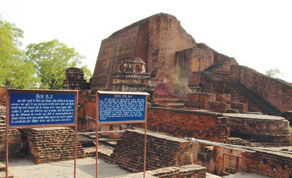
The planned new Nalanda university has been granted 500 acres of land close to the huge red-brick ruins which, along with some marble carvings, are all that remain of the original campus.
The Indian government bill pegs the cost of the university at Rs10bn ($200mn), but project officials admit that figure is unrealistic.
“The target is to create an endowment of $1bn,” said S D Muni, professor at Singapore’s Institute of South Asia Studies.
The Indian government has committed $10mn as an endowment fund to get the project going in the form of a special grant.
China recently gave $1mn to build a Chinese studies library, while Singapore says Buddhist organisations have promised up to $5mn for another library. A private donor has also pledged $1mn.
Asean, which includes Singapore and mainly Buddhist Thailand, has strongly backed the project as a chance to “strengthen regional educational co-operation” but it says funding must be on a voluntary basis.
Singapore has “been very supportive, China is very interested but Japan is going through a bad time,” Sen said. Buddhist groups worldwide are also being targeted for financial support.
“There is a long way to go in firming up the financial base of the university,” he conceded, but he rejects suggestions by critics that the project is doomed to remain a pipe-dream.
“I am sure the money will come,” said Sen, who has been giving lectures about the university in the US and in Asia to drum up support.
Another challenge is Nalanda’s location in one of the most isolated parts of Bihar.
“There are no hospitals or schools... academics don’t like living in the wilderness,” Sen said. Creating the infrastructure “is an enormously uphill task.”
Still, Nalanda officials insist the university will one day again be alive with busy students attending top-class lectures.
“We’ve just received money (from the government) for building the boundary wall for the university,” said Anjana Sharma, a spokeswoman for the project.
“The beginning has been made.”