


Agencies/Bangalore
A long-awaited metro rail service launched yesterday in the southern city of Bangalore is expected to ease the teeming information technology hub’s traffic woes.

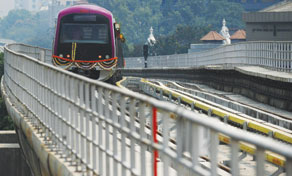
The Bangalore Metro Rail Corporation’s Namma metro train starts its inaugural run in Bangalore yesterday
Federal Minister for Urban Development Kamal Nath inaugurated the Namma (Our) Metro service linking the city’s eastern suburb of Byappanahalli to the central MG Road area.
The stretch, which often takes up to an hour by road during the rush hour, is covered in less than 15 minutes by the metro.
Despite its shiny corporate headquarters, Bangalore suffers from the same acute infrastructure problems that blight the rest of the country, with the city’s reputation as a business-friendly, high-tech centre already in peril.
Traffic, as in all Indian cities, has grown exponentially in recent years, making travelling to work a miserable experience for the estimated 8mn inhabitants who cram into cars, rickshaws and buses.
Software giants Infosys and Wipro are among the major companies based in Bangalore, where load-shedding by power companies leads to regular cuts in electricity and a third of the city is not connected to the water mains.
The metro, begun in 2006 when Prime Minister Manmohan Singh laid the foundation stone, began yesterday on a small elevated section of 6.7km.
B Sashikala, a 25-year-old working in an IT multinational in a suburb, said it was too early to judge how much difference the metro would make.
“It’s nice to know the metro is getting off the mark finally, though the distance covered in Reach-1 (the first phase) is short in a city that lacks efficient public transport,” she said.
The 42.3km network, set for completion by 2014, will comprise two lines of overground and underground sections that criss-cross the city from east-west and north-south. Fares are as low as Rs10 (20 US cents).
Investment has reached Rs40bn, with the total cost now projected at Rs116bn, an increase of 41% over the originally planned amount, according to Bangalore Metro Rail Corporation.
The first phase of the project, a public-private collaboration partly funded by Japanese development money, is already two years behind schedule, mirroring delays with other major infrastructure projects in India.
Earlier this year, the Associated Chambers of Commerce (Assocham), a trade body, warned that Bangalore risked losing its appeal as a destination for IT and biotech companies.
The city already faces competition from Gurgaon and Noida on the outskirts of New Delhi, as well as the southeastern city of Hyderabad, chosen by Google for its India headquarters.
“The growth explosion in Bangalore has pushed the city towards a serious civic crisis,” the report by Assocham stated.
“Roads choked with vehicles, frequent power outages, erratic water supply and poor sanitation are tough problems on account of which Bangalore is losing its lustre,” it added.
More broadly, India’s severe infrastructure deficit, often contrasted with China’s gleaming new railways and roads, is seen by economists as holding back the country’s development.
There are also growing concerns on the subcontinent about the impact on the quality of life of residents of India’s polluted and teaming cities, where green space is being gobbled up for development amid rapid urbanisation.
Bangalore has no suburban train network and has an estimated 4mn vehicles that ply its narrow streets, according to the Additional Commissioner of Police in Bangalore, Praveen Sood.
“No other city in the country has such a high ratio of vehicle-population density. This is because there is no efficient public transport system and the road infrastructure is poor,” Sood said.