


Agencies/Pretoria
The leaders of the emerging economies of India, Brazil and South Africa (IBSA) yesterday underscored the urgent need to reform the United Nations.

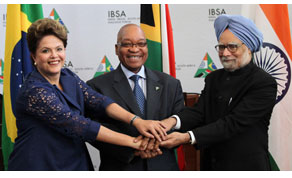
Brazilian President Dilma Rousseff, South African President Jacob Zuma and Indian Prime Minister Manmohan Singh join hands in a symbol of solidarity at the end of the fifth India-Brazil-South Africa (IBSA) Summit at in Pretoria yesterday
The three countries, all of whom are now non-permanent members of the UN Security Council, reiterated the need to add more members to the high table with increased participation of the emerging economies.
In a joint statement after summit level talks, Prime Minister Manmohan Singh, Brazilian President Dilma Rousseff and their host South African President Jacob Zuma, said the Security Council expansion must be of both permanent and non-permanent categories.
In the statement, officially called the Tshwane Declaration, the three sides also discussed what is called the G4 initiative for UN reforms among India, Brazil, Germany and Japan for mutual support of their candidature as permanent members of the Security Council.
“The initiative has been supported by a wide coalition of member states from all regional groups of the UN. Therefore, they expressed the view that such strong support should be considered as the basis for further discussion in the ongoing intergovernmental negotiations on the UNSC reform,” the statement said.
The need for greater progress in the negotiations was identified as critical to ensure the required impetus to change and the three sides committed themselves to close co-operation and co-ordination at the current General Assembly.
Earlier this month India, Brazil and South Africa - together members of the Security Council for the first time since the trilateral forum was formed in 2003 - abstained on a vote against the Syrian regime proposed by some members, notably the US.
This had led to the first ever walk-out by the US at the high table of the council, which in diplomatic circles was seen as a victory of sorts for developing countries in general, and IBSA in particular.
The summit was dominated by the global economic crisis amid questions over the group’s relevance.
“The three economies contribute to the strengthening of the South-South co-operation and shared values for reform in the UN Security Council,” Zuma said at the summit opening.
“We have similar views on many global issues such as the primacy of the development agenda, a just and equitable international order, a rule based international trading system, climate change and the reform of the UN,” he said.
The IBSA countries discussed trade, the international economic crisis and the G20 summit scheduled for November 3-4 in the southern French city of Cannes.
The countries managed to surpass an intra-trade target of $15bn set during the forum’s inception in 2003, achieving $16.1bn in 2010 and on track for a 2015-target of $25bn.
But critics call into question IBSA’s importance after South Africa joined the BRICS group of countries last year, which include emerging heavyweights Russia and China.
“Given the explosiveness of the relationship between India and China, China has done a very skilful job in neutralising India by inviting SA to join BRICS,” Mills Soko, associate professor of international political economy at the University of Cape Town told Business Day newspaper.
IBSA has often been seen as India’s project to increase its influence.
“We share the principles of pluralism, democracy, tolerance and multiculturalism,” said Singh said in his opening notes.