


Agencies/New Delhi
India is hosting the leaders of Myanmar and Vietnam this week, giving New Delhi the opportunity to forge closer economic and security ties with two countries encountering testy relations with India’s giant regional rival, China.

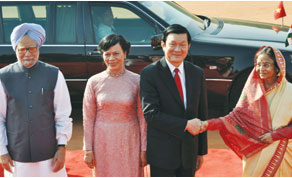
Vietnamese President Truong Tan Sang shakes hand with his Indian counterpart Pratibha Devisingh Patil as his wife Mai Thi Hanh and Prime Minister Manmohan Singh look on during a welcome ceremony at the Presidential Palace in New Delhi yesterday
Myanmar President Thein Sein arrived yesterday in the Buddhist pilgrimage site of Gaya in Bihar before flying to New Delhi for the official leg of his state visit tomorrow, amid hopes that meaningful reform in Myanmar is under way.
The trip follows Myanmar’s decision late last month to suspend construction of a $3.6bn Chinese-backed dam project, triggering a rare public rebuke from Beijing.
Some saw the move as signalling the desire of Thein Sein’s new nominally civilian government to shed Myanmar’s image as a client state of China and open other doors, including to Western nations who maintain sanctions imposed on the former military regime.
For energy-hungry India, resource-rich Myanmar with its large oil and natural gas reserves is an inviting prospect.
India began engaging the Myanmar junta in the mid-1990s over security and energy issues and as a counter to China’s growing strategic influence in the Southeast Asian nation that was formerly called Burma.
The policy drew international criticism, with US President Barack Obama chiding India during a visit here last year for not speaking out over human rights abuses in Myanmar.
India however feels its approach has been vindicated by a series of reformist moves initiated by Thein Sein since he took power following a controversial election last November.
He held direct talks with opposition leader Aung San Suu Kyi and, on the eve of his India visit, Myanmar announced a mass prisoner amnesty, raising hope for the imminent release of hundreds of political detainees.
India is also hosting Vietnam’s President Truong Tan Sang who began a three-day visit yesterday.
Soon after the president’s arrival, the two countries signed an extradition treaty and decided to launch a biennial security dialogue to expand their strategic partnership.
The two countries also decided to more than double their bilateral trade from $2.7bn to $7bn by 2015 and agreed to boost the two-way investment.
In a subtle message aimed at Beijing whose relations with Hanoi are under strain, Prime Minister Manmohan Singh called India’s strategic partnership with Vietnam “a factor of peace, stability and development” in the Asia-Pacific region. However, he added that the relationship stood “on its own merits.”
The two sides inked a crucial extradition treaty and agreed to boost co-operation across a broad spectrum of areas, including trade, energy, science and technology, IT and conservation and restoration of Indian cultural relics in Vietnam.
China has looked on with a wary eye as ties between India and Vietnam blossomed. A joint oil and gas exploration project between state-owned firms in disputed islands on the South China Sea has raised hackles in Beijing, and was slammed as a violation of Chinese sovereignty by China’s state media.
Reports of a standoff between an Indian vessel sailing away from a Vietnamese port and the Chinese navy also stoked fears the two giants may be on a collision course for resources, although both sides subsequently played down the incident.
With its major economic partners the US and Europe facing financial turmoil, India wants to foster commercial partnerships with other emerging markets, including a big trade deal with the Southeast Asian bloc, Asean, that includes both Vietnam and Myanmar.
G Parthasarathy, a former ambassador to Myanmar, said New Delhi had always argued that Western sanctions against Myanmar were a “low-cost option” that simply drove the junta deeper into the arms of China.
“I think we are seeing that our policy of engagement has paid off. We said the move towards democracy would be incremental, and we are seeing that now,” Parthasarathy said.
Indian trade with Myanmar stood at $1.2bn last year, far short of the $4.4bn between Myanmar and China.
New Delhi clearly scents new opportunities under Thein Sein’s leadership, and Parthasarathy said Myanmar appeared to be seeking greater “diplomatic elbow room” that would leave more space for India.