Agencies/Mumbai
Singer and composer Jagjit Singh, who won generations of fans by reviving the traditional genre of ghazal music, died yesterday in a Mumbai hospital at the age of 70.

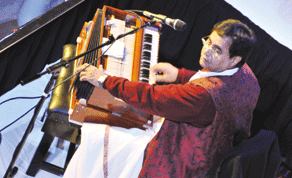
A file photo of Jagjit Singh performing at Symphony Hall, Birmingham, on September 12, 2008: end of an era
Singh, dubbed “The Ghazal King”, had been in intensive care for three weeks and underwent major surgery after collapsing with a brain haemorrhage before a concert in Mumbai.
Prime Minister Manmohan Singh led the tributes, saying the singer’s appeal came through making ghazals - a poetic form of singing that spread to India from the Middle East in the 12th century - accessible to everyone.
“He gave joy and pleasure to millions of music lovers in India and abroad,” Singh said. “He was blessed with a golden voice.”
Ghazals were traditionally reserved only for the elite, but Jagjit Singh popularised the form in the 1970s and 1980s by pioneering a modern sound and using Western instruments alongside Indian classical ones.
Besides spreading the appeal of ghazals in India, Singh sang and composed for Bollywood.
He will be best remembered for his music in popular films like Prem Geet in 1981 and Arth released the following year.
He last sang in the low-budget film Khushiyaan, which is due in cinemas on Friday.
Top Bollywood lyricist Javed Akhtar said Singh’s death was an “irreparable loss to the Hindi film and music industry.”
Singer Lata Mangeshkar described his music as “intoxicating” and said he “sang from the heart.”
“I am in shock after hearing about Jagjitji’s death. It is such a big loss, an end of an era. He was one artist who never needed films to get popular. He was an instant hit,” Mangeshkar said.
“I can’t imagine the days when I will no longer be able to hear his silken voice, no longer be able to talk to him or listen to his new songs. Now his old ghazals is all we have. His soothing voice, his warmhearted nature are all gone now. He was the pride of India. I also feel bad for his wife Chitra, she is all alone now,” said Lata Mangeshkar’s sister and legendary singer Asha Bhosle.
An upset Usha Uthup, another leading singer, said she could not even begin to describe her sadness.
“I can’t even begin to tell you how sad I am. It is a horrible feeling. I have known him for 42 years of my singing career. What a wonderful human being he was. I cannot forget his insistence on using some musical instruments that no one else did. It is such a loss. Love you Jagjit.”
Ghazal singer Pankaj Udhas said he was “shattered and devastated”. “I didn’t want to hear this news. I was hanging on a thin thread of hope that Jagjitji will remain with us. His style was incomparable. He revolutionised the entire approach of this form of singing and gave a new dimension to non-film music.”
Singh’s classic ghazals, including Chupke Chukpe Raat Din and Tum Itna Jo Muskura Rahe Ho, were popular studio recordings and featured often in concerts and movies.
Jagjit Singh was born to a poor family in the desert state of Rajasthan on February 8, 1941.
After moving to Mumbai to make his fortune, he found a foothold in regional-language and Bollywood cinema, going on to form a successful duo with his wife Chitra in the 1970s and 80s.
Chitra quit singing after the death of the couple’s only son, Vivek, in a road accident in the 1990s, while Singh sang fewer live concerts and his music took on a more spiritual and religious tone.
In 2007, Singh performed at the parliament building in New Delhi to mark the 150 years since the country’s first war of independence against British rule, also known in British history as the Indian Mutiny.
Singh was awarded India’s third-highest civilian honour, the Padma Bhushan, in 2003.