


 |
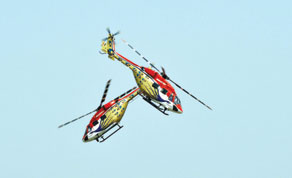
| Dhruv ALH (Advanced Light Helicopters) of the Indian Air Force’s ‘Sarang’ (Peacock) aerobatic team perform during the Air Force Day parade at Hindon in Ghaziabad, on the outskirts of New Delhi yesterday |
The winner of India’s $10.4bn tender for 126 combat aircraft is expected to be announced in November, Indian Air Force chief Air Chief Marshal Norman Anil Kumar Browne said yesterday.
Browne’s assertion comes a day after the acquisition council led by Defence Minister A K Antony gave its go-ahead for the opening of commercial bids from European consortium EADS Cassidian and French Dassault, after clearing the ministry’s report on their offset proposals.
“In the middle of November, we shall be able to announce to the whole world which plane we have selected, the L1 vendor (lowest bidder),” Browne said after he inspected the 79th Air Force Day parade here.
Earlier in his address to the air warriors, Browne said: “The process for acquisition of the MMRCA (Medium Multi-Role Combat Aircraft) is in its last lap and we should be able to open the bids in 10 days’ time from now.”
However, explaining the complexities involved in finalising the winner, the IAF chief said that after opening of the commercial bids, “complex calculations” would be done in a tabular format of the entire life-cycle cost, the acquisition cost and the technology transfer.
“It may take two to three weeks to calculate these,” he added.
EADS Cassidian has offered its Eurofighter Typhoon and Dassault its Rafale to the IAF, which is looking at inducting these aircraft from the beginning of 2015.
The two planes had been shortlisted in April this year after eliminating other competitors - American Boeing’s F/A-18, Lockheed Martin’s F-16, Russian UAC’s MiG-35 and Swedish Saab’s Gripen - through a rigorous technical and weapons evaluation process that lasted for over a year.
India had issued the tender for the 126 planes in August 2007 and has reached a stage of finalisation of the tender just over four years, a remarkable feat considering that it has as a norm taken over two decades for it to finalise deals for other defence equipment.
Meanwhile, the IAF chief the security scenario in India’s immediate neighbourhood was extremely fragile.
“The need of the hour is to be ever vigilant and prepared.”
Impressing upon the air women and men the “need to develop a security mindset,” he said it encompassed “physical security of our assets on one hand to security of vital communication and operational networks on the other.”
“The assets entrusted in our care by the nation are expensive and scarce,” he noted.
Pointing out that the air force was going through the process of transformation and modernisation, Browne said the IAF had successfully inducted and operationalised many new systems into its squadrons and units.
“The transformation and modernisation process that is currently under way will alter the very complexion of the air force further within this very decade,” he said.
Referring to MiG-21 combat plane crashes, Browne said of the last three accidents, two were caused by “inexperience of young pilots.”
“As far as the two-three accidents we had of the MiG-21s, unfortunately, except for one case, the other cases are pointing towards inexperience of young pilots, who have not been able to handle the (high speed) landing,” Browne said.
However, rookie pilots would not be flying from January 2013 the supersonic “unforgiving” MiG-21s, which have a landing speed of about 330kmph.
“This is the last (pilot training) course which will be flying the MiG-21. After this, all pilots will be trained on Hawk (advanced jet trainer). This course will finish in December next year. So this is very crucial period. We have to be very careful,” Browne said.
The air crashes were also linked to the lack of basic trainers for the IAF, which grounded the HPT-32 Deepak last year after it claimed 23 pilots’ lives and had 108 engine cuts.