


Agencies/New Delhi
India and Afghanistan yesterday signed a strategic partnership agreement deepening their economic and security ties, Prime Minister Manmohan Singh said.

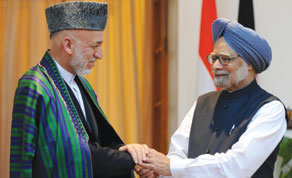
Hamid Karzai shakes hands with Manmohan Singh during a meeting in New Delhi yesterday
Singh reached the deal with Afghan president Hamid Karzai during talks in New Delhi in a move likely to raise suspicion in Pakistan, which is already wary of the relationship between its two neighbours.
The deal is the first such pact signed by Afghanistan as it eyes alliances to help guarantee its security as international troops begin withdrawing from the war-torn country after more than a decade of fighting.
“My discussions with President Karzai have once again underscored the importance of a strong and broad-based partnership between India and Afghanistan,” Singh said.
Singh explained that the strategic partnership agreement would cover security co-operation, trade and economic ties, as well as social and cultural exchanges.
The two leaders also signed two separate deals increasing links in mining and energy.
The agreements come at a time of severely strained ties between Pakistan and Afghanistan.
Karzai has accused Pakistan of supporting militant networks in his country and of having links to the recent assassination of peace envoy and former president Burhanuddin Rabbani.
“Afghanistan recognises the dangers that this region faces through terrorism and radicalism that is being used as an instrument of policy against our citizens,” he said in a veiled reference to Pakistan.
India is one of Afghanistan’s biggest bilateral donors, having pledged about $2bn since the 2001 US led-invasion, for projects from the construction of highways to the building of the Afghan parliament.
The partnership agreement with India would be one of several being negotiated by Kabul, including one with the US, that are part of an Afghan bid for greater security as Nato troops head home.
India wants to ensure that a withdrawal of US troops by 2014 does not lead to a civil war that spreads Islamic militancy across borders. At the same time, it knows its traditional foe Pakistan has far greater influence in Afghanistan.
Karzai’s visit has been planned for months, but it comes as Afghanistan appears increasingly frustrated with Pakistan.
Many senior officials accuse Pakistan’s intelligence agency of masterminding the assassination last month of Rabbani, Kabul’s chief peace negotiator with the Taliban.
Karzai himself has said there is a Pakistani link to the killing, and investigators he appointed believe the assassin was Pakistani, and that the suicide bombing was plotted in the Pakistani city of Quetta.
“At this juncture, the visit will cause great heartburn in Islamabad,” said Saeed Naqvi, a fellow at the Observer Research Foundation think-tank in New Delhi.
“That is unfortunate from the Indian perspective because anything achieved in the visit will be seen by Pakistan as an insult.”
Wary of Pakistan, Indian officials have always said they want to focus on what they like to call “soft power” - economic aid and trade. But India could offer more security training to Afghanistan, something almost certain to annoy Pakistan.
India has already trained a small number of officers from the Afghan National Army.
Still, India treads carefully. It suspects Pakistan of involvement in several major attacks, including two bombings of its embassy in Kabul in 2008 and 2009, seen as warnings from Islamabad to stay away from its traditional “backyard.”
Without a land border with Afghanistan and dependent on Pakistan for any overland trade, India knows it influence is limited.
“India will want to play its part in keeping Afghanistan stable, but it is focusing mainly on economic ties,” said C Raja Mohan, senior fellow at New Delhi’s Centre for Policy Research. “It does not does not see itself as a counterbalance to Pakistan. It knows that Pakistan is setting the terms there.”
Karzai may also be wary of upsetting Pakistan, a country crucial for forging any peace deal with the Taliban.
“Karzai wants to sign a strategic deal with India during his trip but it may hurt his recent call on peace talks with Pakistan,” said Ahmad Saidi, a Kabul-based political analyst. “If Afghanistan wants to move forward with a peace process, it should attract Pakistan’s attention.”
India does have historical ties to former Northern Alliance leaders who battled the Pakistan-backed Taliban in the 1990s. Some believe that India could increase its influence with these leaders if Afghanistan moves back towards civil war.