


Agencies/Guwahati
I
ndian Air Force helicopters flew rescue workers to a remote Himalayan region yesterday in search of survivors of a strong earthquake that killed dozens of people in India, Nepal and the Chinese region of Tibet.

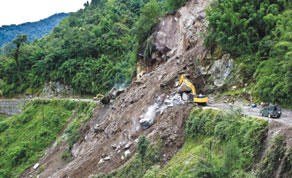
Border Roads Organisation (BRO) personnel help a monk as he crosses a landslide at Phengla on the outskirts of Gangtok yesterday. Rescue teams backed by army sappers using explosives tried to force their way to the remote epicentre of a powerful earthquake
Most of the casualties were near the epicentre of Sunday’s 6.9 magnitude quake that bucked roads and knocked down houses in the sparsely populated northeastern state of Sikkim, popular with trekkers for its Buddhist monasteries and spectacular trekking.
Convoys of vehicles carrying rescue workers, medical teams and emergency supplies left the Sikkim capital Gangtok at daybreak yesterday.
But progress was tortuously slow over the narrow, badly damaged roads more often frequented by groups of adventurous tourists heading for Himalayan trekking trails.
After covering just a short section of the 60km route to the worst-affected districts of Mangan and Sangthan, the convoys came to a complete halt near the town of Phingla, where the path was blocked by a huge rockfall.
As army engineers drilled holes for explosives to try and blow apart the largest boulders, rescuers could only wait in frustration along with distraught locals trying to get through to relatives - unsure whether they were alive or dead.
“I’ve been here for six hours, waiting for the army to clear the road,” said Pema Doma, 37, who has heard nothing from her parents or 16-year-old son in Mangan since the quake hit.
“I’d walk if they would let me,” she said. “The anxiety is killing me. What if he’s screaming for me? What if he’s calling for me and I can’t even hear him?”
Those who did attempt walking around the rockfall were stopped by soldiers.
“I know many shortcuts to reach Mangan but the army says it’s not safe,” said P Sherpa, 62, whose son is a student at the North Sikkim Academy, a private school in Mangan.
“So all we can do is sit here and stare at the rocks.”
One army official said it could take up to 48 hours to clear the entire stretch of road to the quake epicentre.
But on a positive note, a break in the monsoon weather allowed a resumption of helicopter flights which had been grounded most of Monday by heavy rains and low cloud.
Air force officials said food packages and small medical teams with doctors and paramedics had been air-dropped into Mangan and Sangthan.
The death toll from building collapses and landslides in Sikkim stood at 50, but Indian Home Secretary R K Singh warned the number could rise as emergency relief workers reached far-flung villages.
Around a million people visit Sikkim every year and an estimated 60% of the state’s tiny population of 500,000 rely on tourism for their livelihood.
“Business will be severely affected,” said state tourism official Sam Ten.
Hundreds of Gangtok residents spent a second night out in the open, too frightened to sleep in homes badly damaged by the quake.