


 |
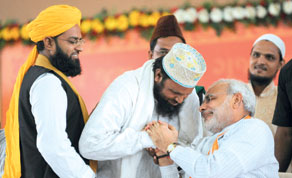
| Muslims greet Gujarat Chief Minister Narendra Modi in Ahmedabad yesterday |
Gujarat Chief Minister Narendra Modi, who some think could be India’s next prime minister, began a “harmony” fast yesterday to soften his image as a hardliner blamed for religious riots that claimed hundreds of mostly Muslim victims nine years ago.
The fast is seen as a bid by Modi, and his party, the main opposition Bharatiya Janata Party (BJP), to launch him as a national leader as the government loses popularity over inflation and corruption scams.
Seizing the moment after the Supreme Court referred to a lower court a case in which Modi was accused of complicity in the 2002 violence, he is using the fast to depict himself as a conciliator with a strong record on the economy.
“In democracy, there is no place for any ill will or revenge,” Modi, wearing a white turban, said from an air-conditioned hall in Ahmedabad, capital of Gujarat, where he will conduct his fast.
“My effort has been to take Gujarat forward. In terms of economic and overall progress, Gujarat has made giant strides,” Modi said of his state which has seen 11% growth in recent years.
Hundreds of supporters, both Hindu and Muslim, sang religious slogans as he entered the hall, flanked by senior BJP members.
“It is for peace and communal harmony. Through my fast, I want to reach out to more people,” said Modi in comments broadcast live on national television.
Parties are gearing up for an election in the heartland state of Uttar Pradesh next year, a key barometer for general elections in 2014.
In a rare sign of contrition, the notoriously self-assured Modi wrote an open letter on the eve of the fast opposing religious and caste divisions.
“I am grateful to all those who pointed out my genuine mistakes during last 10 years,” he wrote.
The makeover attempt is seen by commentators as grooming him into a prime ministerial candidate for the next general elections in 2014.
He made no apologies for what human rights groups have condemned as his lax response to the massacre during the communal riots.
At the same time, he told the audience “I feel the pain of all the families who lost their near and dear ones.”
Modi, who celebrated his 61st birthday yesterday, said 11% annual growth showed Gujarat had recovered from the riots that killed more than 1,000 people and was now peaceful.
“My fast is not against anyone...that was, is and will never be my agenda. Just like the world praises Gujarat’s model for development and governance, that day is not far when people will discuss our model for inclusive growth and communal harmony,” Modi said.
“I can say with pride that we want to move ahead and give something back to the nation. A state like Gujarat can pull another state which is not so developed. We have the strength and the capability,” Modi said.
After leading Gujarat for the past decade, there has been speculation Modi would seek a greater role in national politics. L K Advani, a veteran BJP leader who many believe has ambitions to be prime minister, heaped praise on Modi.
“In Gujarat, there is good administration and zero tolerance towards corruption and terrorism. If this policy is adopted across the country, then India would rise to new heights,” the 83-year-old leader told reporters at the hall.
The BJP moved ahead of the ruling Congress Party in two polls last month as support for Prime Minister Manmohan Singh’s government withered because of anger over prices and corruption.
Modi cut bureaucracy to help turn Gujarat into a motor of India’s growth. But his reputation as a hardliner who let rioters rampage dogs him.
“Why did Modi not, for example, reach out to the riot-affected families still awaiting justice,” said journalist Barkha Dutt, in a column in the Hindustan Times.
Witnesses at the time said state police were absent during the worst of the violence, fuelling suspicion that Modi condoned the attacks on Muslims in retaliation for the deaths of a dozen Hindu pilgrims in a train fire.