


Agencies/New Delhi
India’s inflation quickened to a 13-month peak of nearly 10% in August, data showed yesterday, piling pressure on the central bank to hike interest rates again despite a slowing economy.

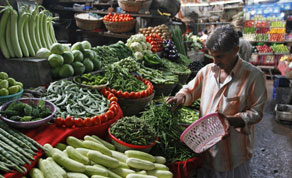
A vendor arranges vegetables at a market in the western city of Ahmedabad yesterday. Indian inflation climbed to its highest in more than a year as prices of food and manufactured goods surged
Annual inflation jumped by over half a percentage point to 9.78% in August from July’s 9.22%, according to the figures, which came days after data showed industrial output grew at its slowest pace in nearly two years.
“It is more bad news, inflation has gone up - it is perilously close to double-digits,” Finance Minister Pranab Mukherjee told reporters, saying the government was working with the Reserve Bank of India to “overcome” the problem.
“This is a time of stress not only in India but all over the world. We shall have to maintain our nerve.”
Inflation is one of the biggest headaches for the Congress-led government, which is also reeling from a spate of corruption scandals. The price gains have hit India’s impoverished millions who are the Congress Party’s key supporters.
The official August inflation figure, which exceeded market forecasts of 9.6%, was fuelled by price rises in food, fuel and manufactured goods.
RBI officials will hold a policy-setting meeting tomorrow and most economists are betting on another quarter-point interest rate hike.
But government policymakers have been voicing doubts about further monetary tightening as the economy loses pace.
“We have to seriously look at whether we should stick to the (tightening) policy... or begin to think out of the box,” chief economic adviser in the finance ministry Kaushik Basu said.
Business groups are complaining that the rate rises are choking economic growth while failing to check inflation.
However, CLSA senior economist Rajeev Malik said yesterday’s inflation data was “bad enough to justify a rate hike.”
The central bank has raised rates 11 times in 18 months - the longest streak of monetary tightening in a decade.
India’s economic growth has weakened under the hikes as borrowing costs have surged for everything from consumer appliances to plant equipment.
Data on Monday showed industrial output growth slowed to 3.3% year-on-year from 8.8% the previous month, reflecting decreased demand in Asia’s third-largest economy.
Adding to the inflationary woes, India’s currency has slumped to a near two-year low against the dollar amid worries about Europe’s massive debt crisis, as investors exit emerging market assets for the safe haven of the dollar.
The rupee’s fall will make imported goods such as foreign crude oil, on which India is reliant, costlier.
Economists said the latest price data gave little choice to central bankers.
It “confirms inflation remains too high for comfort,” said HSBC’s Asia chief economist Leif Eskesen.
“The bank’s primary concern remains inflation and further tightening is needed with a 25-basis point rate hike expected on Friday.”
“Clearly, inflation is not easing as expected by the RBI despite its aggressive monetary stance, and some more time may be needed for the past policy actions to show effect,” said Arun Singh, senior economist at Dun & Bradstreet, who expects a 25 basis point rate hike tomorrow and another thereafter.
The government is hoping that a good monsoon season will ease food prices, which triggered the overall cost-of-living spiral.
India has received 3% more rainfall than normal so far during the crucial June-to-September rains and more showers are expected, D Sivananda Pai, India’s chief monsoon forecaster, said yesterday.
Draft bill seeks to give cheap grains for 810mn people
India’s government has agreed a draft law to provide cheap grains to two-thirds of its 1.2bn people, a plan that could widen fiscal deficit but help win voter support for the government and its allies. Voter anger at high food prices has damaged the popularity of Prime Minister Manmohan Singh’s government in a country where 40% of its population live below the UN poverty line, threatening his Congress Party’s chances in a key state election next year and the 2014 national elections. The bill to subsidise food for 810mn people could give the Congress-led coalition a political edge at a time when it is struggling with corruption scandals. But it will also hurt the government’s finances. The planned subsidies double the cost of an existing programme that sells cheap grains and pulses to nearly 180mn poor families in Asia’s third largest economy, the agriculture ministry says. In the long run, India may find it hard to produce enough grains to sell at subsidised rates to a growing population, since farm yields are falling. The food security bill, which was released by the food ministry for public debate, must be approved by parliament to become law, possibly during a winter session that starts in December.