


 |
|
|
The Jammu and Kashmir’s legislature will debate whether to ask New Delhi for clemency for a Kashmiri man sentenced to death for his role in the 2001 attack on the parliament, a lawmaker said yesterday.
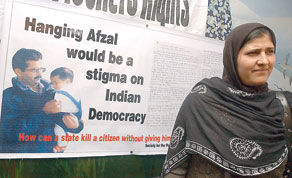
Independent legislator Abdul Rashid said he had submitted a resolution to the Kashmir assembly speaker seeking clemency for Afzal Guru, a businessman from the northern Kashmir.
“Let the house resolve that Afzal Guru be granted amnesty on humanitarian grounds against the death sentence granted to him by the Supreme Court of India,” reads the resolution.
Rashid said executing Guru could have “serious consequences” for the political situation in Kashmir, where large protests against his sentence have been held in the past.
Guru was convicted of plotting the December 13, 2001 raid on the parliament that left 15 people dead, including the five attackers, and brought India and Pakistan close to war.
Guru insists he was not involved in the plot.
Hardline separatist leader Syed Ali Geelani has warned New Delhi of major unrest “if such a “blunder” as executing Guru is carried.
“India cannot control the situation here - notwithstanding its military power,” Geelani said last month.
“Guru’s death will create hundreds of Afzal Gurus in Kashmir.”
More than 47,000 people have been killed since the outbreak of a separatist insurgency in Kashmir in 1989 and anti-India sentiments run high.
“The house will discuss the resolution during the upcoming summer session of the state legislature beginning September 26,” Kashmir Assembly speaker Akbar Lone told reporters.
Rashid’s move follows the passage of a similar resolution in the southern state of Tamil Nadu seeking clemency for three men convicted of the 1991 murder of former prime minister Rajiv Gandhi.
Last week, the Madras High Court stayed the trio’s execution for two months.
The federal home ministry has called on the president to reject the mercy petition filed by Guru.
The main opposition in the Kashmir state assembly, the Peoples Democratic Party, said it would support the resolution.
Kashmir remains under heavy military control but this summer has not seen the cycle of violence and strict curfews that have rocked the state over recent years.
Ruling party members as well as the opposition believe that hanging Guru could break the “peaceful atmosphere” in the said.
Federal Minister for Renewable Energy and former Kashmir chief minister Farooq Abdullah has stated his opposition to hanging Guru as it could transform him into a hero for Kashmir’s youth.
India has not carried out an execution since 2004. The Supreme Court says the punishment is reserved for the “rarest of rare” crimes.
The lone surviving gunman of the 2008 Mumbai attacks in which 166 people were killed, 22-year-old Pakistani Mohamed Ajmal Amir Kasab, is also on India’s death row.
Meanwhile, the central government’s interlocutors on Kashmir have termed as speculative reports that they are likely to recommend pre-1953 status for the state - when it had autonomy over all subjects except foreign affairs, defence and communications - as a way forward to resolve the crisis.
The three interlocutors - journalist Dilip Padgaonkar, academic Radha Kumar and economist M M Ansari - said in a statement they were engaged in preparing a draft of the final report and had not given the final shape to the recommendations.
“The (media) report is purely speculative in nature. The group of interlocutors is presently engaged in preparing a draft of its final report, which is expected to be submitted to the government of India before its term ends. The three members of the group are yet to enumerate, let alone discuss and finalise the recommendations. They will do so after they return from their last visit to Jammu and Kashmir in the latter half of this month,” they said in the statement.
A media report had said that the interlocutors were likely to recommend that the Kashmir government be given exclusive jurisdiction of all departments except defence, foreign affairs and communications, which is very close to the position prevailing in the state prior to 1953.