


 |
|
|
A Chennai court yesterday delayed by two months the execution of three men convicted of the 1991 assassination of former prime minister Rajiv Gandhi.
The three men were due to be hanged on September 9 after President Pratibha Patil rejected their final mercy pleas earlier this month.
But the Madras High Court said it had “stayed the execution of the capital punishment by eight weeks” after a further round of appeals from lawyers and state politicians who oppose the executions.
The hangings would be the first in India since 2004, when a former security guard was hanged for the rape and murder of a 14-year-old schoolgirl in Kolkata.
Murugan, Santhan and Perarivalan belonged to the now-defeated Tamil Tigers militant group of Sri Lanka, which was accused of plotting the murder of Gandhi by a female suicide bomber two decades ago.
The three men, who have spent 11 years on death row, filed a petition against their death sentence in high court on Monday.
The court ordered the government to file a response, NDTV news channel reported.
The death penalty is not commonly carried out in India and there is a Supreme Court direction that if mercy petitions take too long then a death sentence is commuted to life imprisonment.
Ram Jethmalani, a lawyer for one of the convicted men, said the clemency petition was rejected by the president after 11 years and this was wrong because the precedent was if there was a delay of more than two years, the sentence was commuted to life imprisonment.
The convicts in their petition on Monday asked the court to send a notice to the government to seek and explanation for the delay.
While Murugan and Santhan are Sri Lankan nationals, Perarivalan is an Indian Tamil. They were sentenced to death in 1999 along with an Indian woman for plotting to assassinate Gandhi.
Gandhi was killed by a female suicide bomber in Sriperumbudur, in Tamil Nadu, on May 21, 1991 as he was addressing an election rally.
The Supreme Court confirmed the death sentences of the three men, but commuted the woman accomplice’s sentence to life imprisonment.
In 2006, the LTTE expressed regret over the assassination, calling it a “monumental historical tragedy.”
There were protests in Tamil Nadu after the date for the hangings was set. One woman died after setting herself on fire to demand the three men should not be hanged.
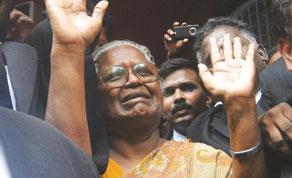
Large crowds gathered outside Madras High Court cheered after news of the stay order came in.
The Tamil Nadu assembly yesterday passed a unanimous resolution asking the president to reconsider the clemency plea.
Chief Minister J Jayalalitha said the resolution was moved on behalf of the state government.
“Perhaps the delay in deciding on the mercy petition made the high court grant the stay. The Rajiv Gandhi assassination case is one of the rarest of rare cases where death sentence is warranted,” political commentator Cho Ramaswamy said.
“Apart from Rajiv Gandhi, several others got killed in the blast,” he added.
According to him, the “save the three” chorus sung by almost all parties was politically motivated.
Added Gnani, another political analyst: “The assembly could have passed a resolution against death penalty in general and not specifying the three alone. That would have been a shrewd move on the part of Jayalalitha.”
Gandhi rose to become India’s youngest-ever prime minister after his mother, former premier Indira Gandhi - who was herself assassinated in October 1984 - and he ruled until losing the 1989 election.
The shredded clothes and the shoes Gandhi was wearing when he was killed 20 years ago remain on display in a museum in New Delhi.
The separatist Tamil Tigers were wiped out in 2009 in a bloody offensive by Sri Lankan government troops.
Gandhi’s killing was widely seen as retaliation for him sending Indian troops to Sri Lanka in 1987 when he was prime minister, in a failed attempt to disarm the guerrillas.