


Agencies/New Delhi
 |
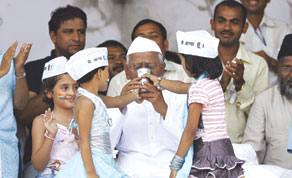
| Children Simran and Ikra offer coconut water and honey to Anna Hazare after he ended his fast at Ramlila grounds in New Delhi yesterday |
Sipping coconut water and honey, anti-corruption crusader Anna Hazare ended a hunger strike on its 13th day yesterday, a protest that had sparked huge rallies across the country, exposed a weak government and ushered in a new middle-class political force.
After initially arresting Hazare and dismissing him as an anarchist, Prime Minister Manmohan Singh’s government caved in to the demands of the 74-year-old as parliament backed anti-graft legislation that met many of his demands.
“It’s a proud moment for the country that a mass movement which was carried out for 13 days was peaceful and non-violent,” Hazare, wearing a crisp white kurta smock and cap, told cheering supporters from a stage at the Ramlila Maidan ground in New Delhi that has become the epicentre of a nationwide crusade.
“We have taught the world how to conduct a peaceful agitation,” he added.
“The parliament in Delhi had to bow down to people power, but our fight does not end here,” he said to huge applause. “We want to bring about a change in the country but within the framework of the constitution.
Hazare tapped a groundswell of public anger against endemic corruption, uniting the country’s bulging middle-class against a hapless political elite and underlining voter anger at Singh and the ruling Congress Party.
Over 40,000 supporters flocked to witness Hazare break his fast, while TV pictures showed hundreds of people dancing, celebrating and distributing sweets in the activist’s village of Ralegan Siddhi in Maharashtra.
Tens of thousands of mostly urban and wired voters across India celebrated the achievement of an unprecedented movement that may usher in a new force in Indian politics and damage the ruling Congress Party in crucial state elections next year.
The Lokpal legislation was presented in early August, but activists slammed the government’s draft version as toothless because the prime minister and judges were exempt from probes.
Hazare had demanded that the bill include bringing civil servants under a proposed corruption agency’s authority, ensure similar agencies at the state level and create a citizen’s charter.
In calling off the hunger strike, his second this year, the veteran activist fired a warning shot at lawmakers and the weary government, threatening to restart his agitation should parliament renege on its promises.
That threat, a headache for the ruling Congress Party that will hope to move on from the crisis to tackle key economic reforms shelved in the political melee, came as another social activist cautioned against expecting “a miracle”.
“We have achieved the first milestone in having a strong Lokpal Act and it may take its own time. It’s not something you can expect today, tomorrow or next month,” Santosh Hegde, a former Supreme Court judge who sat on the panel that drafted the bill, said.
“Let not the people of India expect a miracle.”
Hazare also declared his intentions to campaign against “corrupt” politicians in the 2014 general election, in a country where 30% of Lok Sabha (lower house) MPs have pending criminal cases against them, according to research by the Association for Democratic Reforms.
Undermined by graft scandals and seen as out-of-touch with voters battling high inflation, Congress’ failure to deal with Hazare’s campaign before it flared up into a national issue spells danger for the ruling party in state polls next year ahead of the 2014 election.
While protests in India are not uncommon, the sight of many well-off young professionals using Twitter and Facebook taking to the streets of Asia’s third-largest economy suggest an awakening of a previously politically-ambivalent middle-class.
“Anna wins it for the people,” splashed the front page of the Sunday Times newspaper, as grassroot activists across the country revelled in victory.
Supporters surged to Hazare’s protest site in a sea of saffron, white and green from nearby metro stations yesterday, as smiling protesters with the national flag painted on their faces chanted “long live Anna” and “victory to mother India.”
“It is a historic day,” said Aamir Pratap, 37, who brought his wife and three sons to the site in central New Delhi.
“Anna and the whole country succeeded in uniting the parliament yesterday for such a crucial bill.”
Finance Minister Pranab Mukherjee announced parliament’s support for Hazare’s demands after over nine hours of fervent debate in both chambers of parliament that highlighted just how much the activist’s campaign had rocked India’s political establishment.
A crowd of supporters cheered as Hazare arrived at a hospital in Gurgaon, a city outside New Delhi, where he will be kept under observation for at least 24 hours and has been put on an intravenous drip after losing over 7.5kg.
“None of us could manage what he did. He is a true leader and this country needs him,” said Pankhuri Singhania, a 27 year-old beautician cheering at the protest site.
Deep-seated change has been under way for years in India as its economy globalises, bolstered by a widely used freedom of information act, aggressive private media and the election of politicians who have rejected traditional caste-support bases to win on governance issues.
After a botched arrest as part of a hardline approach to Hazare, a government U-turn saw ministers praise the activist, suggesting a leadership deficit in Congress without party head Sonia Gandhi, who is recovering after surgery for an undisclosed condition.
Congress pledged a slew of economic reforms after winning re-election in 2009 that would have made foreign investment easier and tax collection more effective. But graft and anger over inflation has stymied attempts to debate the legislation.
Law Minister Salman Khurshid congratulated Hazare on “a successful and peaceful” protest adding that “civil society should play an important role in the country’s political system. This movement was an example.”
The fast’s popularity was seen as a bruising defeat for softly-spoken Premier Singh, who appeared unable to engage with the nationwide debate on corruption.
“He needs determination and willpower to push through reform, and he just doesn’t have it. India is disappointed in him,” Gurcharan Das, a bestselling author on contemporary India, said.
“Hazare has won in terms of his success in agitating people to find a voice,” Das said.
“In future people will be more assertive and confident in standing up to official misbehaviour. That is more important that any legislation issue at this moment.”
Donations pour in for Anna
Donations have been pouring in from across the country to support social activist Anna Hazare’s anti-graft movement. India Against Corruption (IAC), the NGO spearheading it, has so far received more than Rs7mn in cash donations and more is still coming in, an activist said. Vikas Tyagi, a co-ordinator at the donation department, said “many people are coming in and giving us donations.” The department maintains an account of money received and spent on a daily basis. “We use that amount in different areas such as purchasing food items, maintaining loudspeakers and other electric systems. We keep a record of all the money,” he said. The IAC, headed by Arvind Kejriwal, receives cash donations from only Indian citizens or those who have an Indian passport. According to the IAC website, those with Overseas Citizenship of India (OCI), or People of India Origin (PIO) or people with dual citizenship cannot make donations due to regulatory restrictions.