


Agencies/New Delhi
Anti-graft activist Anna Hazare whose hunger strike has galvanized millions to hold the biggest protests in decades yesterday sounded a note of defiance after government calls for dialogue.

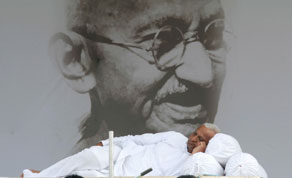
Anna Hazare rests in front of a huge portrait of Mahatma Gandhi after speaking to supporters on the sixth day of his hunger strike in New Delhi yesterday
Hazare, who has not eaten since Tuesday, is fasting at an open-air venue in New Delhi in front of tens of thousands of noisy supporters who back his demands for an end to the culture of corruption among Indian officials.
Anti-graft protests have erupted across the country over the last week and Prime Minister Manmohan Singh has been widely criticised for mishandling one of India’s biggest social movements in decades.
Singh on Saturday appeared to soften his hardline stance, saying there was “a lot of scope for give and take” over a proposed anti-corruption bill that Hazare’s campaign wants replaced with their own stronger version.
But Hazare told huge crowds gathered at the Ramlila grounds in central Delhi that “even if the prime minister comes here, I will not move from here until our bill is passed.”
His insistence that the government introduces this bill tomorrow and passes it by the end of this month has sparked criticism that his group was dictating policy to an elected parliament, putting pressure on him to compromise.
“We have not closed the door of dialogue. We have kept it open. Only through dialogue the issues can be resolved,” Hazare said.
Hazare alleged that the government’s intentions in creating an independent and powerful anti-graft watchdog were “not good”.
“The government does not have good intentions. Their intentions to curb corruption are bad. The government deceived us,” he said.
He asked his supporters to be ready for a bigger revolution if the government failed to pass the version of the Lokpal bill he and his aides want.
“I request all you that if the government doesn’t pass the bill, there will be a movement in the country never seen before,” he thundered.
He said the government had “betrayed” him and his team members over the bill they wanted the government to pass to curb rampant corruption.
“If you cannot get the bill, I ask you to leave the chair,” he said, amid a huge applause.
Protesters chanted “Anna, you keep fighting, we are with you,” and “Hail mother India”.
Hazare’s campaign has found resonance with millions of Indians, particularly the middle classes tired of endemic bribes and a series of corruption scandals that have touched top politicians and businessmen in Asia’s third largest economy.
But critics of Hazare’s hunger strike, who include novelist and social activist Arundhati Roy, say he is setting a precedent by holding democratic institutions hostage.
“The danger is if we get rid of these institutions and say that discussions will happen outside parliament, then tomorrow there can be a mobilisation of any kind of extremist group,” renowned social activist Aruna Roy told CNN-IBN TV.
Roy’s civil rights organisation, the National Campaign for People’s Right to Information (NCPRI), said it would introduce its own anti-graft bill to parliament.
On Saturday, Prime Minister Singh took the initiative for the first time during the fray with Hazare and said the government was willing to talk.
A ruling Congress Party lawmaker also sent Hazare’s bill to a parliamentary committee for consideration, meeting a demand of the protesters.
There was speculation that the government was trying to engage Hazare in back channel talks and was looking to have interlocutors from his home state Maharashtra, including Umesh Chandra Sarangi, an additional chief secretary to the state government.
Spiritual guru Bhayyu Maharaj is another choice for a negotiator with Hazare, according to sources in the government.
Sarangi met Hazare twice since Friday night. But Hazare’s close aide Swami Agnivesh denied that he had met as a government mediator.
“(He) came last night as a personal friend of Hazare,” Agnivesh said. “He was given both versions of the Lokpal bill and he went away.”
The possibility of talks was also discussed in a meeting between Hazare and his team members following which Agnivesh said the government needed to create an atmosphere of trust by withdrawing its bill from parliament.
“We are open for talks. We will not budge. This is the least they can do to earn our trust and introduce the Jan Lokpal bill,” Agnivesh said.
Finance Minister Pranab Mukherjee also said the government desired “a new chapter of talks with the civil society” and added that the constitution “can accommodate all views.”
For many, the pro-Hazare movement has highlighted the vibrant democracy of an urban generation that wants good governance rather than government through regional strongmen or caste ties—a transformation that may be played out in 2012 state polls that will pave the way for a 2014 general election.
“Over the past five years corruption hasn’t necessarily changed but attitudes have. We have now reached a breaking point of no return. Enough is enough and we want change,” said Sanjeev Sahay, 39, a litigation lawyer in Delhi, who had come to support Hazare with his children.
Several scandals, including a telecoms bribery scam that may have cost the government up to $39bn, led to Hazare demanding anti-corruption measures. But the government bill creating an anti-graft ombudsman was criticised as too weak as it exempted the prime minister and the judiciary from probes.
A weak political opposition means that the government should survive the crisis, but it could further dim the prospect for economic reforms and hurt the Congress party in elections.
The main opposition Bharatiya Janata Party is organising a nationwide protest against the government on Thursday, while a group of left parties is planning a national protest tomorrow.
Dubai arrests Indian over rally
An Indian man has been arrested in Dubai after organising a march in support of his country’s anti-corruption campaigner Anna Hazare, who is on hunger strike in New Delhi, a report said yesterday. Abu Dhabi-based The National newspaper said the unnamed Indian was being questioned for “illegally organising a march through Facebook,” citing a senior Dubai police criminal investigations official.
About 150 Indian expatriates joined the march on Saturday night on Al-Mamzar beach in support of the anti-graft movement in their homeland, but police dispersed the protesters, The National said.
The investigator said no permit had been obtained for the demonstration.
“We were suddenly stopped by police,” the paper quoted a protester as saying. “We were asked to leave immediately. We were just walking with badges of support.”