


AFP/New Delhi
Anti-corruption activist Anna Hazare, who was detained yesterday as he prepared to lead a protest, is a frail 74-year-old former army driver who idolises independence hero Mahatma Gandhi.

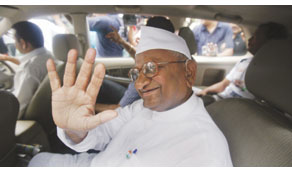
Anna Hazare waves from a vehicle after being detained by police in New Delhi
The life-time bachelor wears simple, white, home-spun cotton, round wire-framed glasses and dreams of an India centred around self-sufficient villages - much like Gandhi, who was killed in 1948.
The strict social conservative has also adopted the hunger strike, used to great effect by the father of the nation against the British colonial leaders, as his weapon to pressure officials.
Hazare, born Kisan Baburao Hazare into a poor family on June 15, 1937, says he opted for a life of protest and working for the disadvantaged after a life-changing moment while under fire in the military.
Spurred by patriotism, he had joined the army in 1963 and went on to serve in the 1965 India-Pakistan war, which was caused by rivalry over Kashmir.
During the fighting, he narrowly survived an air attack and at this moment “took an oath to dedicate his life in the service of humanity,” according to his official website.
“As long as there is life in my body, I will keep protesting,” Hazare told a crowd of supporters while leading a 98-hour hunger strike in April this year demanding the government allow him to help draft a new anti-corruption law.
After 15 years in the army, he retired to his drought-prone native village of Ralegan Siddhi in Maharashtra and began a successful programme of water conservation to aid local farmers.
In 1991, he launched a non-profit organisation called Bhrashtachar Virodhi Jan Aandolan (The People’s Movement Against Corruption) and would go on to lead campaigns against the Maharashtra state government.
In a sign of things to come, in 2003 he went on hunger strike for 12 days to force the state to implement a local Right to Information Act, which gave citizens access to official data.
His current campaign has piled pressure on the national government to create a powerful new ombudsman to investigate complaints of corruption against senior politicians and bureaucrats, including the prime minister.
His efforts have seen him amass a large following and public backing from high-profile supporters such as Bollywood superstar Aamir Khan and best-selling author Chetan Bhagat.
He has won a spate of awards, but has also received his share of criticism.
In February 2005, a Maharashtra state probe accused Hazare’s Hind Swaraj agricultural charitable trust of using Rs220,000 ($5,000) from its coffers to pay for the activist’s 60th birthday celebrations.
Former Supreme Court judge P B Sawant, who headed the investigation, said that Hazare failed repeatedly to act against his own workers when citizens accused them of extortion and harassment.
The veteran activist has also come under fire for advocating violence - he calls for the death penalty for corrupt officials - and for subverting India’s parliamentary democracy by using blackmail through hunger strikes.
He is also accused of being autocratic by his detractors, who point to a ban he imposed on “immoral” liquor in his village in the early 1990s, and of having close political links to rightwing Hindu groups.
The Congress Party, which leads India’s coalition government, has called him an “unelected tyrant.”